

Community gathers for discussion on how to prevent, protect against active shooters
 Mike Jones
Talking about how to prevent or respond to an active shooter isn’t an easy topic to handle, so state police Trooper Rocco Gagliardi found a way to mix in serious discussions with, at times, lighthearted comments and even humor.
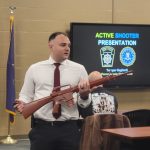
Gagliardi led a nearly 90-minute presentation on the subject Tuesday night at the North Strabane Fire Department in Eighty Four that attracted 65 people who listened intently while also later having time to spend with other police agencies to learn more about the issue.
“How do we bring (the discussion) out from left field?” Gagliardi said of the newly designed presentation that takes a different approach on a difficult issue. “If we get people to say it wasn’t bad (by) keeping it light … people are more involved in the presentation. (People say) ‘We want the info, we want the stats, we want to know what to do if it happens.’ Keeping it light in the room, you really hold their attention.”
Gagliardi, who is a spokesman for Pennsylvania State Police’s Troop B in the region, explained that this is the first in a series of community presentations he is conducting, but the seminar also will be offered directly to organizations, businesses, schools or religious institutions, if requested. On Tuesday night, state police partnered with the FBI, Washington County Sheriff’s Office, North Strabane police and South Strabane police to offer both a presentation and face-to-face resources for the public. A representative from Allegheny Health Network also attended and had a station demonstrating how “stop the bleed” kits work.
“We will have conversations tonight that we need to have,” Gagliardi told the crowd gathered in the fire hall’s community room. “Are they awkward? 100%.”
He then pulled out a red-colored replica of an AR-15 rifle that is a prop firearm, which got everyone’s attention. But he explained that it would not be the focus of the presentation, nor would there be a political debate over it since that was not an issue he or anyone else would be able to solve Tuesday night. Instead, Gagliardi wanted to start with the basics to get the group on the same page.
“We need to get to the bottom of this. That’s the whole point of this. What is an active shooter?” Gagliardi said. “Everyone wants to start on Page 20. … We have to start at the beginning.”
According to the federal government, the definition for active shooter does not even include the word shooting, firearm or gun. The official definition means that someone is “actively engaged in killing or attempting to kill people in a confined and populated area.” That means it could involve someone using a knife as a weapon or even a motor vehicle.
With that somewhat surprising fact out of the way, Gagliardi brought up a sobering thought. Standing several large televisions displayed with the words “Where can it happen?” Gagliardi pointed to how some of the most prominent active shooter situations have happened in Western Pennsylvania, including the Tree of Life Synagogue massacre in 2018 and the mass shooting at LA Fitness in Collier Township in 2009. Gagliardi said the audience first must get over the “false reality that it won’t happen to me, it won’t happen here” in order to make preparations.
“We need to prepare now,” he said. “We need to have the best plan ever, with the hope not to use it.”
According to FBI statistics, the number of incidents involving active shooters has gone down from 61 in 2021 to 50 in 2022 to 48 in 2023. Last year, the most incidents happened in “open spaces” with 23, compared to 14 at shopping centers and three in schools.
“All of these should be at zero. I think we should all agree with that,” Gagliardi said. “But the first two places are open spaces and commerce (so) when you go to these locations, do you have a plan with your family?”
Gagliardi then walked the audience through “violence indicators” that people should notice, but don’t always pay attention to when there is troubling behavior by a person who is plotting.
Those indicators could be increasing absence from work or school, repeated violations, arguments, alcohol or substance abuse, lack of conversations, levels of anger, withdrawal or depression, disturbing discussions or posts on social media about violence and even domestic violence. Many of those “red flag” indicators are seen after an incident, but Gagliardi said the public should be paying attention beforehand.
“That’s how easy it is to miss these things,” Gagliardi said. “We’re looking for things that should not occur.”
The discussion grew especially serious when Gagliardi explained the premise behind “run, hide, fight” in the event there is an active shooter.
“You cannot run, hide or fight until you understand fully what’s going on. And that takes some time,” Gagliardi said.
Gagliardi then went into detail of each option, acknowledging that a person doing harm already has an upper hand in the situation because they likely have been planning.
If the “run” option is available, Gagliardi said people should react immediately – “don’t watch, go,” he said – and find a way to exit the area. Some people “freeze up” in such situations, but they should take notice of their surroundings and leave if possible.
“Hiding” involves locking doors, barricading an entrance with anything available, silencing but not turning off cellphones and taking in one’s surroundings. But as part of that, people should prepare to “fight” if needed in that situation, Gagliardi said.
“Hiding is a stepping stone,” Gagliardi said.
Gagliardi admitted that “fighting” might not always be ideal, but it might be the “only option” left. He said anything can be used as a weapon, including chairs, lamps, cellphones, fire extinguishers or even a flag pole. The only goal is to incapacitate the shooter and get the firearm away from that person by any means necessary, he said.
“The fight is already not fair, so why fight fair-minded?” Gagliardi said.
Gagliardi was able to elicit laughs through self-deprecating humor and other lighthearted moments as he walked back and forth through the audience, all while commanding their full attention.
“We think what we’re doing with active shooter is different than any other market,” Gagliardi said about the presentation.
Pat Sanders, who is the administrative assistant at Church of the Covenant in Washington, agreed with that viewpoint, and said she thinks it will be a subject brought up with her church’s leaders.
“I think we’ll be talking about it, definitely,” Sanders said. “He explained it well. He had a little humor to help keep our attention.”
Gagliardi and state police will be conducting similar seminars on Dec. 3 at the Upper St. Clair Community & Recreation Center and on Jan. 30 at the Brentwood Civic Center. Local groups can also have Gagliardi conduct private sessions at their location by emailing him at rogagliard@pa.gov.