

Keep an eye out for spotted lanternflies
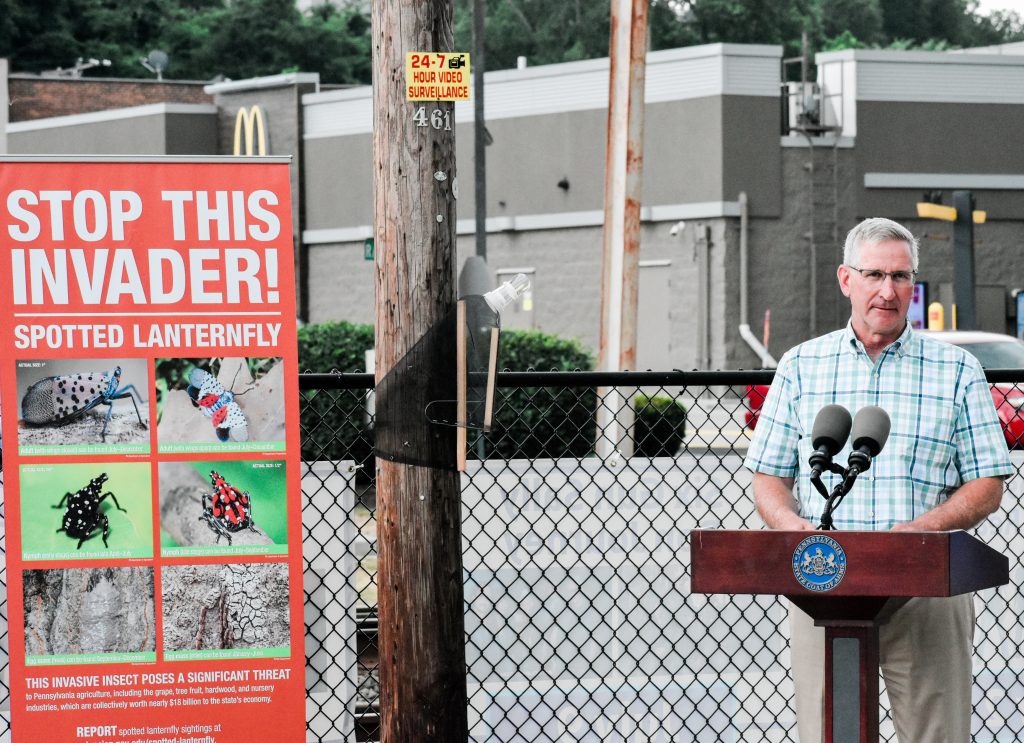
Pennsylvania Department of Agriculture secretary Russell Redding expresses the importance of knowing about and actively stopping the spread of the spotted lanternfly, an invasive species that has infested 45 counties in the state. Redding addressed the media Wednesday afternoon at the Noble J. Dick Aquatorium in Monongahela. (Photo by Katherine Mansfield)
Katherine Mansfield
Katherine Mansfield
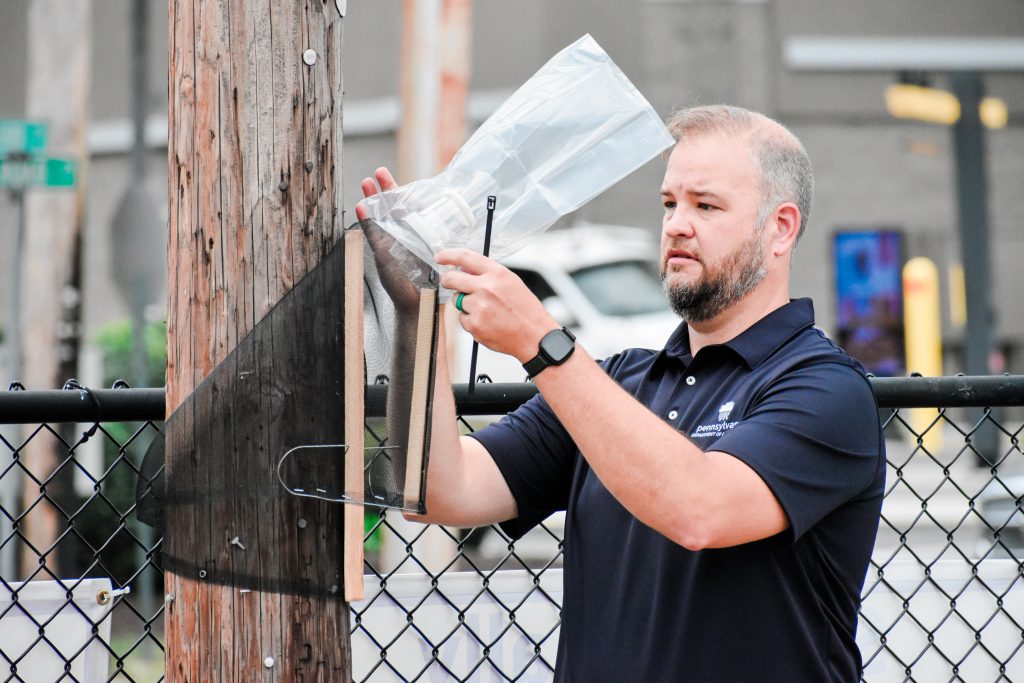
Jay Losiewicz demonstrates how a circle trap works during a press conference at the Noble J. Dick Aquatorium in Monongahela Wednesday afternoon. Losiewicz recommended local homeowners buy or build the trap to stop the spread of the spotted lanternfly, and encouraged business owners to get permitted against the invasive species.
Katherine Mansfield
Katherine Mansfield
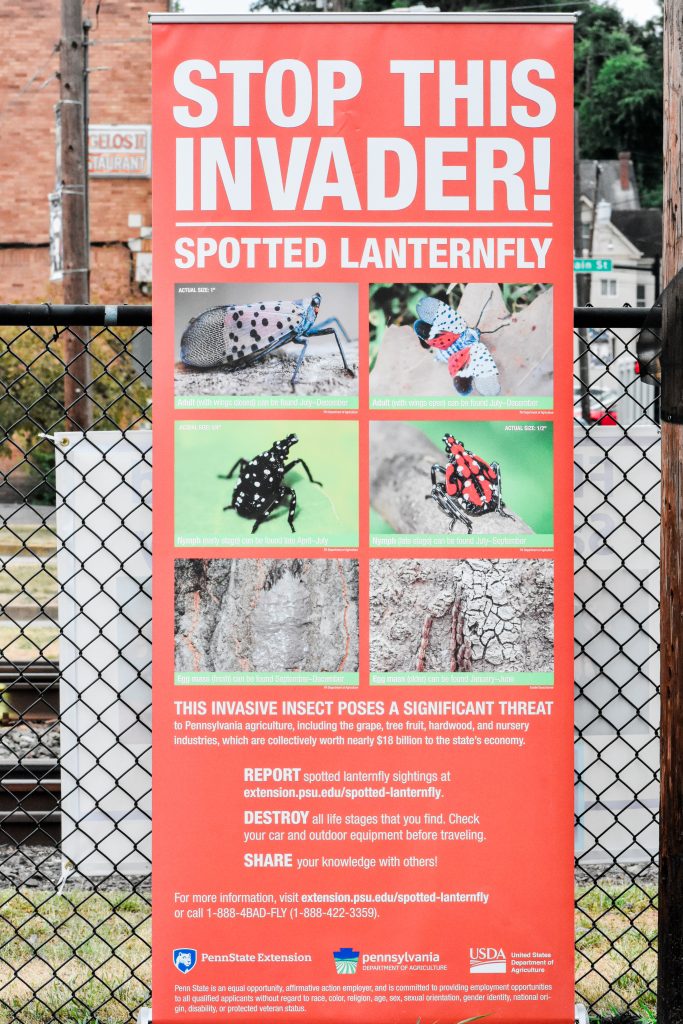
Penn State Extension, along with the state Department of Agriculture and the USDA, puts out educational materials on the spotted lanternfly, an invasive species that has devastated industry in the state and recently spread into Washington County.
news@greenecountymessenger.com
Washington County is a spotted lanternfly quarantine zone.
In March, Washington County and 11 other counties in Pennsylvania were added to the state Department of AgricultureÄ¢¹½ÊÓƵ spotted lanternfly quarantine zone. On Tuesday, the DOA held a press conference to remind residents of the risks spotted lanternflies pose to the environment and business, and to offer advice for how to stop the spread of the invasive species.
The spotted lanternfly has so far been confined to the northeast region of Washington County, and has not been reported in Greene or Fayette counties.
“They can move on their own about 10 miles a year, give or take, but they’re very good at hitchhiking on vehicles,â€� said Jay Losiewicz, management technician for the DOA. “ItÄ¢¹½ÊÓƵ very possibleâ€� that they could enter those counties, he said.
“But hopefully not,� Losiewicz added.
“Pennsylvania was the epicenter of the spotted lanternfly. The first time (the species) was identified in America was in Berks County, in 2015,â€� said DOA secretary Russell Redding. “We did not know the full impact of that invasive pest. What we have learned is that it is invasive in every way. ItÄ¢¹½ÊÓƵ invasive socially, economically and culturally, and certainly environmentally invasive as well. It has been a concern, continues to be a concern, because of what we have witnessed over the last number of years.â€�
Since the spotted lanternfly first appeared in Southeastern Pennsylvania (it hitched a ride on stone imported from Asia), the invasive species has wreaked havoc on crops and local industry.
Redding said it has impacted the timber industry, among others. Within three years of infesting a few of Berks CountyÄ¢¹½ÊÓƵ vineyards, those vineyards were completely gone. The infestation became so bad that several homes in the county were taken off the market.
“The Penn State University and the Center for Rural Pennsylvania, I believe, were the partners that initially did the economic study, (which) projected about $325 million loss a year,� Redding said. “We have seen devastation in some vineyards in the eastern part of the state, and some of the trees and the hardwood industry. But most devastating has been in the vineyards.�
One reason for the spread of the spotted lanternfly – itÄ¢¹½ÊÓƵ now in nine states and 45 Pennsylvania counties – is how easily the pest moves.
“Everything with wings is a problem. ItÄ¢¹½ÊÓƵ not that it flies long distances … but it really is an opportunist. It has traveled with many unknowingly,â€� Redding said.
Not only does it flutter from place to place; itÄ¢¹½ÊÓƵ known for hopping aboard vehicles and trains.
“Look at your car before you travel to make sure you’re not taking the spotted lanternfly with you,� said Valerie Sesler, Penn State Extension Master Garden Coordinator for Southwestern Pennsylvania.
Losiewicz said the key to slowing the spread of spotted lanternflies is knowing what you’re looking for.
Right now, spotted lanternflies are black or red bugs dotted in white spots. Next month, it enters its adult phase. The spotted lanternfly will have translucent, black-speckled wings. When it flies, its wings open to reveal a bright red coloring.
Along with checking the car and cargo before leaving a quarantine zone, folks can slow the spread by killing the invasive pest when they see one, and by purchasing or crafting a circle trap.
You can learn how to make a circle trap out of items most people already have at home – screening, wood, clothes hangers, the top of a plastic bottle, a bag and a zip tie – online at https://extension.psu.edu/how-to-build-a-new-style-spotted-lanternfly-circle-trap.
The circle trap works against the spotted lanternfly by preventing the insect from climbing high up a tree or a pole and launching into the wind to find its next meal, Losiewicz said.
Zip tying a bag over a plastic bottle cap affixed to netting traps the pest and prevents it from launching.
“They will get captured inside the bag and cannot get back out,� Losiewicz said. “Just every two weeks or so, just double-check that bag, change it out with a new one and keep it up. Every spotted lanternfly that we kill means there are 30 to 50 fewer the next year.�
Losiewicz encouraged all business owners within quarantine zones like Washington County to get permitted. The permit process teaches business owners how to spot the lanternfly.
“The permit process is an agreement between you and the Pennsylvania Department of Agriculture and our trading partners, that they understand we’re looking for spotted lanternfly everywhere. We’re making sure that we are not inadvertently taking it out of a quarantine zone, moving it to a non-quarantine county or to a new state,� Losiewicz said.
Permits are free, he said.
Redding said the DOA has received funding from the U.S. Department of Agriculture, and the state has appropriated funds for researching the invasive species.
“As much as we know about the spotted lanternfly, thereÄ¢¹½ÊÓƵ a lot we don’t know,â€� said Redding. “We continue to learn every season.â€�
Partnerships between the state DOA and Penn State University, along with the USDA and organizations like the Washington County Conservation District, accelerates research and helps manage the infestation of the spotted lanternfly.
“Science will solve this problem, as many others, but we’re not quite there. We have a better command today than we did when it first invaded Pennsylvania,� Redding said. “We’re working hard. We have a plan around the spotted lanternfly and continue to work at it.
“Importantly, if you see it, report it, and then squash it. The less spotted lanternflies, the better.�
Report a spotted lanternfly sighting at Penn State ExtensionÄ¢¹½ÊÓƵ web site, extension.psu.edu/spotted-lanternfly or to call the spotted lanternfly hotline at 1-888-422-3359.
To keep up to date with the latest spotted lanternfly news, subscribe to Penn State ExtensionÄ¢¹½ÊÓƵ newsletter on the Extension website.