

Lighting the night, naturally: Fireflies sparked a recent presentation at Ohiopyle
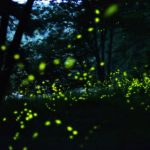
Fireflies. They’re a background to summer, so familiar they don’t tempt a second thought. Yet visitors to Ohiopyle State Park did give these mysterious beetles a second thought, and a third and more when they attended an educational program at the park campgroundÄ¢¹½ÊÓƵ amphitheater on Saturday, June 24.
A threatening storm likely discouraged more from joining the 16 campers and local residents assembling on wooden benches set in a sloping hillside, as park Environmental Interpretation Technician Emma Hough began the presentation.
“Tonight, we’re going to learn about fireflies, sometimes called ‘lightning bugs'� Hough said. “How many here have caught a firefly?�
Every attendee raised a hand.
“ThatÄ¢¹½ÊÓƵ usually the response,â€� she quipped. “Fireflies are part of nearly everyoneÄ¢¹½ÊÓƵ youth in this part of the world. We’re entering the height of firefly season, and a damp humid evening like we have tonight is a good opportunity to learn about them rather than just catch them.â€�
Hough presented a slideshow about fireflies on the amphitheater stage and summed up the insects’ natural history.
She explained that fireflies are among the vast group of insects classified as beetles, and that there are several different species of fireflies native to our region. The most common is the Pennsylvania firefly — Photuris pennsylvanica. Viewed up close, in good light, the Pennsylvania firefly can be identified by the narrow margin of yellow or orange along the black outer covering of the folded wings. The dome-shaped thorax (shoulders) is also yellow around the margins, with a black mark in the center and two red spots.
Few attendees knew that a class of elementary students from Upper Darby, Pennsylvania, upon learning of the Pennsylvania firefly, petitioned the State Legislature to designate the species as PennsylvaniaÄ¢¹½ÊÓƵ official state insect. Governor Milton Shapp made the proclamation official with his signature in 1974.
Hough explained the reasons why fireflies glow. Those flying around over the grass or weedy fields are generally males, while others perched, immobile, on a leaf are females. The males blink out light-signals in a sequence unique to their species, while the females watch, looking for that male with a special appeal.
Fireflies are one among several organisms that exhibit “bioluminescence,� the ability to produce light through chemical reaction. Fireflies breathe through tubes in their abdomen called trachea. When they breathe, air mixes with an enzyme, luciferase, to produce the familiar yellow light, but no heat. But, besides mate attraction, bioluminescence has another “darker� purpose, Hough remarked with a chuckle at the pun.
Females also use their light-making ability to procure food. When hungry, they’ll temporarily abandon the search for a mate and look for the light-flash signals of the males of other firefly species. Then, the female will imitate that signal with perfect precision. When the duped male of another species alights near the masquerading female, she attacks and eats him.
Hough took a more serious tone and asked if attendees thought fireflies are as abundant now as when they chased fireflies as children. Nearly everyone agreed that fireflies now seem to be less plentiful.
“ItÄ¢¹½ÊÓƵ true, fireflies are declining in many areas,â€� Hough said. “The primary reasons for their decline are destruction of habitat — woods and fields around suburban areas — widespread use of pesticides, and the spreading occurrence of artificial light. If you want to help fireflies, don’t use pesticides around your home, and try to minimize lights at night. Artificial light confuses them and disrupts their ability to find mates.â€�
Hough then led the group on a short hike to an overgrown field as night descended. Initially, only the occasional firefly brightened the dusk.
Hough passed out tiny flashlights with instructions on a small card. Participants were encouraged to read the card and blink out a prescribed sequence with the light. Each card was paired with one other, and Hough asked the group to look for, and identify, the same light sequence they were blinking with their own flashlight. Soon the group broke up and reassembled into pairs of identical light sequences.
“ThatÄ¢¹½ÊÓƵ exactly how fireflies find one another,â€� Hough beamed.
Reflecting later on the exercise, Hough said, “Hands on learning is important. Getting people involved in an experience is key to enabling people to retain a core memory. Being out here and going through a simple game like the flashlight pairing is more powerful than just watching a video about fireflies. You get a lot more from being there and experiencing.�
By the time the group put away the flashlights, the whole field and woods margin sparkled with bioluminescence.
“There are thousands of them,� one participant marveled.
“Just like I remember,� responded another.
Hough then encouraged the group to catch some fireflies, which she temporarily confined in small transparent plastic cubes, with a magnifying lens as one side. The lens enabled close-up looks of the captured insects.
“I’ve never looked at one so closely,� someone offered.
“A lot of people are around various aspects of nature, but never have an opportunity to expand their understanding,â€� Hough said later. “Here, we give people a chance to learn about things they never learned in class, about the natural world and why itÄ¢¹½ÊÓƵ important to conserve it.â€�