

The Bridges of Greene County: A connection with the past
 Amy Fauth|Greene County Messenger
Some are looking to spend a relaxing drive through the countryside. Others are seeking a picturesque backdrop for their latest selfie on Instagram. And, some are just looking to recapture the charm, romance and history of small town America.
Whatever the lure, covered bridge driving tours are a tourism-driver all over Pennsylvania and here, in Greene County.
Across the state, there are 200 remaining covered bridges, and Pennsylvania is home to the most remaining covered bridges in the U.S. Covered bridges display various architectural styles and classic colors set against beautiful, natural landscapes, which are an attraction for many, according to VisitPA.com.
JoAnne Marshall, tourism director in Greene County, has seen firsthand the draw of the county’s seven covered bridges. The covered bridge driving tour is the most searched page on the Visit Greene County website, www.visitgreene.org.
The history of covered bridges is charming. Although built out of necessity to get across small town America’s creeks and streams, the bridges took on another meaning, especially for young lovers of the period.
Over a century ago, when horse and buggies were the common travel vehicle in rural America, young people would often stop in the middle of a bridge to sneak a kiss. That’s where they earned their nickname, “kissing bridges.”
Marshall said the county’s “kissing bridges” are a perfect callback to the county’s tourism message.
“When you visit Greene County, it’s like stepping back into small town America,” said Marshall. “You’re stepping back into our history and heritage of America by seeing these bridges that are reminiscent of our history.”
Greene County has seven publicly accessible covered bridges on the self-guided tour, which takes about 2 to 4 hours to complete. In addition to a driving tour, the website also offers detours to historic attractions, farm tours, dining options and local history facts.
The covered bridges include:
-Carmichaels Covered Bridge
-White Covered Bridge
-King Covered Bridge
-Shriver Covered Bridge
-Scott Covered Bridge
-Woods (Neddie Woods) Covered Bridge
-Cox Farm (Lippencott) Covered Bridge
They all can be driven over (one lane only) and have height restrictions.
Covered bridges are something that can be enjoyed in every season – whether visiting the area from out of town or just going for a nostalgic weekend activity with the family.
“For the people that travel them every day it’s something they overlook, (and) for those that are out searching, they are gorgeous architecture in our countryside,” said Marshall.
Because they’ve been around for over 100 years, many of the covered bridges don’t have exact documentation as to when they were built. But, then that’s part of the mystery.
In Greene County, there’s a discrepancy with one of its bridges. The White Covered Bridge was identified on a 1990 state survey as being built in 1900, but a resident born in 1911 clearly recalled it was built in 1919. Most local residents dispute the survey, and in 2019, held a 100th anniversary celebration of the bridge.
The White Covered Bridge is included in the Washington and Greene Counties’ Covered Bridge Festival, which is held the third week of September.
Carmichaels Covered Bridge is also included in the festival. Built in 1889, it spans Whitley Creek near Garards Fort. At 70 feet long, it’s the county’s largest covered bridge.
Thousands attend the covered bridge festival each fall, and those that come to Greene County often take the opportunity to visit the five other covered bridges in the county.
The festival is a cooperative event between Visit Washington County and Visit Greene County, the tourism promotion agencies for their respective counties.This year’s festival will mark the 53rd annual and is planned for Sept. 21-22. Each of the festival locations offer an array of activities, including handmade arts and crafts, homestyle foods, historical reenactments, crafting demonstrations and entertainment.
Most of Greene County’s covered bridges were built some time in the late 19th or early 20th century. Although the county’s Cox Farm (Lippencott) Covered Bridgewas built during World War II.
“It’s a ‘newer’ bridge,” said Marshall. “It was built with wood because there was a shortage of steel during the war.”
The bridge spans Ruff Creek, near Lippincott on state Route 221. After the original bridge was destroyed in 1943, it was replaced with a covered bridge. It’s the youngest and shortest bridge at 27 feet long.
The (Neddie) Woods Covered Bridge on Oak Forest Road was built in 1882, making it the oldest bridge in the county. The land belonged to Edward “Neddie” Wood, a Civil War veteran, and the bridge was named after him.
The Shriver Covered Bridge on Hargus Creek near Rogersville was built in 1900, but also had to be rebuilt in 2013 with six steel I-beams to support traffic. It also features original stone abutments that appear to have been laid dry and has wingwalls of similar material that extend a bit above the level of the roadway.
Located just a few miles from the West Virginia border, the King Bridge on Kings Sister Hill Road in Wayne Township was built in 1890 and was restored over 10 years ago. Its 49-foot span can bear a standard three-ton load.
Everyone has their favorite, but for Marshall it’s the Scott Covered Bridge. Built in 1885, the Scott Covered Bridge sits above Ten Mile Creek. Located off of Route 21, the Scott Covered Bridge has a window the span of the bridge, which among other things is a great spot for photography.
Another distinctive feature of the county’s covered bridges is their color.
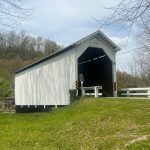
“We’re unique in the fact that three of our bridges on the eastern side of Greene County – White, Carmichaels and Cox Farm – they are all painted white – whereas the other four bridges are natural wood tones, unpainted.”
The county doesn’t have any red bridges, which is a common color for covered bridges. However, there is a bridge in Meadowcroft that originally came from Greene County and was painted red. The Pine Bank Bridge was constructed in 1871 over Tom’s Run in Pine Bank in Greene County.
In 1961, when PennDOT planned to replace the bridge with one made of concrete and steel, Meadowcroft founder Albert Miller decided to rescue the bridge. He had it dismantled and moved to Camp Meadowcroft, the forerunner of Meadowcroft Rockshelter and Historic Village.
Because all seven of Greene County’s covered bridges are on public roads, they are often measured and certified. Owned by Greene County, the bridges have been restored and shored up to preserve them.
“They’ve all been renovated in the recent decades to accommodate modern vehicles, however there are height restrictions on all of them,” said Marshall.
As part of the modifications and renovations, they have all been reinforced with steel I-beams to handle the loads that cross them.
Take a selfie. Enjoy the thrill of driving a vehicle over a bridge built before you were born. Even stop in the middle of the bridge and sneak a kiss with your sweetheart when no one’s looking.