

Steelie ascent More rain needed to aid steelhead trout trek up Lake Erie tributary streams
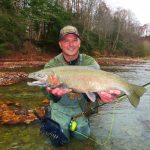 Ben Moyer
As this drought-stricken year wanes, there are many good reasons to hope for rain. One good reason on the minds of some fishermen is steelhead trout. Tributary streams flowing into Lake Erie have been low, clear, and warmer than normal throughout the fall. Only a long, steady rain will entice more steelhead up out of the big lake to ascend the tributaries, just like salmon do on their annual spawning runs in Alaska.
Once steelhead are forging upstream in good numbers, anglers line the banks of famed streams like Walnut Creek, Elk Creek, 20-mile Creek, 16-mile Creek, Raccoon Creek and others that wind northward to join their flow with Lake Erie. It’s a fishing spectacle that happens nowhere else in Pennsylvania, but steelhead attract anglers to Erie from across the state and the nation.
Last Sunday’s rain did help, but Erie streams have been so low for so long that it wasn’t the flush of fresh water steelhead enthusiasts were hoping for. They were glad, though, to get what fell.
“Yesterday’s rain did do a bit to bump flows up and add a touch of color (to the water), but not much,” posted one avid steelheader on the Fish USA Erie Fishing Reports website. “Fishing conditions will still be quite challenging for the foreseeable future.”
In low water conditions, any steelhead that have swum upstream into the tributaries are “spooky,” nervous and difficult to catch. Deeper flows with some tint of mud (color) in the water put them at ease and more willing to strike a lure or fly.
In recent weeks, most successful anglers caught their steelhead at the mouths of creeks in the lake surf, where huge schools of steelhead had staged, waiting for higher flows to lure them inland.
By Monday, Veterans Day, after Sunday’s rain, both steelhead and anglers were dense along lower stretches of Walnut Creek. Friend Marshall Nych of New Wilmington, Mercer County, and I opted to check Elk Creek to escape the crowd.
We had a gracious invitation from a “friend of a friend” to fish a private access stretch of Elk Creek, but that beautiful spot was so far upstream than no steelhead had yet arrived. The water was still so low that the absence of fish was obvious.
We decided to try a spot I’d “found” last fall and where I’d caught some big steelhead, miles farther downstream and nearer the lake, with public access but required a long steep downhill hike (uphill on return) to reach the stream.
Most folks were deterred by the hike because we fished for six hours and saw three other people, one fishing couple and one lone angler.
Fish were present, but difficult to entice. Steelhead can be unnervingly “fly-shy,” which they proved to be that day. Marshall did better than I, drifting woolly bugger patterns and artificial salmon eggs. My most exciting action came by watching the huge fish muscle their way upstream through rapids and over falls, their broad tails kicking up plumes of spray as they powered against the current in pods of eight to 10 big fish.
When an angler hooks a steelhead, the fish really turns on the muscle. Steelhead are known for their high leaps and fast runs, frequently breaking the line with their speed and brute strength.
Steelhead trout are not native to Lake Erie or its tributaries. They are not even a distinct species. In their native waters of the Pacific Coast, what’s known as steelhead are simply a strain of rainbow trout that are spawned in the streams, then descend to the ocean to live most of their lives. They return to their birth-streams only to spawn, exactly like the better-known salmon. They’re called steelhead because of the silver color they acquire while living in the ocean, or, in our regional case, in Lake Erie.
The Pennsylvania Fish and Boat Commission, and the state fisheries agencies of New York, Ohio, and Michigan have worked together to introduce steelhead to Lake Erie to create a recreational fishery. It’s been a huge success.
To this point, the steelhead that swim up Pennsylvania streams are not known to reproduce naturally, even though that urge is what’s driving them upstream. To support the fishery, Fish and Boat Commission fish culturists capture hundreds of steelhead every fall in nursery streams where fishing is prohibited. They spawn those fish artificially, hatch the eggs and raise the fry in hatcheries, just like “regular” trout. The Fish and Boat Commission then releases those young steelhead (smolts) into tributary streams, where they imprint on the water chemistry just as if they had been born there. The agency releases between 1.5 million and 2 million steelhead smolts into Pennsylvania tributaries to Lake Erie each year.
When they mature and feel the spawning urge, they return, and the steelhead anglers are waiting.