

Finally getting her due: Pioneering swimmer Hushla to be inducted into WVU Hall of Fame
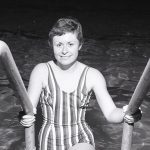
MORGANTOWN – All Bette Hushla wanted to do back there in 1965 was chase her dream of competing as an Olympic swimmer, not change the world, but in her effort to do so, she played a large role in doing just that.
She wasn’t a protester, just a backstroker looking for a school team upon which she could compete.
That place would be West Virginia University but she found herself swimming upstream against what was then the current times across America as opportunities for women athletes were severely limited. WVU had no women’s athletic teams.
So, instead of finding Olympic gold, she wound up having to settle upon becoming a member of the WVU Athletic Hall of Fame for her pioneering role in bringing equality to women in college and high school athletics.
At WVU she made national headlines as a swimmer on the WVU men’s swimming team for these were pre-Title IX days and there was no gender equality in scholastic or collegiate sports.
On Saturday, she was named one of eight inductees into the WVU Hall of Fame along with Anthony Becht (football), Chris Brooks (men’s basketball), Bob Donker (men’s cross country and track & field), Mark Landers (baseball), Rasheed Marshall (football), Adrian Murrell (football) and Liz Repella (women’s basketball).
The shame was for an athlete who spent her all-too-brief swimming career trying to get to the finish line as fast as she could, it took 60 years for her to get to the Hall of Fame and she was no longer around to claim her place in history, having succumbed to complications from Covid-19 in 2020 at age 76.
“She was not an activist in any way. She saw herself as a woman who wanted to continue on and get to the Olympics. Unfortunately, that never happened,” her sister, Marianne Ly, said from her home in Maine after the public announcement of her induction on Saturday.
After her death in 2020, Ly had authored a self-published book about her sister’s life, “Remembering Bette.” It had been a life filled with unwanted controversy and that took her down many, many roads to accomplishment.
Hushla’s family had roots in West Virginia, her mother having been born in the state. She decided she would continue her education as a music major in Morgantown after graduating high school in 1963.
“She just wanted to continue to train. There were no women’s teams then. That was the problem,” Ly explained. “They had all controversy in 1965 with her swimming on the men’s team but she didn’t have a choice. There was nothing else.
“Years later you had Title IX, but it was people like my sister who brought awareness to the situation. Women needed to have their teams, too.”
Bette Hushla’s young life was centered around the swimming pool in the athletic family of Fred and Beatrice Hushla.
“We grew up in swimming. My parents were swimmers,” Ly said. “This was the thing we all did. Bette’s big dream was to go to the Olympics. Back in the day you didn’t have the sponsors and the scholarships you have now. You competed to be able to say you were the best. It was an honor to be at the top.
“My father was very involved with sports all his life. He swam marathons when he was young. Then he got involved in YMCA programs. He ran a swim team in Rochester, New York, for years. After that he got involved with luge and was the national manager of the Olympic luge team for years.”
In the end, though, he walked away from it.
“He said there was too much politics involved,” she said.
It was much like what his daughter, Bette, ran into, although he did live out his Olympic dream before it soured on him, taking teams to the Sapporo games in Japan, to Innsbruck, Austria and Lake Placid.
When she arrived at WVU the school did not sponsor any women’s sports teams, so her freshman year she competed unattached in AAU swim meets.
The school had already made history when Marilee Hohmann became the first female athlete to represent WVU on the rifle team in 1961.
Hushla would have been a big-time recruit in this era as she owned the world’s fourth fastest time in the 100-yard backstroke while her long-course clocking fell three-tenths of a second shy of the winning time in the 1960 Rome Summer Olympics.
She was hoping to swim in the 1964 or 1968 Olympics but had no team for which to compete in college.
Jack Lowder, the new WVU swim coach, realized he had no backstrokers on his team and asked Hushla if she would like to join the men’s team, having found no rules against it.
She accepted and won six of the eight races in which she competed, Sports Illustrated uncovering her success and making note of it in its “Faces in the Crowd” section.
Hushla was preparing for the Southern Conference meet in Williamsburg, Virginia, on March 3, 1965. Three days before competition was to begin the conference ruled her ineligible because she was a female.
“Our tournaments are for the male species,” Southern Conference commissioner Lloyd P. Jordan told the Associated Press. “We don’t have any girls in any of our tournaments. As far as the office is concerned, the ban against girls participating is in the book.
“I am truly in favor of women participating in athletics, but with their own.”
A student protest took place at WVU, where Dean of Women, Betty Boyd, secured 2,000 signatures in one day and forwarded it to the conference office.
The nation’s media quickly latched onto this, Bud Collins of the Boston Globe writing:
“The case of Miss Hushla, a 19-year sophomore at West Virginia, is clearly one for the Supreme Court. The Constitution seems to disapprove of decrees such as the one issued by Southern Conference Commissioner Lloyd Jordan regarding Miss Hushla.”
WVU sports historian John Antonik noted that criticism came from everywhere, citing Charlotte News sportswriter Bob Myers’ column a week later:
“Bette’s plight puts another light on the situation. West Virginia has always been a proud basketball school steeped in winning tradition.
“I ask, Mr. Commissioner, what if Rod Hundley had been Hilda Hundley, if Jerry West had been Mae West, if Rod Thorn had been Rose Thorn? If George King had been Jessica King, Buddy Quertinmont were Beaulah Quertinmont and Bob Camp were Becky Camp? They would have had to play the Texas Cowgirls in last night’s eliminations at Philadelphia.
“[The rule books] must have been rewritten since 1962 for that year West Virginia records indicate Marilee Hohmann was a member of the Mountaineers’ rifle team. She did compete in the conference championship.”
But Hushla did not compete in the Southern Conference Championships, wound up getting a history degree in 1967 and never set foot in a swimming pool again for the rest of her life.
Like her father, she’d had it with the politics.
“She never swam again,” Marianne Ly said. “I tried and tried for years to get her to swim. I’d say, ‘C’mon. Let’s take a swim’ but she’d just say no. She was the type of person that never let on that anything bothered her. You never could tell she was being bothered. She’s very strong willed. She was bothered but she didn’t show it.”
She simply moved on and while women’s sports got Title IX and grew to the point that Caitlin Clark could become a national sensation, Hushla never took interest in it or accepted her role.
“The sad part is, she never talked about it. People didn’t know she was a champion swimmer. When she passed away four years ago, there were these people she always talked with and I said, ‘You knew she was a champion swimmer, didn’t you?’ And they said, ‘No.’ They never knew that. She never talked about it,” Marianne Ly said.
Bette Hushla went on to live a full and varied life, Marianne Ly writing in her book that she was “a gifted musician, voracious reader, dedicated co-worker, a friend to those in despair, a five-time cancer survivor and a lover of cats and all animals.”
And now a Hall of Famer.