

Academy adds new math concepts; subtracts old teaching techniques
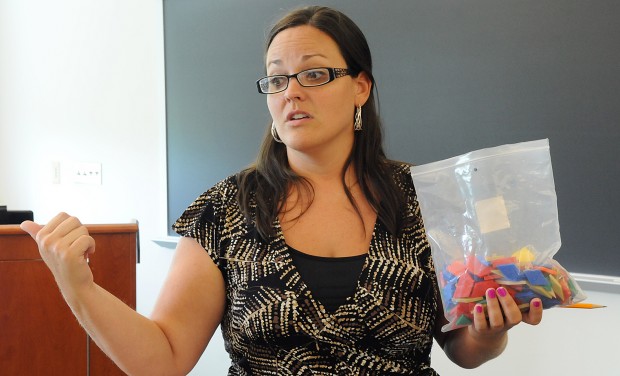
Mindy Harris, math coach at Uniontown Area High School, teaches new ways to help students visualize fractions through hands-on methods. Harris was part of a professional development program, held at Penn State Fayette, The Eberly Campus, that helped local teachers learn the new techniques.
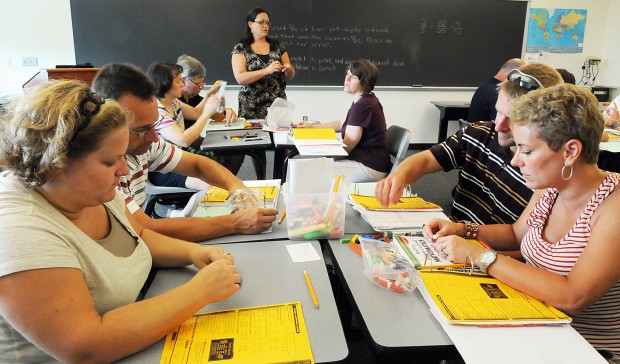
Teachers from nine area school districts gathered at Penn State Fayette, The Eberly Campus, to take part in a math professional development program coordinated by the college and Intermediate Unit 1's Center for Science, Technology, Engineering and Mathematics Education.
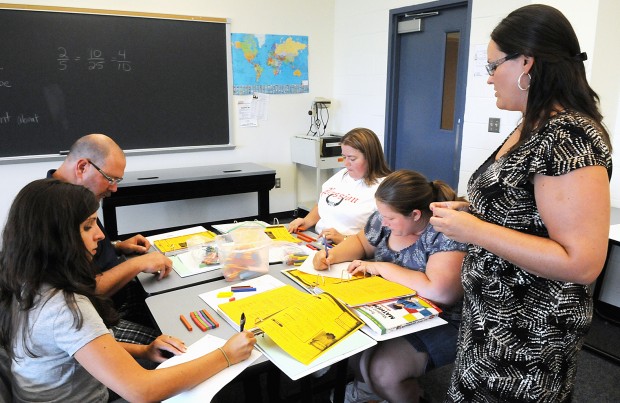
Mindy Harris (standing) Uniontown math coach, explains new math concepts to a group of teachers from Connellsville including (from left) Julie Kezmarsky, Bill Bauer, Stacey Huffman and Tiffany Griffith during a professional development program held at Penn State Fayette, The Eberly Campus.
A professional development program designed to help teachers deliver new math techniques to their students is geared at multiplying success in the classroom.
The Math Academy is part of a three-year federal grant coordinated by Intermediate Unit 1Ä¢¹½ÊÓƵ Center for Science, Technology, Engineering and Mathematics (STEM) Education and Penn State Fayette, The Eberly Campus.
Now in its second year, the program aims to help teachers implement more visual, hands-on techniques of learning math for students in grades three through eight to help promote algebra readiness. Fifty one teachers from eight districts in Fayette, Washington and Greene counties returned to the classrooms at the Fayette campus this year to further their understanding of the new techniques and learn how to best incorporate those into the classroom.
According to Amy Lewis, IU1 math specialist and co-director of the program, the purpose behind the nontraditional approach to math is to aid in content deepening and strengthen connectivity to the classroom and STEM.
“During the two-week program in the summer, the teachers learn how to create problems in the classroom where kids can come to their own understanding,� Lewis said. “We figure out how we can help kids develop a deeper understanding of math.�
Lewis said the program helps teachers and students steer away from the old techniques such as adding a zero to numbers as a shortcut of multiplying by 10. Instead, teachers are shown ways to manipulate objects and use other visuals to help add more interest and sense to mathematical equations in a more student-centered way.
She also noted that none of the instruction in the program is lecture based and that a field trip for teachers to Duke Energy Power Plant has been built into this yearÄ¢¹½ÊÓƵ program to help support learning. Participants receive 120 hours of professional development training which includes three days of follow up in the classroom during the school year.
This year, the teachers are working with rational numbers, or fractions and decimals. Instruction is broken into three groups of varying levels of understanding which are third and fourth grade, fifth and sixth grade and seventh and eighth grade.
Lewis said the grant, which is awarded in annual increments of $192,500, is in response to increasing rigors in standards and accountability.
“ItÄ¢¹½ÊÓƵ also an opportunity for teachers to increase their confidence level,â€� she said. “Which in turn will help better prepare kids to perform better in math.â€�
Mindy Harris, a math coach in the Uniontown Area School District, also instructs other teachers participating in the program. She said a more student-centered math curriculum is currently implemented on the junior high level in the Uniontown district.
“We are shifting from the teacher telling the kids what to do, to the teacher supplying activities to help the students figure out what they need to do,� she said.
During the professional development program, Harris tasked teachers with using wooden colored rods of varying lengths to convert fractions.
“If you can teach it with a picture or maniuplate numbers with objects, itÄ¢¹½ÊÓƵ proven that the learning is longer lasting,â€� Harris said.
In addition to Harris and Lewis, adjunct program instructors include Nicole Hill, math professor at the Fayette campus, and Harry Lynch, retired high school math teacher.
Lewis said she encourages teachers to communicate with parents about the new math learning principals so that families may help foster learning at home. Harris said in Uniontown, family game nights are held where parents are invited to learn techniques in a fun atmosphere. She also communicates with parents through agendas and parent/teacher conferences.
Harris said educational enhancement programs such as the Math Academy are crucial in todayÄ¢¹½ÊÓƵ competitive and busy world.
“As educators, our schedules are so packed during the school day that we don’t have time to reflect on best practices,� she said. “This program gives us a time to interact with other school districts and to be more competitive with international countries who are outscoring us on national exams.�