

Disenfranchising voters: It’s all about the win
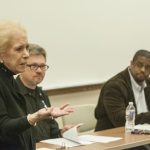
CALIFORNIA — The right to vote is a fundamental element of democracy in the United States, with constitutional amendments safeguarding that right, yet the practice of disenfranchising certain elements of society continues.
“The 15th Amendment and the 19th Amendment should have settled everything, right? Then the 24th Amendment was needed to get rid of the poll tax. Federal laws without teeth are meaningless,� Dr. Kelton Edmonds told students at California University of Pennsylvania Tuesday as the university continued its celebration of Black History Month.
A panel of three professors from the History and Political Science department presented the program “Partisanship, Disenfranchisement and Race.�
Edmonds said the disenfranchisement of black people in the post-Civil War era did not end with the 15th Amendment, which made it illegal to deny someone the right to vote based on race, color or previous condition of servitude. Practices such as poll taxes, literacy clauses and grandfather clauses made it difficult or impossible for former slaves and the descendants of former slaves to vote. Intimidation and violence continued to play a role in keeping black people from the voting polls into the 1960s, Edmonds said.
“It just isn’t party-specific. It started as the Democrats trying to disenfranchise people, but now in the modern era, itÄ¢¹½ÊÓƵ the Republicans,â€� said Dr. Melanie Blumberg.
Blumberg said that in her home state of Ohio, a number of measures were attempted to prevent certain groups, including African Americans, from voting, including a directive from the Ohio Secretary of State to prevent weekend voting.
“African American churches particularly had huge voting drives after church,� Blumberg said.
There was a billboard campaign launched by an unknown person or group stating that voter fraud is a felony and that those who commit it could face prison. When those billboards were challenged in court, they were replaced by ones stating “Voting is a Right, Not a Crime.�
Blumberg said provisional ballots that were submitted without stating what form of identification the voter would have presented if voting in person were invalidated.
Dr. Michael Slaven said that Republican strategists in Pennsylvania were stunned by President Barack ObamaÄ¢¹½ÊÓƵ 2008 presidential win. Because of his popularity with voters who were young, poor or minorities, those groups were targeted for disenfranchisement by the strategists.
“They alleged massive voter fraud. Massive voter fraud just doesn’t exist. The odds of your name being used in voter fraud in any given election is lower than the odds of being struck by lightning,� Slaven said.
Slaven noted that when Pennsylvania adopted its photo identification law for voters in March 2012, it was one of the strictest in the country. The identification card had to be issued by Pennsylvania or by the federal government, resulting in 785,000 Pennsylvania voters without valid identification materials.
The law was challenged and mostly overturned in October 2012 with a court ruling saying a voter could be asked for identification, but would not be required to produce it. The state Supreme Court has since struck down the law entirely.
“There have already been several attempts to restructure the law and also proposals to redistrict to eliminate districts with a high minority population,� Slaven said.
Slaven noted that historically black voting districts in Philadelphia have been combined with traditionally white suburban districts, in effect eliminating the effectiveness of the minority voters. Slaven said itÄ¢¹½ÊÓƵ not so much that the Republican party is racist as it is attempting to mold the vote for a victory by disenfranchising the poor.
“ItÄ¢¹½ÊÓƵ about winning,â€� Slaven said.