

Two commissioners split on paying prison bills
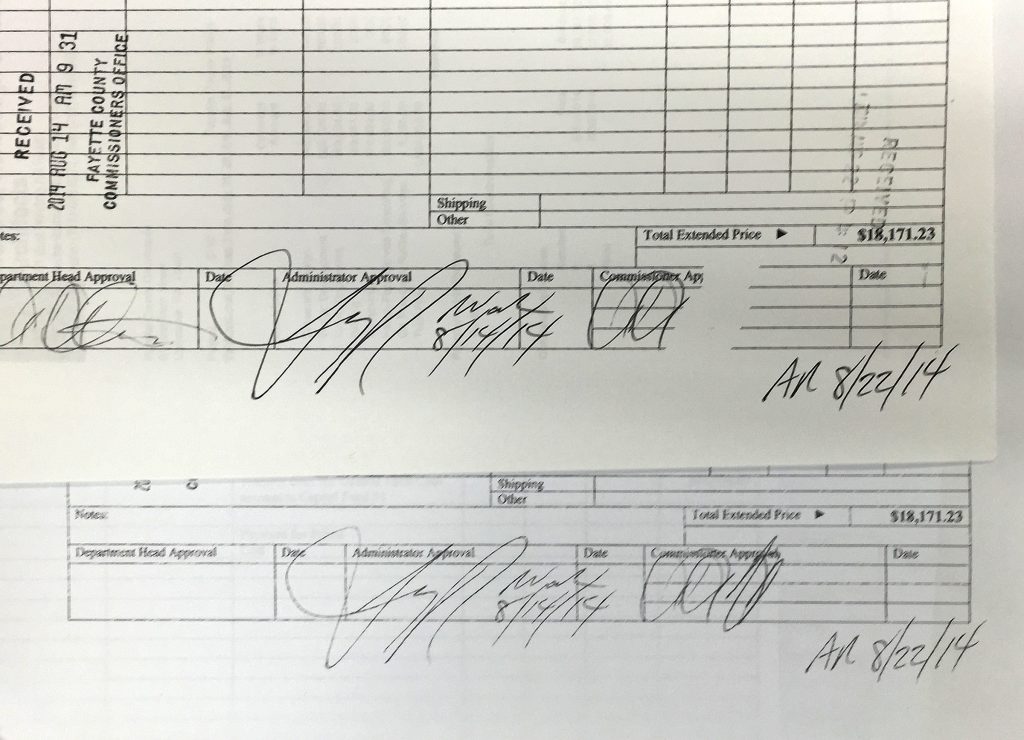
Pictured are photocopies of county purchase requisition orders that according to Fayette County Chief Clerk Amy Revak, had the two required signatures necessary on the originals before being sent to the controller's office for payment. Later, Commissioner Vincent Zapotosky said he used white-out to remove his signature as he did not support the payment of the invoice.
Roberto M. Esquivel|Ä¢¹½ÊÓƵ
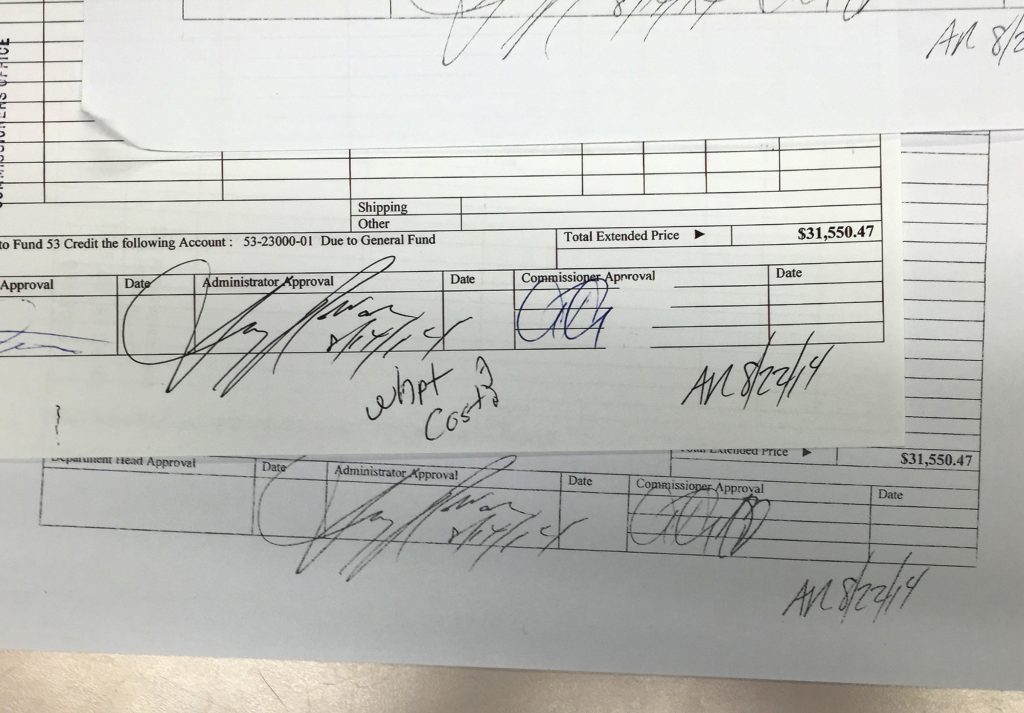
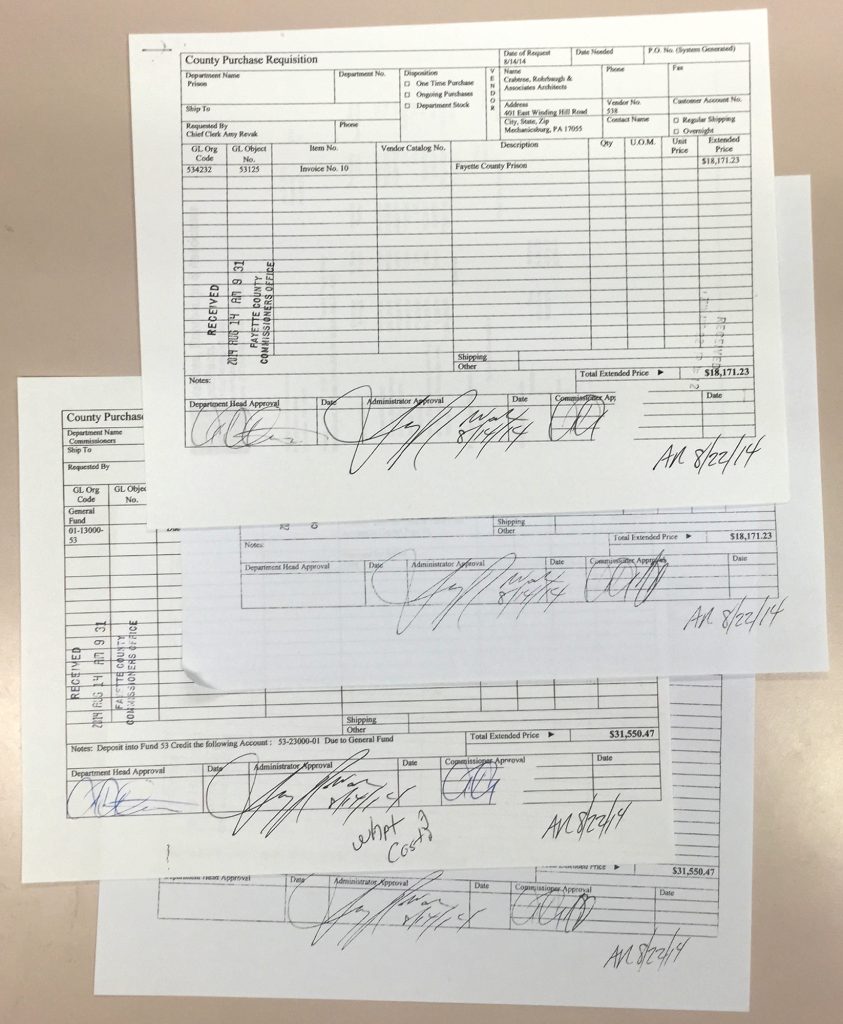
Pictured are photocopies of county purchase requisition orders that according to Fayette County Chief Clerk Amy Revak, had the two required signatures necessary on the originals before being sent to the controller's office for payment. Later, Commissioner Vincent Zapotosky said he used white-out to remove his signature as he did not support the payment of the invoice.
As the clock ticks for Fayette County to either pay for architectural and engineering design work for a shelved prison or face suit, two commissioners are split on whether the invoices were properly submitted for payment.
In mid-February, lawyers for Crabtree Rohrbaugh & Associates of Mechanicsburg told officials that the county hadn’t paid $325,607 to Crabtree and RW Sleighter Engineering Inc. of Lemont Furnace for work done on the proposed Justice and Rehabilitation Center (JRC). If the money isn’t paid, the law firm threatened to sue.
Crabtree and Sleighter were hired to design the proposed 115,000 square foot, 480-bed new prison; however, the project was abruptly halted in mid-August as it was ready to go to out for bid.
In a response to CrabtreeÄ¢¹½ÊÓƵ attorney, Commissioner Angela M. Zimmerlink wrote that while prior bills were paid through the general fund, a new procedure for payment was put into place on Dec. 1.
“General fund monies are no longer available and have not been since year end,� said Zimmerlink in the Feb. 24 letter. “However, the county has since borrowed funds through a bond and all jail related invoices are now paid using those available bond/loan funds via a draw down process through two financial institutions.
“Our process was written and says so in order to expedite payments in a timely manner.�
According to the new procedure, Chief Clerk Amy Revak prepares a requisition for payment and circulates it for approval by two of the three commissioners.
Once initialed, the acting Controller Jeanine Wrona reviews the paperwork and sends it for funding to be approved and transferred to her for payment. Revak maintains a listing of the paid invoices and adds them to the monthly agenda for ratification, according to the procedures.
Zimmerlink, Wrona, Treasurer Nancy L. Wilson and Commissioner Vince Zapotosky approved the new procedure.
Revak said that she was notified on Feb. 9 of the changes.
Commissioner Al Ambrosini said that he hasn’t received a copy of the guidelines, but added after learning of the process that the changes only impact the controllerÄ¢¹½ÊÓƵ office, not how bills are handled in the commissionerÄ¢¹½ÊÓƵ office.
“These bills should have been paid,� he said. “They sat in the bill tray for months. Some were even signed by two commissioners and then were returned with one of the (commissioner) signatures removed or scribbled out.�
In her letter to the Crabtree attorney, Zimmerlink said the invoices have not been processed because Ambrosini still has them.
“In a meeting several months ago attended by me, (Ambrosini), financial consultant, bank representative and county staff, I asked (Ambrosini) to process any invoices he had and he confirmed to all of us that he had a number of invoices on his desk,� said Zimmerlink in the letter. “To date, the same has not been processed.
“Unfortunately, bills cannot be paid if not processed and instead sitting on a commissionerÄ¢¹½ÊÓƵ desk.â€�
Ambrosini produced copies of the unpaid bills which were attached to requisition forms showing Revak received the bills, and generated a document for the commissioners to sign so that she could send the documents to the controller for payment.
Two requisitions – one for $13,379 and the second for $18,171 – show Revak added her signature after Ambrosini and Zapotosky signed off to pay the bills on Aug. 22.
Revak said that prior to her adding her initials, she had to ensure that the document was approved by two officials.
“They both had the appropriate signatures when they got to my desk,� she said. “Bills can not be paid without the approval of two commissioners.�
However, those invoices were later returned to the commissionerÄ¢¹½ÊÓƵ mail trays without ZapotoskyÄ¢¹½ÊÓƵ initials.
Zapotosky said that he initialed the invoices in error and removed his authorization to pay the bills.
He explained that there are sometimes “hundreds� of invoices to be signed and that was likely the case when he signed and removed his initials.
“Luckily, Kathy (Winkler, my administrative assistant) caught it and brought it to my attention,� he said. “She is familiar with my stance on all issues and reviews the requisitions to ensure I have signed the ones that should be signed and not signed the others that I don’t approve.
“When she showed me I had signed those particular requisitions, I used white-out to remove my signature.�
Zapotosky said that with the number of requisitions it is easy to become distracted and sign one haphazardly.
“Everyone has done it at one time or another,� he said.
However, Revak said that the requisitions had to be altered after they arrived at the controllerÄ¢¹½ÊÓƵ office because she had initialed and dated the documents.
“I do not attest and date them unless the requisitions have two signatures,� she said.
It is unclear when ZapotoskyÄ¢¹½ÊÓƵ signature was removed, but the original invoice shows his signature was there on Aug. 22 when it was attested by Revak.
In September, a second round of invoices were generated, including a $219,361 bill from Crabtree; a $3,201 invoice from Sleighter and a $13,730 bill from Dunbar Borough/Township Sanitary Authority.
Only RevakÄ¢¹½ÊÓƵ signature indicating the generation of the invoice on Sept. 25, and AmbrosiniÄ¢¹½ÊÓƵ initials are on those forms.
Ambrosini said after the unsigned invoices sat in the commissionerÄ¢¹½ÊÓƵ office for nearly four months, he gathered them up in December and took them to solicitor John Cupp for direction.
“I told (Cupp) at the time that if these bills weren’t paid we were going to get sued and now that is happening,� he said. “I didn’t hide the the invoices in my office as I was accused of doing.
“The invoices were properly processed. We had a contract and they should be paid.�
Zimmerlink, meanwhile, questioned several billing items in her letter to CrabtreeÄ¢¹½ÊÓƵ attorney, including a purported increase in the contract amount and the listed fee for a feasibility study prepared by Crabtree.
“With respect to an amended ($1.799 million original contract) fee increasing the same by $254,005, please be informed that while I have not yet done a review of our resolutions, I do not recall the required formal action being taken to amend the original contract,� she said. “Accordingly, would you please provide me with a copy of any document executed by commissioners modifying the original contract.�
Zimmerlink added that an unpaid $30,379 invoice for the feasibility study had been paid earlier by the county, and asked for a copy of an amended agreement as the original amount approved by commissioners was $24,000.
“I cannot locate a resolution approving said increase,� she said. “I questioned this at the time the invoice was submitted and paid but received no commissioner response.�
Ambrosini, meanwhile, said that he has directed Revak to seek a second signature to the unpaid invoices.
“If we are going to avoid litigation, they need to be signed and paid,� he said.