

Drivers beware: Potholes are everywhere
Brad Hundt
First comes the cold.
Then comes the snow.
And then come the potholes.
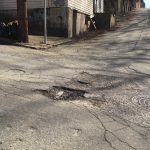
Early March is the time of year when we hope the worst of winter is behind us, but the best of spring is still weeks away, and potholes that dot streets and roads are tangible reminders of the carnage winter has wrought.
Potholes are typically generated when water seeps into the ground beneath the pavement. The freezing water then leads the pavement to crack and break. Plows that traverse streets and roads can exacerbate the problem, tearing off the patches that have been placed on potholes. This allows water to seep back into the holes, putting road and street crews back to square one. In addition, road salt lowers the freezing point of water, and that extends the freezing and thawing cycle.
This winter hasn’t been notably worse than any of our recent cold-weather seasons, according to Valerie Petersen, a spokeswoman for the state Department of Transportation. “This year appears to be about the same as previous years,� she said.
For PennDOT, the interstates are at the top of the list when it comes to repairing potholes, with secondary roads following.
“Every year we experience quite a few potholes in our area — and our crews fill them,� Petersen said.
In Perry Township, Fayette County, Supervisor AJ Boni said the number of potholes is “definitely up.�
Boni estimated they’ve been cold-patching 15 to 20 potholes a day, only to find they need resealed as temperatures drop and the patches freeze and pop off.
A cold patch is an asphalt mix that allows the material to remain flexible in freezing weather, so crews can work with it.
“The cold patch material is simply placed into the pothole with a shovel and then compacted. After a short time, the material will become hard,â€� said PennDOTÄ¢¹½ÊÓƵ Petersen. “Although this is designed to be a temporary repair, cold patch jobs can last two or more years.â€�
Boni said one of the worst areas for potholes in the township is Memorial Drive, which used to be old Route 51 and is basically a concrete road under blacktop. The road is porous, and water seeps through it and then freezes.
“As soon as we get through this and once the weather breaks, we’ll get some good materials in there and then we’ll do some of our paving projects,� Boni said.
The owner of a Brownsville auto-repair business said heÄ¢¹½ÊÓƵ been keeping more than busy.
“I can definitely tell you in the last two weeks, we’ve had three different vehicles with broken springs,â€� said Joe Lacey of LaceyÄ¢¹½ÊÓƵ Auto Repair.
Along with broken springs, Lacey said potholes can wreak havoc on struts and wheels. And repairs aren’t cheap. Lacey said the damaged springs each came with a $1,000 repair bill.
“Not only do potholes pose a safety risk to motorists, they can really leave a dent in your wallet,� says Mike Hoshaw, vice president of automotive services at AAA East Central. “Even if the damage isn’t as obvious as a flat tire, vehicles can end up with bent wheels or damaged suspension parts.�
AAA advises motorists to inspect the tires on their vehicles, noting that properly inflated ones can act as a cushion when driving over a pothole. The agency also recommended being alert, espcially of puddles, which can disguise deep potholes. If a motorists hits one, Hoshaw said to be aware of noises or vibrations, noting potholes can dislodge wheel weights, damage the tire or wheel or break suspension components.
From his observations, Waynesburg has experienced roughly the same or an increased number of potholes compared to previous seasons, according to Mike Simms, the boroughÄ¢¹½ÊÓƵ manager. Temporary cold patch is being used to fill them now, with more permanent fixes being applied later in the spring, when asphalt producers start their work.
Crews in Waynesburg “are out every day patching potholes,� Simms said.
Petersen said most permanent pothole patching is completed in the spring when the temperatures are consistently above freezing, with cold patches being used during the winter, weather permitting.
George Kosisko, the street foreman with the City of Connellsville, said the cold spell has kept him and his crew busy with filling potholes, adding they patched hundreds of potholes this year so far.
“Just be patient with us,� Kosisko said. “We’re getting as many as we can.�
Along with other duties the road crew needs to address, such as the removal of tree branches and debris after recent strong winds, Kosisko said they’ve been trying to go through at least two truckloads of patching material per day.
A truckload can patch between 20 and 25 average-size potholes.
“WhatÄ¢¹½ÊÓƵ frustrating is after you patched them, you drive around and you’d think you didn’t do any,â€� Kosisko said.
Once the weather breaks, Kosisko said they’ll be able to head out to take time and properly fill more potholes. Anyone whoÄ¢¹½ÊÓƵ got a bad one is welcome to call and leave a message, he said, at 724-628-2020, ext. 301.