

To catch a thief: Connellsville jeweler reflects on time spent helping police
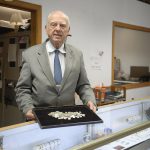
Jewelry appraisal and altruistic crime-fighting go hand-in-hand for Joe Orszulak, who assisted in the case of a notorious jewelry thief who made the FBIÄ¢¹½ÊÓƵ Top 10 Most Wanted list in 1985.
Orszulak, of Connellsville, appraised a portion of $500,000 in goods stolen by Bernard Welch, a well-known burglar who escaped a Chicago prison where he was serving a 143-year sentence.
At the time, Orszulak was a Greensburg coin dealer and jewelry salesman who assisted state police in theft cases. Orszulak would later set up shop in Connellsville with KathrynÄ¢¹½ÊÓƵ Jewelry on East Crawford Avenue. Welch was nabbed Aug. 7, 1985, and police found a stash of loot in his West Newton hideout. Welch moved to the Greensburg area June 19, 1985, after his escape on May 14, 1985. In 1980, Welch shot and killed cardiologist Michael Halberstam during a burglary.
Orszulak said Welch watched Halberstam leave his Washington, D.C. home, and proceeded to burglarize it. But the doctor had forgotten something and returned home, prompting Welch to shoot Halberstam.
“The doctor recovered temporarily from the shot, and drove himself to the hospital,� Orszulak said.
On the way, Halberstam spotted Welch and tried to run over him. He crashed, and died, which officials determined was due to the gunshot wound.
In August 1985, Orszulak was called into appraise a portion of the stolen goods, which he determined had a wholesale value of about $50,000, and helped law enforcement complete an inventory of the items. The stash included a $6,000 gold watch, $20,000 in cocktail rings set with various stones, rifles, guns and other jewelry.
He recalled laughing with reporters about one of the pieces of jewelry, which he said looked like a chastity belt.
While the Welch case was the most widely known case on which Orszulak assisted, it was far from the only time he assisted police in an arrest. One of OrszulakÄ¢¹½ÊÓƵ clients was approached by a con man, Jerry Carbone, who was attempting to bamboozle the client out of his wealth by offering gold coins at “a ridiculously low price,â€� Orzsulak said.
Orszulak filled a suitcase with thousands of dollars – “my money, incidentally,� he said – and he and his client met Carbone at a restaurant near the Pittsburgh airport. Undercover officers were also in the restaurant, and police blocked exits Carbone might try to take by vehicle.
The deal went smoothly. Carbone was arrested, and Orszulak got his money back.
When asked if he had any concerns about his safety or his cash, he said, “not really.�
“I’ve always had a really good rapport with law enforcement,� he said.
His wife didn’t worry about him either, he said, pointing out a bullet hole at his shop. Smash-and-grab robbers hit the shop in 2001, watching Orszulak leave before entering the store. Kathryn Orszulak was there with several employees.
“She ushered the girls into the backroom… and went after them,� Orszulak said.
She fired a shot from a revolver to scare them off, and the men fled. Kathryn Orszulak and her employees left through a side door, and encountered the men again in an alley.
“Of course, they were scared to death,� he said.
The two men smashed display cases before fleeing, and escaped with two trays of jewelry. Charges were later filed in the case.
“We will stand and fight, and sheÄ¢¹½ÊÓƵ the epitome of it,â€� he said.
“Oh, yeah, I will go after them,� the petite, gray-haired woman added with a grin.
He estimated he assisted on about 300 cases, with the majority of those between 1978 and 1985.
“I actually chased down two criminals and held them for the police, and had one group of individuals actually arrested in the store,� he said.
Precious metals thefts increased at the time, when the price of gold and silver rose sharply in 1980, with gold selling for $850 per ounce and silver nearing $50 per ounce. On Wednesday, Orszulak said, the price of gold was $1,944.50 per ounce, with silver at $27 per ounce.
Today, law requires recording all jewelry purchases to submit to law enforcement, but that was not the case before the precious metals sales act was signed into law in 1984. At that time, Orszulak was already assisting state police in cases, and they even provided him with surveillance cameras to catch thieves in the act.
He was involved in fewer cases as word spread that he had surveillance cameras and was helping police. But some still came to him, tempted by his prices.
“Word came up pretty quick among the thieves that if you came here, you’re gonna get arrested,� Orszulak said. “‘Why’d you go to Joe when you knew you’d get your picture taken?'� he said the officers would ask them. “They said, ‘Well, he pays the highest prices.'�
He also gave two presentations to state police in the late ’70s or early ’80s, using the surveillance footage to see if they identified any suspects in his shop, and took suggestions to help in their cases.
“ItÄ¢¹½ÊÓƵ been a lifelong thing, helping the police,â€� he said. “ThereÄ¢¹½ÊÓƵ no need to explain where I stand on supporting blue lives.â€�