

ChatGPT-maker OpenAI hosts its first big tech showcase as the AI startup faces growing competition
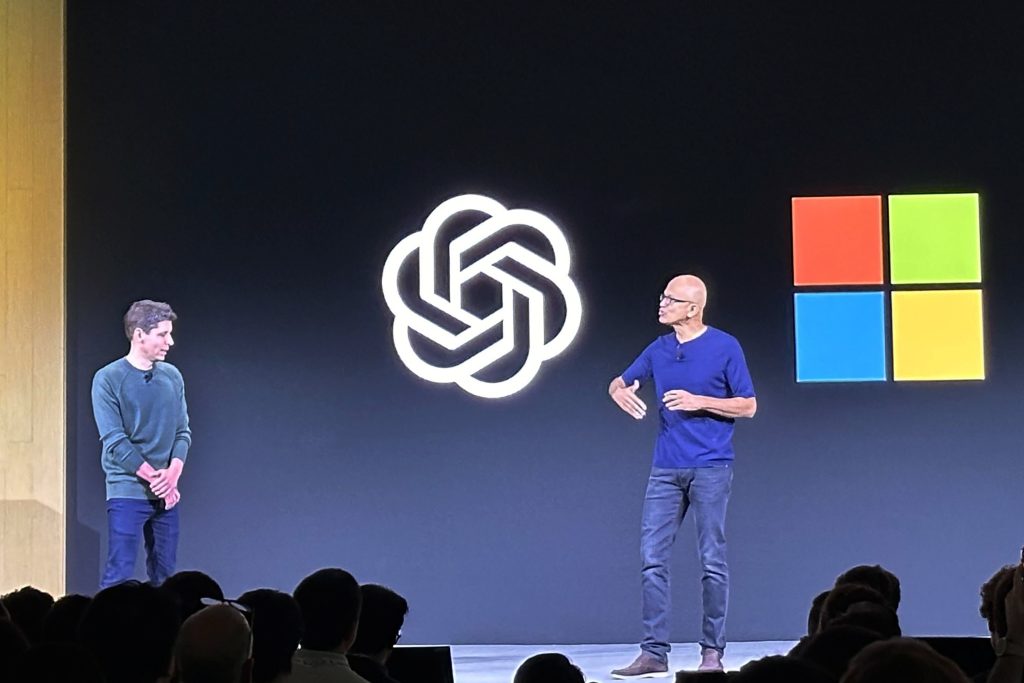
Sam Altman, left, CEO of OpenAI, appears onstage with Microsoft CEO Satya Nadella at OpenAI DevDay, OpenAI's first developer conference, on Monday, Nov. 6, 2023 in San Francisco.
FILE - Text from the ChatGPT page of the OpenAI website is shown in this photo, in New York, Feb. 2, 2023. About 900 software developers and other attendees showed up to the inaugural developer conference for the artificial intelligence company behind ChatGPT Monday, Nov. 6, 2023 embracing a Silicon Valley tradition for technology showcases that Apple helped pioneer decades ago.
SAN FRANCISCO (AP) — Less than a year into its meteoric rise, the company behind ChatGPT unveiled the future it has in mind for its artificial intelligence technology on Monday, launching a new line of chatbot products that can be customized to a variety of tasks.
“Eventually, you’ll just ask the computer for what you need and it’ll do all of these tasks for you,â€� said OpenAI CEO Sam Altman to a cheering crowd of more than 900 software developers and other attendees. It was OpenAIÄ¢¹½ÊÓƵ inaugural developer conference, embracing a Silicon Valley tradition for technology showcases that Apple helped pioneer decades ago.
At the event held in a cavernous former Honda dealership in OpenAIÄ¢¹½ÊÓƵ hometown of San Francisco, the company unveiled a new version called GPT-4 Turbo that it says is more capable and can retrieve information about world and cultural events as recent as April 2023 — unlike previous versions that couldn’t answer questions about anything after 2021.
It also touted a new version of its AI model called GPT-4 with vision, or GPT-4V, that enables the chatbot to analyze images. In a September research paper, the company showed how the tool could describe whatÄ¢¹½ÊÓƵ in images to people who are blind or have low vision.
ChatGPT has more than 100 million weekly active users and 2 million developers, spread “entirely by word of mouth,� Altman said.
He also unveiled a new line of products called GPTs — emphasis on the plural — that will enable users to make their own customized versions of ChatGPT for specific tasks.
Alyssa Hwang, a computer science researcher at the University of Pennsylvania who got an early glimpse at the GPT vision tool, said it was “so good at describing a whole lot of different kinds of images, no matter how complicated they were,� but also needed some improvements.
For instance, in trying to test its limits, Hwang appended an image of steak with a caption about chicken noodle soup, confusing the chatbot into describing the image as having something to do with chicken noodle soup.
“That could lead to some adversarial attacks,� Hwang said. “Imagine if you put some offensive text or something like that in an image, you’ll end up getting something you don’t want.�
ThatÄ¢¹½ÊÓƵ partly why OpenAI has given researchers such as Hwang early access to help discover flaws in its newest tools before their wide release. Altman on Monday described the companyÄ¢¹½ÊÓƵ approach as “gradual iterative deploymentâ€� that leaves time to address safety risks.
The path to OpenAIÄ¢¹½ÊÓƵ debut DevDay has been an unusual one. Founded as a nonprofit research institute in 2015, it catapulted to worldwide fame just under a year ago with the release of a chatbot thatÄ¢¹½ÊÓƵ sparked excitement, fear and a push for international safeguards to guide AIÄ¢¹½ÊÓƵ rapid advancement.
The conference comes a week after President Joe Biden signed an executive order that will set some of the first U.S. guardrails on AI technology.
Using the Defense Production Act, the order requires AI developers likely to include OpenAI, its financial backer Microsoft and competitors such as Google and Meta to share information with the government about AI systems being built with such “high levels of performance� that they could pose serious safety risks.
The order built on voluntary commitments set by the White House that leading AI developers made earlier this year.
A lot of expectation is also riding on the economic promise of the latest crop of generative AI tools that can produce passages of text and novel images, sounds and other media in response to written or spoken prompts.
Altman was briefly joined on stage by Microsoft CEO Satya Nadella, who said amid cheers from the audience “we love you guys.�
In his comments, Nadella emphasized MicrosoftÄ¢¹½ÊÓƵ role as a business partner using its data centers to give OpenAI the computing power it needs to build more advanced models.
“I think we have the best partnership in tech. I’m excited for us to build AGI together,� Altman said, referencing his goal to build so-called artificial general intelligence that can perform just as well as — or even better than — humans in a wide variety of tasks.
While some commercial chatbots, including MicrosoftÄ¢¹½ÊÓƵ Bing, are now built atop OpenAIÄ¢¹½ÊÓƵ technology, there are a growing number of competitors including Bard, from Google, and Claude, from another San Francisco-based startup, Anthropic, led by former OpenAI employees. OpenAI also faces competition from developers of so-called open source models that publicly release their code and other aspects of the system for free.
ChatGPTÄ¢¹½ÊÓƵ newest competitor is Grok, which billionaire Tesla CEO Elon Musk unveiled over the weekend on his social media platform X, formerly known as Twitter. Musk, who helped start OpenAI before parting ways with the company, launched a new venture this year called xAI to set his own mark on the pace of AI development.
Grok is only available to a limited number of early users but promises to answer “spicy questions� that other chatbots decline due to safeguards meant to prevent offensive responses.
Asked for comment on the timing of GrokÄ¢¹½ÊÓƵ release by a reporter, Altman said “ElonÄ¢¹½ÊÓƵ gonna Elon.â€�
Much of what OpenAI announced Monday was attempting to address the concerns of businesses looking to integrate ChatGPT-like technology into their operations, said Gartner analyst Arun Chandrasekaran.
Getting cheaper products “was clearly one of the big asks,â€� as was being able to customize AI models to tap into an organizationÄ¢¹½ÊÓƵ own internal data sources, Chandrasekaran said. He said another appeal to businesses was a “Copyright Shieldâ€� in which OpenAI promises to pay the costs of defending its customers from copyright lawsuits tied to the way OpenAIÄ¢¹½ÊÓƵ models are trained on troves of written works and imagery pulled from the internet.
Goldman Sachs projected last month that generative AI could boost labor productivity and lead to a long-term increase of 10% to 15% to the global gross domestic product — the economyÄ¢¹½ÊÓƵ total output of goods and services.
Altman described a future of AI agents that could help people with various tasks at work or home.
“We know that people want AI that is smarter, more personal, more customizable, can do more on your behalf,� he said.
—-
O’Brien reported from Providence, Rhode Island.
—â¶Ä“
The Associated Press and OpenAI have a licensing agreement that allows for part of APÄ¢¹½ÊÓƵ text archives to be used to train the tech companyÄ¢¹½ÊÓƵ large language model. AP receives an undisclosed fee for use of its content.