

‘Witches of Scotland’ podcasters visit Citizens Library
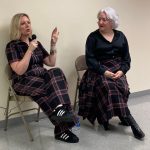 Brad Hundt/Observer-Reporter
Salem, Mass., isn’t the only place where witches were being hunted centuries ago.
Three-thousand miles away and 130 years before the hysteria in Salem, Scots were enthusiastically tracking down witches and blaming them for the woes in their lives, whether it be a bad crop or bad weather. It led the authorities to enact the 1563 Witchcraft Act, which called for death to anyone found to be a witch.
“Scotland was the epicenter of witchcraft accusations during this time,” according to Claire Mitchell, a Scottish constitutional lawyer. Scots believed “that if anything bad happened to them, witchcraft was afoot,” she added.
This grim episode in Scottish history, which led to about 2,500 people being executed after they were accused of witchcraft, has been explored deeply by Mitchell and fellow Scot Zoe Venditozzi, and they have shared what they have found in the podcast “Witches of Scotland” and the freshly published book, “How to Kill a Witch: The Patriarchy’s Guide to Silencing Women.” Mitchell and Venditozzi discussed their work and the bubbling cauldron of misogyny, religious prejudice and fear that led to the witch hunts at Citizens Library in Washington Wednesday night.
Venditozzi, who is a teacher, and Mitchell used trial transcripts, eyewitness accounts and other documents to piece together just how 4,000 people ended up being classified as witches, with 85% of them being women. Part of Venditozzi and Mitchell’s motivation was the prospect of shedding some light on a part of Scottish women’s history that has largely been ignored. Mitchell explained, “We have lots of statues of men. There are no statues of women in Scotland.”
And Scotland’s witch trials, which lasted into the 1700s, have largely been swept under the rug. Venditozzi noted that when she was growing up, epochal events like World War II and the Industrial Revolution were given classroom time, but nary a peep was made about the witch trials.
“I was never taught anything about the witch trials,” Venditozzi said. “It was basically about machines. It wasn’t about people.”
The fervent belief that witchcraft was afoot in Scotland and other places – Germany, France and Switzerland also had witch trials – was part of pre-scientific thinking, as people struggled to make sense of a world that could be harsh and unforgiving. But in Scotland, the witch trials were also fueled by anti-Catholic animus, clergy eager to show how they were “protecting” their flock, and a bedrock belief in the inferiority of women and how easily they could fall prey to the devil. Mitchell pointed out that most of those accused were older, not well-heeled and viewed as “troublesome” or “quarrelsome” within their own communities.
Mitchell explained that if someone was, in fact, accused of being a witch, they were usually tortured. They were often stripped of their clothes and their heads were shaved in a search for “the devil’s mark.” Then they were kept awake for days on end. When they were ultimately executed, they were strangled, and then their bodies were burned in order to prevent them from being “re-animated.”
Thanks to Mitchell and Venditozzi’s efforts in uncovering this history, a formal state apology was issued in 2022 by Nicola Sturgeon, who was then the first minister of Scotland. She said, “At a time when women were not even allowed to speak as witnesses in a courtroom, they were accused and killed because they were poor, different, vulnerable or in many cases just because they were women.”
The “Witches of Scotland” podcast has had 160,000 downloads, with 20% of those coming from the United States. Mitchell and Venditozzi’s talk was sponsored by the Washington County Bar Association.