

Officials monitoring ice build-up on Western Pennsylvania rivers
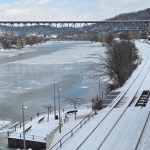
Rivers and creeks across Western Pennsylvania are freezing over thanks to the unrelenting frigid temperatures, but it might be some time before the region has to worry about ice jams and the potential flooding it typically brings.
Photos of The Point in Downtown Pittsburgh that are circulating on social media show the Allegheny River is totally frozen, but the Monongahela River still remains navigable with barge traffic breaking up the ice and creating a channel in the middle of the waterway.
But the Youghiogheny River in Fayette County and Ten Mile Creek that divides Washington and Greene counties are mostly sheets of ice, raising concerns about what could happen when the weather eventually warms.
“Eventually, it will be a concern,” said Alicia Miller, who is a hydrologist with the National Weather Service in Pittsburgh. “The longer it sits around, the more locked in it gets. It will take a rapid warm-up or rain event to lift it and shove it out, and that’s the worse-case scenario.”
Any of those issues might be at least a couple of weeks away with temperatures expected to drop into negative digits over the next couple of nights and with it not forecast to get above freezing in the foreseeable future. Miller said a “gradual warm-up” would be more advantageous with fewer ice jams that typically lead to flooding, but this extreme cold could also cause “stack-up” conditions that push the ice up.
“The weekend conditions will make it even worse. It will just allow for more ice growth to continue,” Miller said. “It’s been so cold, we’ll need a little more time for it to thaw out before we have an impact. But it will definitely be something we’ll have to watch.”
The extreme freeze has wreaked havoc on some of the river gauges designed to measure water levels.
Miller pointed to the Yough River’s gauge at Ohiopyle that has been “really noisy” lately by providing fluctuating readings with “up and down spikes” or falsely showing the river is high from the amount of ice. Those false readings were displayed recently when the water level went from 0 feet to nearly 16 feet in about 12 hours Saturday, and it remained there until dropping back to 2 feet over a couple of hours Tuesday, according to the National Oceanic and Atmospheric Administration’s hydrology chart there.
“It was really high and above ‘action stage’ and now it’s dropped back off,” she said of the odd readings due to the ice. “Usually that’s a sign (of ice buildup) – since we haven’t had any rain – making the gauge read poorly.”
Beyond river gauges, Miller said the public offering eyewitness reports by submitting photographs or videos of ice buildup and water levels is also an important tool for the weather service.
“We utilize a few different things to kind of monitor the ice,” Miller said. “One of them is eyes. We try to get people to report (with) pictures and we have a reporting (link) on our website. They can report ice jams or other problems.”
People can post photos tagging the National Weather Service of Pittsburgh on its Facebook and Twitter pages, or by going to www.weather.gov/pbz/reports to submit online reports.
“We would love to have people keeping an eye on it because ice is unpredictable and things could change,” she said. “Watch for ice movement, report it to the authorities and report it to us. If the ice moves and it locks up somewhere else, that’s where we’ll have problems with flooding because essentially it’ll become a dam because it can’t move anywhere.”