

OP-ED: The manhunt that paralyzed the region in 1977
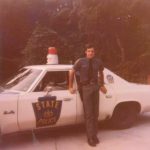 Courtesy of Larry Maggi
It was 48 years ago in September that a convicted cop killer from Philadelphia escaped, leading local police on a two-week manhunt.
Anyone who lived in Washington County during the fall of 1977 probably remembers the news reports, roadblocks, and school closures caused by a 34-year-old fugitive named Russell Shoats. I remember it well because I was a young trooper with the Pennsylvania State Police who was part of the manhunt.
The Shoats story started seven years prior, in August of 1970, when he and a group of revolutionaries shot and killed 43-year-old Philadelphia Police Sgt. Frank VonCollin. A father of two, VonCollin was ambushed and murdered while on the phone dispatching officers to another shooting in Philadelphia. He was shot five times by Shoats and his group, who later shot and wounded two other Philadelphia police officers.
In January 1972, Shoats was arrested and charged with homicide. In 1973, a jury convicted him of first-degree murder and other crimes, and he was sentenced to life imprisonment, without the possibility of parole. Four other suspects were also convicted and sentenced to life in prison.
On Sept. 4, 1977, Shoats and three other inmates took over a cell block at the Huntingdon State Correctional Facility, injuring several guards with a knife before they escaped. One prisoner was killed, two were immediately captured, but Shoats was able to escape.
Twelve days later, on Sept. 26, 1977, a desperate Shoats entered the home of Dale Rhome, a guard at the Huntingdon State Correctional Facility, and forced him, his wife, Marlene, and their 5-year-old son Eric to help him escape in their family car.
After driving about 150 miles they arrived in Washington County, where he ordered Mrs. Rhome, who was driving, to pull over near Cokeburg. When the car wouldn’t start, Shoats abandoned it and forced the family into a wooded area where he tied them to a tree. Shoats took off again and less than four hours later the Rhomes were able to free themselves and seek help at a nearby residence. This is when one of the largest manhunts in Washington County history began.
It was a Monday evening, and I remember that there wasn’t much going on as far as police activity. But the calm was broken when a radio call alerted all state police officers, local police, and the county sheriff’s office to be on the lookout for Shoats. All available police, armed with a physical description of Shoats, were dispatched to organize a manhunt that would eventually reach into Greene and Fayette counties. The plan was to create a perimeter to prevent him from leaving the area. The public was notified immediately via news reports on television and radio, and through newspaper reports the next day. This was how we did it back then; after all, social media as we know it wasn’t available.
I was assigned to Troop S, Interstate 79 patrol and was working the 3 to 11 p.m. shift when I was dispatched to the Cokeburg and Beallsville area, where the search was being organized. We patrolled the roadways, looking for unusual activity and waiting for calls from the public about sightings. The next morning, the state police commanders organized a larger search, bringing in manpower from the FBI, state correctional guards, deputy sheriffs, probation officers, and fire departments. Over a hundred personnel were actively involved in the search.
A command post was set up in Beallsville and there were alleged Shoats sightings in Fayette and Greene counties, which resulted in the cancellation of area schools.
But everything changed on the evening of Oct. 10, 1977 (26 days after his prison escape), when Shoats commandeered a vehicle in the Marianna area and took a local resident hostage with a shotgun. A witness contacted state police to report that the possible suspect was in the back seat of a car heading north on the Beallsville-Marianna Road (Maiden Street) toward the traffic light at the junction of Route 40.
I was one of the troopers and officers in the Beallsville area who devised a plan for a felony stop of the escaped convict. This plan, which had to be enacted within a few short minutes, was to block the road approximately a half-mile south of Beallsville.
When the hostage saw the police, he abruptly stopped the vehicle, jumped out, and yelled that Shoats was in the back seat and armed with a shotgun. Although I can’t remember everyone who participated in the traffic stop, I recall that it was Trooper Larry Szabo of Troop B, Washington, who jumped into the vehicle and apprehended Shoats, who was lying down in the back seat of the car. Trooper Szabo, who displayed great courage and bravery, disarmed Shoats and took him into custody without shots being fired. The fugitive emerged haggard, tired, and just plain worn out after being on the run for over three weeks. When we searched his jacket, we found crabapples and what appeared to be part of a frog, which he apparently scrounged up for sustenance during his brief stint of freedom. He seemed to be thankful that the run was over.
One notable takeaway from this story was the bravery, adaptability, and hospitality of the local people. They opened their homes to us and told us what they saw. They joined together to prepare outstanding, home-cooked meals so that we could have hot food and coffee available 24 hours a day at the local fire departments. If it weren’t for the cooperation of the local citizens, we would not have had this successful outcome.
The capture of Shoats ended a time of fear for the people in Washington, Greene and Fayette counties, who were very concerned for the safety of their families and neighbors. They were able to breathe a collective sigh of relief as they no longer had to lock their doors, stay inside, and be on the lookout for unusual activity. The massive police presence dispersed and it was back to life as usual.
Several years later, Trooper Szabo resigned and became a state trooper in Wyoming, where he was shot and wounded while making a traffic stop. Fortunately, he recovered from his injuries. Russell Shoats died in prison on Dec. 17, 2021. As for me, I retired from the state police in 1997, served six years as the Washington County Sheriff, and am now serving as a county commissioner.