

Determination, grit led Surlas to play football at Alabama
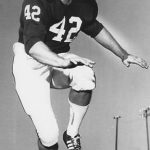
Determination and grit helped Southmoreland product Tom Surlas play football at one of the legendary college football programs.
Surlas battled hard to play in high school at Southmoreland and transformed himself into a solid football player.
“I went to St. JosephĢ¹½ÊÓƵ Catholic School in Everson,” Surlas stated. “I come from the eighth grade into the Southmoreland School District, and I didn’t know anybody and nobody knew me. I played sandlot football since I was a young kid, I probably had a couple of concussions by that time, because I didn’t tackle with my hands and put my head down. Older guys that I played with ended up kicking me in the head. When I was a freshman in high school I didn’t even get a uniform because they didn’t have enough equipment, and I was unknown.
“I was on the field for a couple of weeks and just practicing dummy squad and I quit about the second or third week in. I guess that upset me some. I started lifting weights and put on weight and muscle. I was 155 as a freshman, and gained weight and muscle every year until I was a senior, when I was 205.”
For the Scotties, Surlas was a two-way performer at halfback on offensive, and defensive back and linebacker on defense.
“I started as a sophomore at linebacker,” Surlas recalled. “I made a couple of tackles in the preseason and at the time they saw that I was aggressive. I got playing time on offense my junior year. My senior year I was the starting running back and we had a big backfield. We ran kind of a single wing.”
In the three seasons that Surlas lettered at Southmoreland, the Scotties posted records of 4-5 in 1965, 2-7 in 1966 and 5-4-1 in 1967.
“We were kind of average,” Surlas said. “It was a good team, but we somehow didn’t make the top caliber that we wanted to be. We had a coaching change every year; Benny Malesky, then Joe Gratson my junior year and we had Ray Gorman my senior season. The coaching changes made it hard to get continuity.”
Surlas scored six touchdowns for the Scotties in 1967.
Track & Field was also a sport that Surlas excelled in. He was a three-year letterman for coach Don Gilpen, his specialty was the shot put.
“I still hold the shot put record at Southmoreland,” Surlas said. “I think it was 57 feet or something like that. I enjoyed track, it was what I did as a freshman after I didn’t get to play football. I picked up the shot put, and I thought weights and the shot put, they kind of went together.”
When Surlas graduated from Southmoreland in 1968 he wanted to continue playing football.
“My dad was a coal miner; neither of my parents graduated from high school,” Surlas explained. “I thought I’m probably going to be a blue-collar worker and never thought about college. But football kept giving me thoughts about college. I didn’t have college courses getting me ready for college, so I had interest and coach Gorman sent out letters helping me get noticed. Johnny Majors was at Iowa State and he had some interest, but I needed help. Ellsworth Junior College was about 45 miles from Iowa State and he got me into Ellsworth and it was scholarship and government grants. Ellsworth had a good team my freshman year and I broke my nose in a scrimmage and couldn’t play for weeks. I was a halfback. They switched me to linebacker and I took to it well and I had a nose for the ball.”
Surlas was a two-time All-Conference selection at Ellsworth and a Juco All-American in 1969.
Alabama conducted an intensive junior college search for defensive help and Surlas wound up with the Crimson Tide and he immediately caught the eye of Paul “Bear” Bryant during spring practice.
“That Surlas makes a difference,” Bryant said at the time. “He can move and he can tackle. HeĢ¹½ÊÓƵ a little ahead of the rest of them. HeĢ¹½ÊÓƵ better than I though he was. I think I like him at weak-side linebacker.”
Surlas played on the 1970 ‘Bama team that finished 6-4-1 and tied Oklahoma, 24-24, in the Astro-Bluebonnet Bowl. He didn’t make the trip to the bowl game because he had finished his sophomore requirements at Alabama rather than graduating at the junior college, making him ineligible for bowl participation under NCAA rules.
Early in the 1970 season Alabama lost to USC when Sam “Bam” Cunningham ran over the Crimson Tide. It changed the way Bryant recruited, as he started to look at and recruit black athletes.
“The first guy that they picked up was John Mitchell, who is now the defensive line coach for the Pittsburgh Steelers,” Surlas offered. “I remember Cunningham and he just ran over top of us, it was amazing.”
Alabama had an outstanding 11-1 season in 1971. The Crimson Tides’ only loss was a 38-6 setback to Nebraska in the Orange Bowl.
“We developed friendships and we really got close as a team,” Surlas said. “That chemistry that we had, we really went on a roll. Nebraska was a blur, they were a tremendous team.”
One of the highlights of the season for Surlas occurred in AlabamaĢ¹½ÊÓƵ 14-7 win over LSU.
“I chased Bert Jones from one sideline to the other sideline.” Surlas recalled. “I had tackles in the backfield, I don’t know what made me do it, but it was the best game I ever played for sure.”
Surlas was named to the All-Southeastern Conference defensive team. He was named first team All-American by the Detroit Sports Extra Football newspaper. He was named defensive player of the week by Sports Illustrated for his performance against LSU.
The NFL overlooked Surlas when he graduated from Alabama. The league didn’t like his size at 215 pounds.
“I thought I was going to get drafted and that didn’t happen,” Surlas stated. “I ended going back and getting my degree and then went to the CFL and the Toronto Argos. My first year, I had a serious knee injury and was on and off the field. My second year in Canada, there was a players’ strike and I still had knee problems, so I went to the World Football League in Portland. I was there for a couple weeks, I had a chance to go to Denver and the NFL had a players strike, but you can’t go from the CFL to the NFL in the same season. I didn’t play that year and I got a job back in Pennsylvania on the railroad and it was railroad construction and the job was like weight lifting and I put on weight and muscle and that helped my knee. I then latched on with the WFL Memphis Southmen. That was a great experience. That was the end of football after the WFL folded. I went back to the railroad until the early 1990Ģ¹½ÊÓƵ with Conrail. I went into heavy equipment with Operating Engineers until I hurt my back, which I had originally done on the railroad. I eventually had to go into sales with a water treatment company, and then I retired in 2008.”
Surlas, 65, is divorced and living in Norvelt. He did some high school coaching and still coaches youth football. He is proud of his athletic family. His sons, John and Jason played at Mt. Pleasant and played college football. His daughter, Jen, Jen played basketball at Geibel Catholic and in college.
“What a great blessing that has been,” Surlas said. “They excelled in every type of sport. That has been a great blessing and athletics still remain a big part of my life.”
George Von BenkoĢ¹½ÊÓƵ “Memory Lane” column appears in the Monday editions of the Ģ¹½ÊÓƵ. He also hosts a sports talk show on WMBS-AM radio from 10 a.m. to noon on Saturdays.