

Water and Sky: Floating on Cranberry watching the Perseid
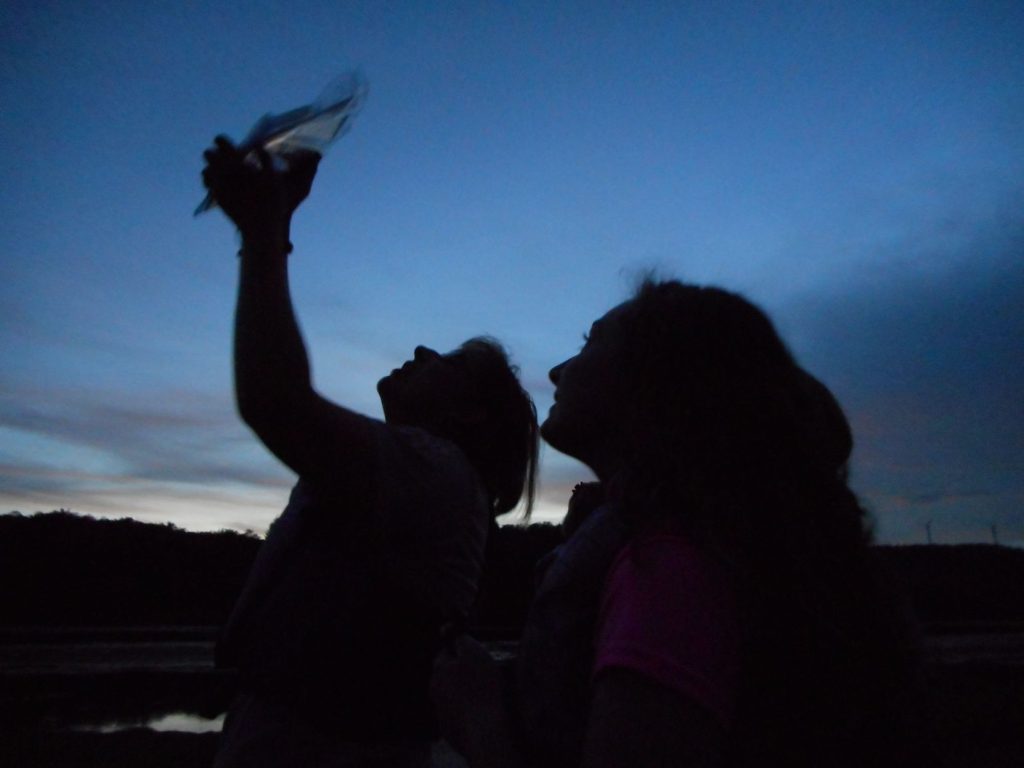
Barb Wallace, Ohiopyle State Park environmental education specialist, uses a computer app to identify planets and stars above Cranberry Glade Lake while Kathy Firestone of Connellsville looks on. Wallace lead a fleet of sky-watchers onto the lake to enjoy the annual Perseid meteor shower.
Associated Press
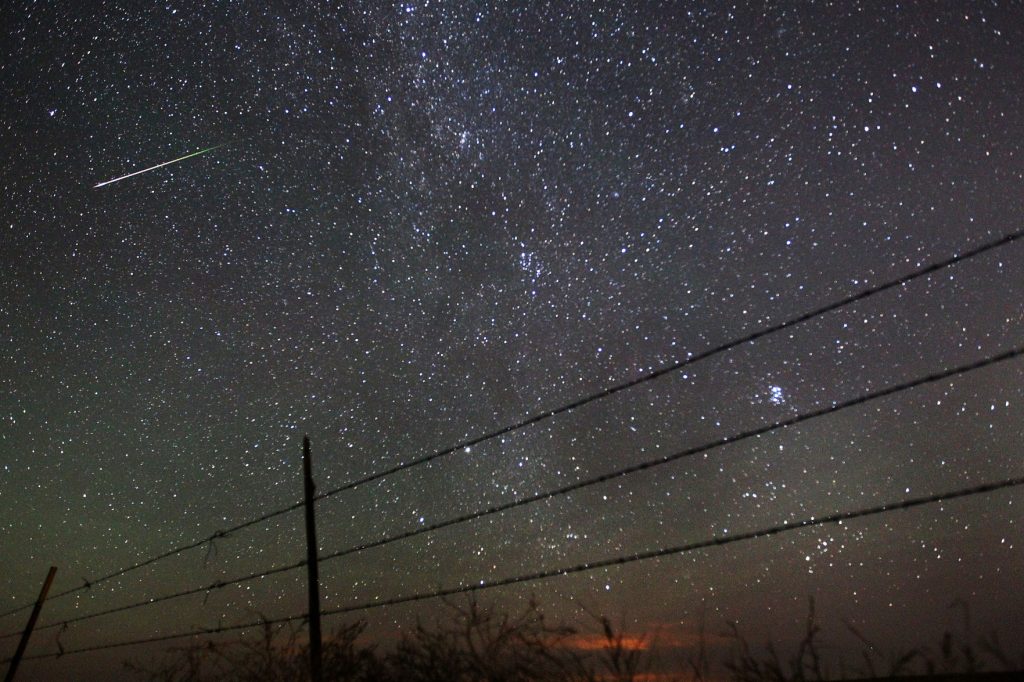
In this early morning photo, a meteor streaks past the faint band of our Milky Way galaxy above the Wyoming countryside north of Cheyenne, Wyo., during a Perseids meteor shower.
If you are reading this, you possess all the equipment you need to enjoy a rare and beautiful outdoor event. What you do not have is much time. The Perseid meteor shower peaked last Thursday night but continues, if somewhat diminished, for the next several nights.
The Perseid shower happens every August, when EarthÄ¢¹½ÊÓƵ orbit of the Sun takes it through the veil of dust, ice and space-debris trailing a comet also orbiting our nearest star.
As earth passes through the cometÄ¢¹½ÊÓƵ spoor, its gravity pulls debris toward itself. When those particles — some as small as a sand grain — strike our atmosphere at unimaginably great speed, they flame out from friction. We see their streaking demise as “shooting stars.â€� But they’re not stars, of course; they are meteors, the small but spectacular tracks of a comet with which we share this solar-centered swath of space.
Meteors collide with earthÄ¢¹½ÊÓƵ atmosphere all the time, but far less frequently than during the annual Perseid spectacle. These mid-August meteors are named “Perseidâ€� because they seem to originate from the constellation Perseus, which rises over our northern horizon now at about 10 o’clock every night.
To see the Perseids, go to some dark place away from the ever-worsening light pollution, position yourself in a comfortable chair and gaze upward. Astronomers says itÄ¢¹½ÊÓƵ best to look generally northward but the meteors can appear anywhere overhead. It takes as much as a half-hour for human eyes to fully acclimate to darkness, so don’t rush it. Enjoy the break from televisionÄ¢¹½ÊÓƵ vision-deadening glare and endless political blather.
Nine area residents made a special effort to enjoy the show Thursday night. With kayaks and rafts lashed to vehicles they met at the Ohiopyle State Park visitor center. From there, park Environmental Education Specialist, Barb Wallace and Environmental Interpretive Technician, Amos Ludwig led the group to Cranberry Glade Lake atop Laurel Ridge. Under a rising half-moon, amid the thrum of bull frogs and the chant of katydids, they launched their little flotilla then clumped loosely together at mid-lake — to watch the sky for meteors.
“We brought you up here because the sky is normally dark and because we like boats and water,â€� Wallace said. “We try to come up with a theme for every yearÄ¢¹½ÊÓƵ educational programs. This yearÄ¢¹½ÊÓƵ theme is ‘fun.’ If it didn’t seem like fun, we didn’t plan or offer it. Welcome to the year of outdoor fun.â€�
“We’re not astronomers,â€� Ludwig said as he briefed the floating assembly, “but we are here to encourage you to take advantage of this astronomical event and to help you understand what you are seeing. We’re in whatÄ¢¹½ÊÓƵ predicted to be an ‘outburst year,’ with greater numbers of Perseid meteors than normal. Astronomers say that tonight, given good conditions, observers could see as many as 200 meteors per hour.â€�
The meteors weren’t expected until after 10, so Wallace and Ludwig used the earlier hours to ponder more predictable icons of the August night sky.
“If you think of the moon as the center of a clock face, the planet Saturn is the bright object at about 8:30, and Mars is directly below the Moon at 6 o’clock,� Wallace explained.
Wallace said that with good binoculars you can see SaturnÄ¢¹½ÊÓƵ rings, then pointed out Mars’ reddish glow, conspicuous despite the lunar brightness.
The first meteor flashed at just before 10, and it was spectacular. While most meteors appear as a brief streaking point, this one was both bright and broad, spewing a trail of sparks, like the comet from which it came but in smaller scale.
From then on, though, the pace was slow. Despite leaning back in their boats and gazing skyward until near midnight, the fleet counted about a dozen meteors.
Viewing conditions, though, were far from ideal.
A cloud bank encroached from the north, brightened by lunar reflection. And lightning coursed across the sky dome almost as frequently as bull frogs bellowed from the shallows. But the lake was mirror-calm, and the humid air was cooling along the ridge crest.
All agreed, meteor outburst or not, they were glad they’d ventured out on a mountain lake in the middle of the night.
“This is such a cool idea for an outing,â€� said Mike Quinn of Deer Lake. “I’ve seen meteors from my deck at home but when I read about this in the paper I knew I had to try it. ItÄ¢¹½ÊÓƵ beautiful out here. More people should take advantage of these opportunities.â€�
Wallace was glad to hear that uttered across the water.
“The bottom line for us at Ohiopyle State Park is that we want to forge stewards of our natural resources by getting people outdoors. If you know nature, you will love it,� Wallace reflected. “We are so lucky to have this amazing place. Our aim is to expose people to it and all its features, which are always there, but not always obvious.�
All educational outings and programs at Ohiopyle are open to the public and free of charge. To know whatÄ¢¹½ÊÓƵ offered check the Outdoor Calendar in this paper or visit www.dcnr.pa.gov.