

The Allegheny: ‘Third’ of three rivers
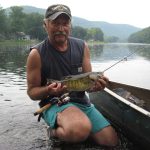
Here, deep in PennsylvaniaÄ¢¹½ÊÓƵ southwest corner, we encounter the phrase “Three Riversâ€� often. Of the three rivers referred to, we’re most familiar with the Monongahela. And if you’ve ever flown out of Pittsburgh International, blessed with clear weather and a window seat, you gaped at a long span of the upper Ohio. The third stream in the trio is the one least known to most of us here–the Allegheny.
When we do see the AlleghenyÄ¢¹½ÊÓƵ lower reaches approaching PittsburghÄ¢¹½ÊÓƵ Point, or from the Turnpike bridge north of the city, those familiar views tell little of this riverÄ¢¹½ÊÓƵ character along its length.
The Allegheny rises from springs in Potter County, Pennsylvania and swells as it flows 325 miles west and south to Pittsburgh, wandering into western New York along the way. For most of that journey the Allegheny flows past high forested bluffs, courses among lush islands, and slides by narrow strips of farmland and small towns constrained by the hills. Seasonal camps and cabins sprinkle the slopes where families, happy to have such a refuge, gather at evening campfires.
Almost 90 miles of the upper Allegheny are designated a National Recreational River as part of the National Wild and Scenic Rivers program. Some of the more remote and appealing stretches flow through the Allegheny National Forest or past vast tracts of state game lands.
The Allegheny embraces one of the most unusual designated wilderness tracts in the entire nation. A string of seven islands, centered at the Warren County town of Tidioute and totaling about 400 acres, are recognized as the Allegheny Islands National Wilderness. Camping on those islands you can hear traffic along Route 62 above the riverÄ¢¹½ÊÓƵ east bank, but the islands themselves are officially wild.
Water quality along the Allegheny is generally good, and fish show none of the mysterious maladies like tumors, random black blotches and female hormones in male fish that plague smallmouth bass in the Susquehanna River, attributable most likely to persistent pollution. Allegheny River anglers catch smallmouth, northern pike, muskellunge, catfish, walleye, and even big brown and rainbow trout in the colder waters just downstream from the Kinzua Dam.
Public access points for boaters are numerous along the Allegheny, especially in the upper stretches through the national forest. And the Allegheny is a family-friendly stream. Kayaks and canoes can glide for dozens of miles, for days at a time on overnight campouts, on a current thatÄ¢¹½ÊÓƵ steady and strong but almost entirely lacking whitewater. There is a tricky plunge just below Warren, and a moderate rapid under the bridge at Oil City. Otherwise itÄ¢¹½ÊÓƵ an entirely placid route.
A close friend of mine, Jim Schafer, passed away suddenly last summer but he’d documented the AlleghenyÄ¢¹½ÊÓƵ diversity and beauty with his photographs in the book: “The Allegheny River; Watershed of a Nation,â€� published by Penn State Press. JimÄ¢¹½ÊÓƵ family had owned a camp on the river near President, Forest County through his entire early life and he loved the AlleghenyÄ¢¹½ÊÓƵ secluded stretches, the little towns tucked into hollows, and the people drawn to it. His photographs show that affection.
Few places in America are so steeped in history as the Allegheny Valley. It started with Native people. The Seneca, who still make their home on the riverÄ¢¹½ÊÓƵ upper reaches, considered the Allegheny and Ohio as one river. They saw our Monongahela as a tributary to that one long stream.
The French who explored and traded in the region in the 1740s called the Allegheny “La Belle Riviere� (Beautiful River).
George Washington, led by Christopher Gist who carved out a plantation near Mt. Braddock, ascended the Allegheny in 1753 to inform the French they were trespassing on EnglandÄ¢¹½ÊÓƵ domain. They were unimpressed and the French and Indian War flared the following spring, right here in Fayette County.
The Allegheny River also played a poorly understood role in the American Revolution 25 years later. In 1779, Washington, then heading American armies, sent Col. Brodhead with 600 men up the Allegheny from Fort Pitt to destroy Seneca towns and crops as punishment for their British alliance. Brodhead reported to Washington that he had encountered a war party of 30 to 40 Seneca in canoes and routed them in pitched battle. That event is known today as The Battle of ThompsonÄ¢¹½ÊÓƵ Island, and an historical marker stands along Rte. 62 south of Warren commemorating the incident.
But the results of an archaeological investigation last summer, funded by the National Park Service, American Battlefield Protection Program, cast doubt on BrodheadÄ¢¹½ÊÓƵ account. Investigators now believe that BrodheadÄ¢¹½ÊÓƵ advance guard somehow surprised or duped a Seneca hunting party of 10 or 12, opening fire before the Indians were prepared to fight.
A mere 72 years later the Allegheny Valley hosted one of the most significant and far-reaching events in all of human history. In August 1859 the first commercially viable petroleum well in the world struck oil at Titusville, Pennsylvania, 14 miles up Oil Creek from the Allegheny River.
The next time you view the AlleghenyÄ¢¹½ÊÓƵ slack flow at PittsburghÄ¢¹½ÊÓƵ Point, consider the riverÄ¢¹½ÊÓƵ long journey, across the land and through time.