

Best advice for fly-fishing: Take all your gear
A column about trout fishing, in the middle of deer season, may seem misplaced. But what is more misplaced than the weather we’re having? Shouldn’t those specks in the air be flurries instead of gnats and mosquitoes?
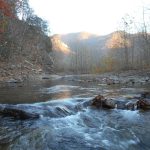
Just before Thanksgiving the weather was especially mild and, I’ll say it, “beautiful.” A friend and I had an opportunity to go trout fishing in West VirginiaĢ¹½ÊÓƵ rugged Potomac Highlands, a short drive south from Uniontown. My friend, who had just returned from a trip in the West, surveyed the craggy skyline, the up-thrusted sandstone summits, and swaths of green pine and golden oak forest as I drove the truck northeast along Rte. 28 from Seneca Rocks.
“You know,” he said. “There is really nothing in the Rocky Mountains that compares to this.”
His observation pleased me since I had talked him into coming along.
We’d rented a little cabin along the North Fork of the South Branch of the Potomac River. To my knowledge, it is only in the Mountain State that stream names are so finely sub-divided in this way. Some find it confusing but I like it for the way it ties a watershed together in your mind. It gives you a sense of where you are, and where the water you’re fishing is headed.
My friend had never fished with fly tackle, which was the tripĢ¹½ÊÓƵ objective. He was incessantly curious, though, asking questions as we drove.
One bit of wisdom I shared turned out to be entirely wrong.
“This time of year, you won’t do any of whatĢ¹½ÊÓƵ considered ‘classic’ fly-fishing,” I reflected. “ItĢ¹½ÊÓƵ too late for insect hatches, so we won’t try to imitate those. We’ll just drift egg patterns, nymphs or San Juan worms; maybe strip some streamers and hope we catch a few fish.”
My friend was beginning to learn that fly-fishing is not always the mystical pursuit it is often cracked up to be. He found it amusing that fly fishermen actually use flies tied to imitate salmon eggs and worms, the same attractants that bait fishermen are sometimes chided for deploying. And he belted out a hardy guffaw when I told him that fly anglers also use bobbers, but they never call them such. “To a fly fisherman, this little round float is not a bobber. ItĢ¹½ÊÓƵ strike indicator,” I confided.
“I feel like I can do this now,” he replied. “It seems less mysterious.”
“ThatĢ¹½ÊÓƵ a great first step,” I affirmed.
What I did not tell my friend is that I had gone through my fishing vest and removed all my boxes of dry flies. These are the flies that do, in fact, imitate natural insects. You cast them out on wispy-thin leaders in hopes that a trout will rise and engulf the fly during its drift downstream. Typically, but not always, itĢ¹½ÊÓƵ a spring and summer approach. For late November, high in the mountains, I considered these a distraction, needless bulk.
On the first evening, we caught three or four trout by the decidedly non-classic tactics I’d described and we both felt the trip a success. But frustration lay ahead.
The next day dawned clear and warm. Sun shone on the pebbly stream bottom through water as clear as top-shelf gin.
It was a pleasure to be out but we couldn’t coax a strike. We drifted nymphs, yellow egg flies, red eggs, “sucker spawn,” which is a fly tied to look like pink eggs clumped together, and worked some streamers in the faster currents. Nothing.
Meanwhile, trout were rising all around us. They boiled the surface with abandon, within inches of our waders, gulping something so small we couldn’t see it. Whatever it was, the trout wanted nothing else on that warm and sun-drenched autumn day.
A few big clumsy dry flies still stuck in the felt patch on my vest from earlier outings. I tried each one, and each was ignored.
Finally, in mid-afternoon with the frenzy ongoing but the sun striking from a different angle, I could see hundreds of tiny pale-blue mayflies riding the surface film. These insects were what fly fishermen call the Blue-winged Olive, known to hatch later, and earlier, in the year than other mayflies. But I had never seen them anywhere in such numbers.
“I hate to tell you this but there are dozens of flies just like that in one of the boxes stacked up in my basement,” I lamented to my friend. “I took them out of my vest before we left. If we had those right now we could have some great fishing.”
That night I pored through all the pockets of my vest and found one overlooked plastic container holding a half-dozen Adams dry flies. The Adams is a generalist, “catch-all” pattern, tied to replicate nothing, but loosely simulate a lot of things. These were tied in size 20, a little bigger than the naturals on the river, but not by much. Fortunately, I had not removed my lightweight leaders with the fly boxes.
The next and final day of our trip was a copy of its predecessor. The olives started swarming about 10:00 a.m. and trout soon rose all over the river.
We cast out the Adams with high hopes, and trout rose to them, assessed the fakes, then turned back down in refusal.
But three or four times we got lucky and nice-size trout accepted our offerings, sipping them under. It took a long time to net these fish on the light leaders required to fool them, which was, itself, enjoyable.
Driving home we agreed that the best bit of fly-fishing advice is to take along all your gear.