

Native smallmouth a worthy fish
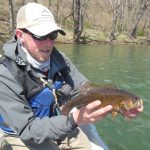
I learned a lot by attending the Youghiogheny River Symposium held June 24th at Penn StateÄ¢¹½ÊÓƵ Eberly Fayette Campus, including the need to pay more attention to smallmouth bass.
Smallmouth bass, Fish and Boat Commission biologists reported, have made an impressive comeback in the Yough. When they surveyed the river recently, deploying electro-shocking equipment from floating rafts, they turned up far more, and bigger, bass than in surveys done in 1994.
The biologists noted astonishing smallmouth bass populations from the Youghiogheny Reservoir outflow at Confluence, all the way to the riverÄ¢¹½ÊÓƵ mouth at McKeesport. ThatÄ¢¹½ÊÓƵ a lot of fishery.
Surprisingly, though we fished often, we never paid much attention to smallmouth bass when I was a kid. We fished for trout, of course, in the mountain streams and probed a number of farm ponds, Cranberry Glade Lake and Virgin Run Lake for largemouth bass. But smallmouth bass never seemed to get on our “radar,� so to speak.
We should take more pride in the smallmouth bass, and habitats that support it, around here. ThatÄ¢¹½ÊÓƵ because we’re at the heart of the relatively small region (continentally speaking) that can claim the smallmouth bass as a native fish.
Although itÄ¢¹½ÊÓƵ fighting attributes and general appeal have prompted stocking smallmouth all around North America, the fish occurred naturally only in the Ohio River watershed, of which we are a part, and the Great Lakes Basin.
Interestingly, the Susquehanna River in central Pennsylvania came to be known as, perhaps, the nationÄ¢¹½ÊÓƵ premier smallmouth fishery in the 1980s and ’90s, even though the bass never occurred east of the Allegheny Mountains until artificially stocked in the Susquehanna and its tributaries.
Sadly, smallmouth fishing on the Susquehanna has declined over the past decade. Bass reproduction has largely failed and many surviving adult fish display grotesque, unnatural black blotches and tumors. Most scientists studying the decline suspect the SusquehannaÄ¢¹½ÊÓƵ bass have succumbed to endocrine-disrupting pollutants that enter the river system from residential and agricultural herbicides, and hyper-fertility from fertilizers that feed excessive algae blooms and deplete oxygen. Some Susquehanna fishing guides say the bass there show some recent signs of improvement, but scientists aren’t convinced.
Youghiogheny bass, happily, show no such symptoms. Bass here appear healthy and are always scrappy at the end of a line. Anglers catch smallmouth bass on a variety of tackle, ranging from fly-fishing gear to natural baits like crayfish, hellgrammites and minnows. Most anglers who target smallmouth bass use spinning tackle to throw lures that imitate those same natural baits.
Smallmouth and largemouth bass are both members of the sunfish family, closely related to bluegills and crappies. But smallmouth bass are easy to distinguish from the better-known largemouth. Smallmouths show a predominant brownish or bronze color, while largemouths are generally olive-green. Smallmouth bass also exhibit striking red eyes and bold dark stripes across the gill plate. Some anglers, out of respect for the smallmouthÄ¢¹½ÊÓƵ fighting traits, refer to the gill-stripes as “war paint.â€�
The most unmistakable distinguishing mark between largemouth and smallmouth bass is, what else? The mouth.
With its mouth closed, a largemouthÄ¢¹½ÊÓƵ upper lip extends from the snout to a point beyond the eye. On a smallmouth, the upper lip always falls short of the eye when the mouth is closed.
The habitats of the two fish also differ. Largemouth bass prefer the warmer, more sluggish water of ponds, swamps, and slow-moving streams. There they are often found near weeds.
Smallmouth bass are more at home in the cooler waters of fast-flowing streams, like the Youghiogheny River and many of its tributaries. Savvy anglers know smallmouth often hold in the current near prominent rocks, where they wait to ambush prey. There are also large smallmouth populations in the deep, cool waters of Lake Erie.
Three friends and I had, perhaps, the best day of fishing of our lives once several years ago on a stream in northern Pennsylvania. One of our group hosted us at his camp near the Allegheny National Forest, and after a thunderstorm raised the late summer stream levels we launched kayaks 11 miles upstream from a takeout ramp on a stream better known for trout than for bass. We fished all the way to our downstream vehicles, catching smallmouth bass throughout the entire span, some approaching 20 inches. We still recall that day but, somehow, have never organized a repeat expedition.
Closer to home, I accepted an invitation to snorkel dive in a well-known stream in our mountains (not the Yough) last summer and was amazed at the number and size of smallmouth bass that allowed us to swim up close. I have intended to return there this year while the cicadas are still around and fish a cicada-fly imitation but haven’t yet made that trip either. I bet you would have a hard time keeping the bass off the hook. Maybe next time. LetÄ¢¹½ÊÓƵ see, when cicadas return for their next emergence I’ll be……