

Filleting fish no mystery; Right tools help
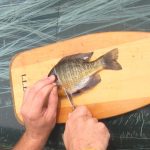
A few days ago, Kathy and I encountered a couple we are friends with at a restaurant in the mountains. While the women chatted about our respective grown kids, the husband and I talked outdoor stuff, mostly fishing. He related that a pond on their property holds some large bluegills, and that he’d decided to harvest some for the table. But he finished by lamenting that he did not know how to fillet these modestly sized (compared to other game species) but tasty, fish.
The ability to fillet fish, especially sunfish such as bluegills, is one of the most rewarding and satisfying outdoor skills an angler in this region can possess. Sunfish are abundant, they are generally easy to catch and they are nearly unequalled as a meal.
I tried to demonstrate there at their table, using a folded napkin to represent the fish but promised I’d follow that up with a column on this skill that is far less difficult than most folks assume.
The right tools will help anyone achieve better results than expected. Too many people try to fillet fish with a pocketknife or hunting blade. Such an approach will discourage trying again. If you want to fillet fish use a real fillet knife, designed for that purpose. One with a 4-inch blade is ideally suited for bluegill-size fish. Good fillet knives are sharp and the blade is flexible, essential for teasing the fillets away from bone.
The other necessary tool is a flat smooth surface on which to work. A dense plastic cutting board is good, as is an old table that you don’t mind gouging or scraping. Canoe paddles make excellent impromptu filleting boards, as does the hull of an overturned canoe. For home use, I built a permanent fish-cleaning surface out of some discarded pieces of composite plastic decking and it works great.
For those new to filleting, I recommend that you scale the fish. Scaling leaves the skin intact but it requires less finesse than removing the skin from the fillet, which you may want to do after you master the basic technique. Fortunately, the skin of sunfish imparts no undesirable taste, so scaling is a “win-win� for beginners. Plus, by retaining the skin your fillet will have a meatier heft to it than one with the skin removed.
To scale a bluegill or other sunfish, simply run a dull knife blade (not your fillet knife) across the fish from tail toward the head, against the grain so to speak. The scales will pop off in a messy blizzard so itÄ¢¹½ÊÓƵ best to do this outdoors.
It will help you to visualize the anatomy before you begin to fillet. Think of the desired fillet as being sandwiched–which it is–by the scales and skin on the outside and the ribcage internally. If you’ve scaled the fish you’ve already dealt with the external obstacle. Your job at that point is to “peel� the fillet away from the ribs.
For some reason, I always fillet the left side of a fish first. I believe it helps to develop such a methodical process.
Once the fish is scaled, use the fillet knife to make a cut immediately behind the gill plate, as if you were cutting off the head, but only as deep as the backbone. When you feel the blade contact the spine, cut no deeper.
Next, turn the blade so that it lies in the same plane as the fish and insert the point into the top of the cut you just made behind the gill plate (pointing “downâ€� from the fishÄ¢¹½ÊÓƵ back).
Carefully cut through the skin at the top of the back, skirting the dorsal fin, all the way back almost to the tail. You can tell you are getting this right if you can feel the bladeÄ¢¹½ÊÓƵ point riding along the “bumpyâ€� backbone as you progress.
Now you have a “flap� of meat that is connected to the fish only at the ribs and belly. Carefully peel the fillet downward, toward the belly, away from the ribs, using the knife to slice between meat and ribs where it “sticks� or “snags.�
Once you get past the ribs, all you need to do is cut through the skin at the belly and you’ve made a fish fillet. Repeat the same process on the other side.
Dip your fillets in beaten egg, then roll them in cornmeal, maybe with some paprika or seafood seasoning. Fry in hot oil for only a minute or two on each side. Season with lemon juice and salt, then try to resist that first bite until the fish has cooled some. You don’t want to ruin a really good thing at that point in the process.