

Fishing companion uninvited, but good at the game
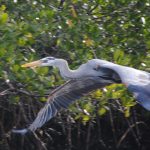
Aligning your schedule with another angler seems more difficult these days. So, generally, I fish alone, snatching an hour or an evening when I can. But lately I’ve had a fishing companion on nearly every outing.
This companion never calls or texts ahead; he, or she, just shows up when the impulse strikes, intent on fishing the same holes or runs that I’m targeting.
He, or she, is a skilled angler, with limitless patience and an uncanny knack for knowing where to fish. My companionÄ¢¹½ÊÓƵ tackle, however, is nothing like mine. Instead of rod and reel she, or he, employs long legs for standing motionless in the stream, a long neck, and a long sharp bill for spearing.
My uninvited cohort is a great blue heron. I’ve been vague about his or her gender because other than the males being marginally larger, great blue heron sexes look exactly alike. So, “It� is its most appropriate pronoun.
I’m accustomed to seeing these large graceful frog-, snake-, and fish-eating birds in swamps, marshes and sluggish sloughs. But the one thatÄ¢¹½ÊÓƵ been fishing with me lately haunts my favorite mountain trout stream, a place you’d expect to encounter a grouse or a turkey, but not so much a blue heron. The path to success in nature is adapting to opportunity, and this heronÄ¢¹½ÊÓƵ a master.
Herons are classed by biologists as “wading� birds. Egrets and bitterns also share that informal label. They stride about in relatively deep water on long agile legs, peering ahead for some disturbance that betrays a fish or frog. Then they station themselves over the spot, motionless, eyes riveted and their long necked coiled back against the breast. When the moment is right the head spears downward, thrusting the long bill into the water. Often that bill emerges grasping a fish.
My heron companion is brash and determined. A few evenings ago I was fishing an appealing pool amid swarming mayflies and gorging trout. I sensed a dark silent presence pass overhead, then watched as the heron settled on a submerged rock at mid-stream, an easy cast away. It stared at me as if it expected me to surrender fishing rights to that premium spot. When I did not surrender it seemed somehow surprised at my bad manners. When I waved both arms to shoo it away it ignored me, and turned its attention to trout.
I like to select words that convey precise meaning, and it occurs to me that there is no more precise way to convey concentration than to say “heron-like.� It stood on its rock like a ceramic statue, eyes trained where a trout was rising in rhythm, intent. But it never struck. The fish must have been just beyond reach of that coiled neck.
Just as suddenly as it appeared it vaulted upward and winged upstream about 30 yards, where it planted itself over a narrow side-current along the bank where I would not have considered fishing.
I missed rise after rise as the trout took my fly because, I’ll rationalize, I was watching the heron as much as the fly.
I almost didn’t see the head spear downward; it was that quick. But I did see the wriggling belly of the bill-gripped trout, bright in the deepening gloom.
Another time I glanced up to see the heron approaching from upstream, its long elegant wings pulsing easily over the frothy backdrop of rapids. It looked huge in silhouette, which is not surprising. Great blue herons are our largest native bird by height. Only the wild turkey, bald eagle and turkey vulture exceed it in weight or wingspan.
It perched on a narrow ledge directly across the flow, a trout already grasped in its yellow bill. Again, the heron stared as if rebuffing my intrusion. Then it maneuvered the fish into head-first alignment and gulped it down.
Great blue herons nest in colonies, generally in forest or on wooded islands. The stateÄ¢¹½ÊÓƵ largest colony in Mercer County holds over 200 nests within an acre or so. I don’t know where this heron nests but the species is known to wander long distances from its roost or nest to feed. Studies have documented the birds roving 35 miles to fishing grounds.
The species was once in peril within Pennsylvania. Ornithologist B. H. Warren stated near the close of the 19th century: “I have no doubt that the time will come when this beautiful heron will be known in this commonwealth only as a rare straggling visitant.�
Warren was wrong. The great blue heron has proven adaptable and opportunistic. Surveys document its numbers in Pennsylvania have risen by 35 percent just since 1993. Roughly 220 known colonies now harbor about 2,700 blue heron nests, mostly in northwestern and northcentral parts of the state.
Many people mistakenly refer to these birds as “cranes.� Cranes are indeed large wading birds, but they’re different from herons. Cranes are rarely–make that all but never–seen around our region, but herons are common. A good tip to know is that cranes fly with their long neck extended straight forward. All herons fly with the neck folded back toward the breast, somewhat like a pelican; unmistakable.