

Carp bias tested on Tenmile
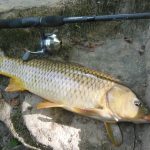
I’ll confess to prejudice — toward a fish. Like most anglers I’ve heard–and accepted — all the negative barbs cast at carp. “Trash fish.” “Mud sucker.” “Pond rat.” And worse.
And I’ve chuckled at that oft repeated carp recipe: “Tack a nice carp to a board, season well, prop up before a slow fire until the flesh flakes, throw away the carp and eat the board.”
But prejudice can morph into respect when you meet its subject face-to-face, or in this case fish-to-line.
Last week a work project placed a number of us along a stretch of Tenmile Creek. I’d harbored some prejudice against Tenmile too, considering it a sluggish and muddy “lowland” stream. But the span just upstream from Mather flows through an appealing gorge where rapids link deep, boulder-studded pools. It could have been a mountain stream, except that big, broad-shouldered carp distracted us much of the time, cruising the pools and sipping drowning cicadas from the surface.
The fish were too large and too numerous to resist returning one evening with friend Rod Temple of Uniontown, rods in hand, but with not much bait. With the cicada emergence at its height, we planned to pluck bait right off the branches.
What became quickly apparent is that carp — say what you will about them — are keenly aware of their surroundings. They cruised about in every pool, but if you advertised your presence they slipped away and never returned to that exact spot. To fool them you had to keep a low profile and minimize movement. That gave you a chance to cast a hook-skewered cicada into a carpĢ¹½ÊÓƵ path.
Another revelation was that carp are as selective in feeding as an esteemed wild brown trout. We did have some of the commercial “paste-baits” that commonly fool stocked trout, but the carp weren’t even tempted. They were cruising for cicadas and would eat nothing else.
They were even selective about their cicadas’ status. They ignored ones whose wings still vibrated, sending out rings of tightly-spaced ripples. But when a carp spotted a cicada that lay still on the surface, it would tip upward, extend its open, round mouth into the surface film, and gulp the bug in.
Two carp gulped in cicadas at the end of my line. When I set the hook my dim view of carp changed, or at least shifted, forever.
No bass, trout or salmon that I have ever caught battled with the brute strength and surprising stamina of those two carp.
The only way to prevent the fish from breaking the 12-pound line was to constantly adjust the reelĢ¹½ÊÓƵ drag, allowing the carp to run against resistance without reaching the lineĢ¹½ÊÓƵ limit. Then, I’d have to tighten the drag, momentarily, in order to gain line back by cranking the reel. Each time the fish ran the reelĢ¹½ÊÓƵ squeal rivaled the cicada song from surrounding woods.
Unlike the cicadas they like to gulp, carp are not native to North America. Carp were brought to America from Asia early in the 19th century and promoted as a food fish, which never got traction here as it has in Europe, where carp were farmed as a food source as far back as the Roman Empire, and where it is still revered as high cuisine.
In the 1880s and ’90s, because carp are tolerant of marginal water quality, many fisheries agencies stocked them to replace declining populations of native game fish. And, like many exotic animal and plant species, carp reproduced unchecked in the absence of enemies and dominated aquatic habitats around this country and the world. One female carp can lay 300,000 eggs during the spring spawn. Like them or not, carp are one of the most successful fishes that swim.
The common carp, the species we caught in Tenmile, has been known to reach weights of 80 pounds. Yet, every carp, even an 80-pounder, is a minnow throughout its life. Often used incorrectly, the term “minnow” actually has nothing to do with a fishĢ¹½ÊÓƵ age. Carp, as well as goldfish, squawfish, shiners, fallfish and chubs, belong to the “Minnow” family of fishes — known to biologists as Cyprinidae.
To entirely overcome my carp prejudice, I’ll have to work on seeing carp as “attractive” in the way I view wild trout, but they are large, strong fish, challenging to approach and hook. In a way, what more can you ask from fishing after work and close to home?