

Wood warblers: Beautiful, diverse and abundant but under-appreciated
Spring offers so many outdoor delights that it can be tough to choose which merits whatever free time you can devote to pleasure and relaxation. Lots of outdoor folks in our area hunt turkeys in the spring, others fish for trout. Another ardent element does their hunting with a penknife and a sack — for morel mushrooms. Some more adventurous foragers glean ramps, dandelion, pokeweed and other wild edibles from the greening woods.
Still, thereÄ¢¹½ÊÓƵ another springtime diversion that I like to enjoy when I have an early morning free and conditions are right — meaning clear weather and little wind. Then, I’ll dress in neutral colors, or even camo, carry a pair of good binoculars that can focus clearly at close range, hike to some remote spot in the mountains and observe birds.
Our mountain forests are the perfect setting to see a great variety of interesting birds. But at this time of year, the loosely classed family known as the wood warblers are the most rewarding to seek. Few parts of North America harbor so diverse an assembly of these colorful migrants as our own stretch of the Allegheny Mountains.
I once did a talk as part of a series of presentations for the Fayette County Cultural Trust at the Connellsville Canteen. The idea of the series, presented by several speakers, was to communicate a sense of pride in various aspects of Fayette CountyÄ¢¹½ÊÓƵ historical, industrial and natural heritage. I spoke about the Laurel Highlands’ unusual diversity of native plants and birds. Researching the material I learned that over two dozen species of wood warblers migrate back to FayetteÄ¢¹½ÊÓƵ ridges every spring from wintering grounds in Central and South America to nest. Few parts of the continent can match that diversity.
All the wood warblers are small (about like a common sparrow or smaller), colorful, insect-eating, highly maneuverable flyers that flit around the tree canopy something like the steel balls in an old-time pinball machine. They rarely sit still for more than a second or two; they’re always zipping off to snatch a gnat, before settling briefly on another branch. Rarely — hardly ever — do you get a really good look at one, holding still, in the open, with the light cast favorably so that you can admire the varied plumage.
At the Connellsville Canteen, I devised what I considered a clever game to convey how difficult it can be to identify these largely uncooperative birds. I had my daughter buy me several packs of bright gold-colored tennis balls. On these, with a black marker, I drew various designs and markings. Then I asked the guests at the Canteen to toss the balls around the room, holding them still and visible for only a second before tossing them to another guest. The object was to identify the pattern on the ball during their brief stints of inactivity. Watching and identifying wood warblers in a forest is like that.
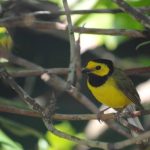
Most warblers are some combination of gold and black, green and black, blue and black, or some blend of those hues. For several years a male hooded warbler spent lots of time in a rhododendron bush right outside our back window at home. My wife called it her “Steeler Bird,� because of its jet-black hood caped over a gold face and throat.
Some warblers, though, exhibit a completely different suite of colors than those cited above. The American redstart, for example, flashes crimson red against deep black.
And the ovenbird sports drab plumage of brown and gray. ThereÄ¢¹½ÊÓƵ a reason for that, however. Unlike most other warblers, which inhabit the treetops, or at least the shrub layer beneath, the ovenbird nests on the ground.
Many warblers’ names are descriptive and betray something about their appearance. As mentioned, thereÄ¢¹½ÊÓƵ the hooded warbler, and the black-throated green warbler, the black-throated blue warbler, the black-and-white warbler, chestnut-sided warbler, yellow-throated warbler, and many others.
The one thing that all these birds have in common is that they need forest, both here on their nesting grounds and in their wintering grounds in the tropical south. As forest disappears, or is too severely fragmented, the warblers disappear.
As noted, it can be difficult to get a good look at these birds for identification, especially when you’re looking straight up and the warblers are silhouetted against the sky, which obscures their color. A good strategy is to get in some elevated position, such as on a cliff or rock ledge thatÄ¢¹½ÊÓƵ nearly the height of the nearby trees. From there you can often observe warblers at eye-level, where their colors are clearly apparent.
The two dozen or so species of wood warblers that nest in our woodlands are just one more element among this regionÄ¢¹½ÊÓƵ amazingly diverse natural heritage.
There are a number of good guidebooks available to help you learn to know these birds, and there is no shortage of places nearby to see them. Ohiopyle State Park offers excellent habitat and lots of good viewing sites.
The convenient overlook at Baughman Rocks on Sugarloaf Road is a good place to look for warblers if you don’t want to hike into the woods. Often they’re visible just beyond the safety rails, with the Youghiogheny Gorge in the background.
Well worth a visit.