

Talented minor-league system bodes well for Pirates’ future
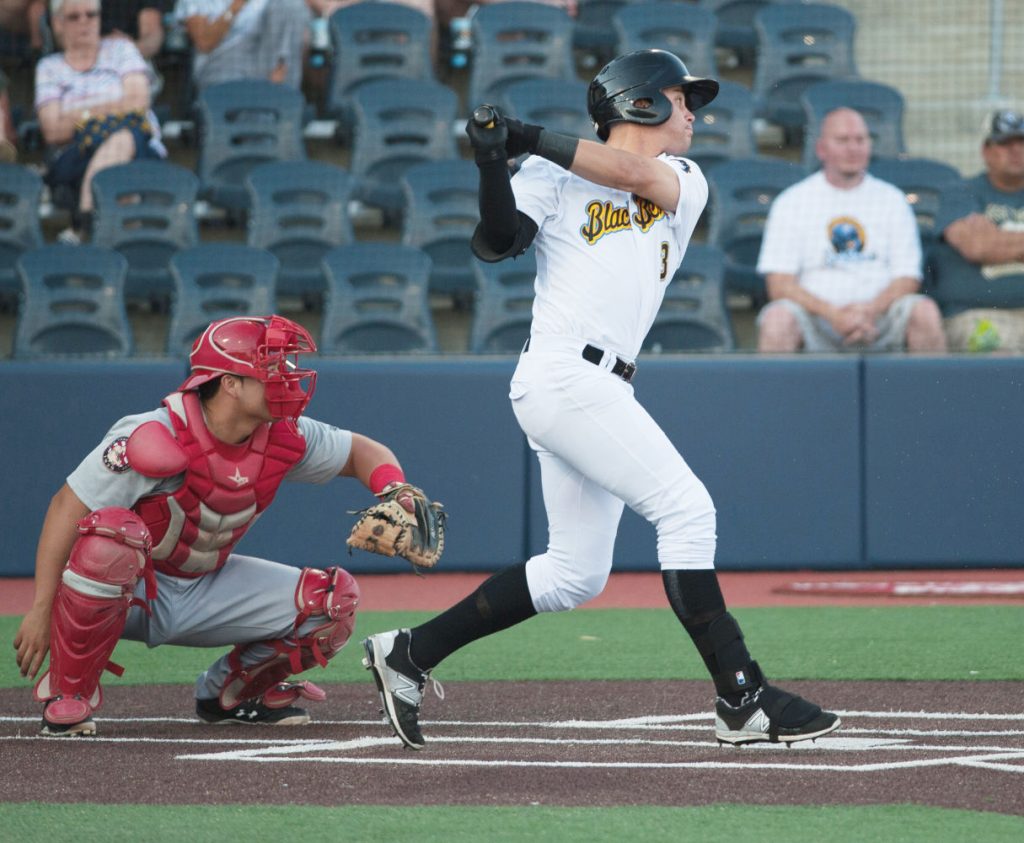
Holly Tonini
Pittsburgh Pirates prospect Kevin Kramer hits a two-run double for the West Virginia Black Bears against the Auburn DoubleDays during a game last season in Morgantown. Kramer is playing for the Bradenton Marauders, the Pirates’ Class A-advanced league, this season.
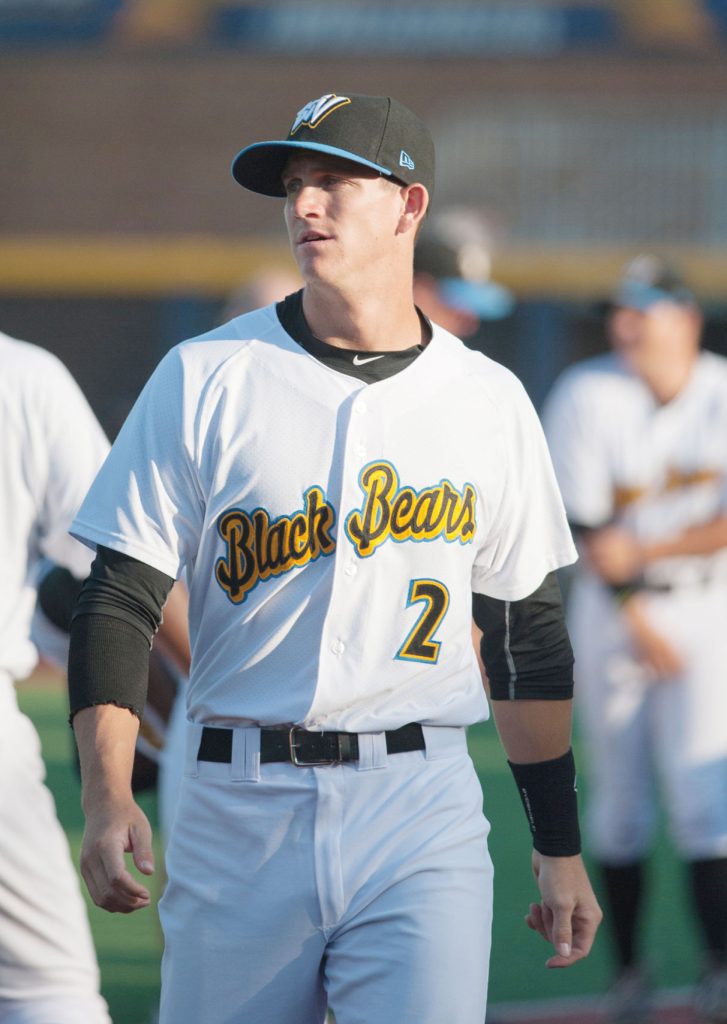
Holly Tonini
Pittsburgh Pirates 2015 first-round draft pick Kevin Newman warms up with Class A affiliate West Virginia Black Bears before a game against the Auburn DoubleDays in Morgantown last season. Newman is playing for the Bradenton Marauders, the Pirates' Class A-advanced league, this season.
Even the most casual of Pittsburgh Pirates fans have heard about them.
Simultaneously billed as both the future of the club and saviors of its present, names such as Tyler Glasnow, Jameson Taillon and Josh Bell can be heard brandied about as solutions rather than the question marks they actually are.
But, as far as question marks go, the Pittsburgh Pirates have some good ones.
The fact is, prospects are called prospects for a reason. Many an over-hyped young arm or hulking power hitter come and go without realizing their potential. As talent evaluators, major league scouts and general managers can simply use the tools at their disposal to load their systems with the best bets possible.
One look up and down the entire Pirates minor league system, and you would swear that the club is playing with house money.
LetÄ¢¹½ÊÓƵ begin at the lower levels. Based out of Pirates headquarters, the Braden Marauders club is home to the “Seinfeld Infield,â€� with both Kramer and Newman in tow. ThatÄ¢¹½ÊÓƵ Kevin Kramer and Kevin Newman, both multi-positional infielders. Both were drafted out of college, and both spent the entirety of 2015 with the West Virginia Black Bears, who brought a New York Penn League championship to Morgantown in the teamÄ¢¹½ÊÓƵ inaugural season.
The Pirates place a premium on infield defense. ItÄ¢¹½ÊÓƵ no coincidence, then, that these two stayed together as they advance a level. That should continue, and the duo should have natural fielding chemistry to go along with promising contact bats.
LetÄ¢¹½ÊÓƵ stay in West Virginia, but hop over to Charleston with the West Virginia Power. The youth movement is well served with 19-yeaold Ke’Bryan Hayes. If the last name is familiar to you, you might be thinking of Charlie Hayes, a 13-year MLB veteran who spent half a season in Pittsburgh in 1996. Ke’Bryan represents a second generation of baseball talent in the Hayes family, and already displays a patient bat that belies his age.
“I’m just trying to take what the pitcher will give me.� Hayes said last year when he, too, won a championship with the Black Bears as an 18-year old. He wasn’t lying. He worked back from an 0-2 count three times on that night to go 3-for-4, and that patience has not left him as he jumped up a level over the off-season.
The Double-A Altoona Curve carry two high-level prospects of their own. Reese McGuire and Austin Meadows represent the future of the catching and outfield positions for the Pirates. Meadows is well regarded in particular, ranked No. 2 overall in the Pirates’ entire system, according to MLBPIpeline.com.
The left-handed hitter is still figuring things out at the plate, but projects to slide right into the PNC Park outfield in 2019, a convenient time frame that matches up with a certain MVPÄ¢¹½ÊÓƵ expiring contract. His skillset leans towards profiling as a contact hitter, but scouts are confident power will show up as well.
McGuire already has the defensive tools of an MLB catcher, and many believe once his bat catches up, he can get to the big leagues sooner than expected. With Francsico Cervelli signing a three-year extension, the club can now take itÄ¢¹½ÊÓƵ time with the 21 year-old fifth-ranked prospect.
McGuire and Meadows steal the headlines, but another name is capturing fans’ imaginations.
Brandon Waddell has gone from winning the deciding game in the 2015 College World Series for his Virginia Cavaliers to pitching for the Curve in under a calendar year. That sort of breakneck pace is nearly unheard of, but Waddell has shown to be able to answer the bell. The left-hander is already 3-0 with a 2.41 ERA in Altoona, showing an ability to remain consistent despite facing a new level of hitting. When I talked to Waddell recently, he let me in on something the Pirates practice that has made his incredible transition much easier.
“One thing the Pirates do is they keep the communication consistent from level-to-level. You work on the same things here in Altoona that you do down in Bradenton. That makes it very easy to succeed,� Waddell said.
Of course, any talk about the Pittsburgh Pirates’ farm system is more or less a preamble before turning your eyes towards the Indianapolis Indians.
The talent level seen regularly at Victory Field in Indianapolis is rather historic. Going into this week, the Triple-A rotation was on pace to hold the single-lowest ERA — 2.72 — of any pitching staff, be it at the Pirates’ Triple-A level or in the Indianapolis Indians’ history.
Leading the way are Glasnow and Taillon, but another hurler is content to pitch in their considerable shadows and make his own name. Right hander Chad Kuhl can claim the lowest ERA of the trio at 0.91, and has only allowed 22 hits in 39.2 innings. A nearly-invisible 0.76 WHIP (walks and hits per inning pitches) tells the tale of a pitcher who has remained in control through his entire time on the cusp of the big league club.
Glasnow was always a heralded prospect, but it was his tear through Altoona in 2015 that vaulted him to MLB PipelineÄ¢¹½ÊÓƵ ranking of ninth overall prospect in all of baseball. GlasnowÄ¢¹½ÊÓƵ missive in 2016 was to develop his change-up, and has done just that. He has came as advertised, with a 2.05 ERA in 44 innings with the Indians. He is averaging 11 strikeouts-per-nine innings, and his strikeouts come in a variety of ways. Able to drop his hammer curveball at any time, Glasnow shows a natural affinity for the craft of pitching.
TaillonÄ¢¹½ÊÓƵ story is a unique one. Going down to Tommy John surgery in 2014 as many pitchers have before him, TaillonÄ¢¹½ÊÓƵ comeback was beset by a hernia injury in 2015. At the teamÄ¢¹½ÊÓƵ annual Piratesfest convention in December of last year, Taillon was quoted as saying that he was excited for a “normalâ€� offseason after these setbacks.
The regular schedule has clearly done him well, as he has somehow managed to look even better than his rotation mate. As unbelievable as it may sound, his 2.08 ERA does not do his performance justice. Pre-injury, TaillonÄ¢¹½ÊÓƵ reputation was always dinged by his lack of control, but this year is walking just one batter per nine innings, down from 3.9 in his last stint with the Indians.
Both Glasnow and Taillon will make appearances for the Pirates in 2016, and the continued struggles of Juan Nicasio and Jeff Locke may accelerate their timelines.
Long thought to be a long-term solution in the outfield Josh Bell signed the largest signing bonus of any Pirates’ draftee, and was switched to first base two years ago. The teamÄ¢¹½ÊÓƵ third-ranked switch-hitting prospect has taken up the mantle of a complete hitter, one that is able to hit for power as well as consistent contact. While the power has not yet fully developed, he has shown an ability to drive the ball and find gaps, giving scouts every bit of confidence that he will eventually find the 20-plus home run stroke.
After some initial challenges, Bell has found his footing at first base and should be ready to serve on the big league club at the start of 2017. Though he may initially platoon with incumbent John Jaso, Bell is clearly the teamÄ¢¹½ÊÓƵ future at the position.
Small market teams such as the Pittsburgh Pirates must carefully balance their farm system in order to remain a steady window of competitiveness. What sets the Pirates apart is their ability to time these arrivals to coincide with their major league contract initiatives.
Other teams bring up their prospects in dribs and drabs, but the Pittsburgh Pirates will soon open the floodgates and infuse the major league club with a large dose of intriguing talent.