

For visitors: Rare insights at mountain retreat
Good friends of ours live on an old farm on the flank of Mt. Davis, PennsylvaniaÄ¢¹½ÊÓƵ highest point. They moved here from Lancaster County 25 years ago, drawn to the mountain landscape and the chance to live simply, interacting daily with the natural world.
Gregarious folks, they invite us “over the mountain and across the river,� meaning Laurel Ridge and the Yough, often for impromptu get-togethers. On each visit, a little of their lifestyle rubs off. We’ve swam in cold clean streams, absorbed sunsets over the Fayette County ridges, shared “grew it and slew it� feasts gleaned through hunting, fishing, foraging and gardening, and met a diverse collection of interesting people.
In recent years our friends have developed several options for paying guests also to spend time at their homestead. The most popular option is, to my knowledge, this regionÄ¢¹½ÊÓƵ only “Glampingâ€� experience. “Glampingâ€� is camping for those not ready, or willing, to camp on natureÄ¢¹½ÊÓƵ terms. The “Glamping Siteâ€� features a roomy wall-tent over a wood floor, with a vast cozy bed, running hot water, an open-air antique tub for bathing under the brilliant stars and a semi-outdoor kitchen. It all looks “primitiveâ€� but offers every comfort.
Glamping guests, through on-line prospecting, find their way to the farm on Mt. Davis from all over America, much of Europe, Israel, parts of Africa and Asia. Our friends say their guests marvel most at the sunsets. Facing west, toward Fayette County, glampers watch the waning daylight blaze over Confluence and the canyon-like Youghiogheny Gorge.
An array of wildlife also captivates glampers. Many are from urban backgrounds, unfamiliar with our local fauna.
Inquisitive guests have asked our friends to identify the big dark birds that parade through the meadow (wild turkeys), marveled at does nursing fawns, posted on-line encounters with weasels in a rock pile and adopted a protective air toward the doves and wrens that nest around the rustic structures.
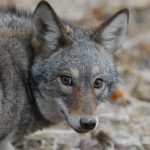
Some glampers, though, are unnerved by the wild things. Nearly all ask about bears, which do amble through on occasion. Some have called our friends in the middle of the night (their log home is a short walk away) when disturbed by hooting owls, swooping bats or any number of alien sounds. But the most anxious fears arise when a chorus of howls erupts at dusk from surrounding woods–the call of coyotes.
Our friends are surprised by the dread that coyotes incite in those who have never before heard their yodeling. They always inform their guests, quite correctly, that there is little to fear from these secretive predators. Furthermore, the hosts explain, if the guests have traveled here from an American city, they live close to coyotes every day and night, but can’t hear them amid the urban din. This straightforward assurance settles most folks’ qualms, and they go on to enjoy their stay then regale friends back home with tales of the wild Alleghenies.
One evening last week our friends invited a small group to a potluck supper on the deck of a woodland cottage they also rent to tourists. The deck is a natural gathering place. It draws guests from the modest but comfortable cabin out to the forest canopy. Maples, walnuts, oaks and spruce stand all around, extending their branches over all assembled. Deep shade and cool breezes are welcome refuge from the dayÄ¢¹½ÊÓƵ heat. Bird feeders hang all about for the guests’ entertainment.
As the sunset dimmed, we’d finished off my ground-venison-stuffed hot banana peppers in tomato sauce and started on the grilled zucchini and deer steaks. It was then that the wild chorus arose. Coyotes yelped all around the cabin, first as singles and then the whole family pack in unison. They were near, nearer than you normally hear them. You had to admit; the songs’ wild abandon carried a hair-raising element up out of the darkness. Imagine, I thought, the emotions that chorus would prompt if you were here, far from familiar city surroundings, and heard that cry for the very first time. It would be unnerving, but exhilarating, something to always remember and be glad you’d heard.
The coyote chorus died suddenly, as it had risen. After our last admiring comments, someone caught a flash of movement among the branches, then a scrabbling sound and one of the bird feeders swayed and rocked above the porch. We trained a flashlight on the feeder and some of us squealed in delight. A flying squirrel had soared out of the woods to make a meal of sunflower seeds meant for chickadees. It clung to the feeder, gnawing the kernels out of the hulls, unconcerned with our lights and attention.
Biologists say that flying squirrels are among the most abundant mammals in local forests (the southern species, that is; the northern flying squirrel is quite rare here). Yet, this was the first flying squirrel most of the group had ever seen. Flying squirrels, like coyotes, are most active at night but they don’t howl and yelp so we never know they’re there.
“Happens all the time,� said our host. “There would be more if we weren’t talking so much. Some guests really enjoy them. Others are afraid, at least at first, but they always tell us about them as they’re leaving. They thank us for the chance to see such things.�