

Male grouse with attitude draws a line in the woods
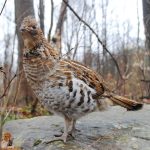
Mundane would be a good word to describe most text messages. But occasionally a standout dispatch will appear on that illuminated screen — like this one from a friend who lives on the shoulder of Mount Davis in Somerset County: “Aggressive grouse here. Come over and see him when you can.�
So, last Saturday, despite the chilly drizzle, I packed the camera and drove over Laurel Mountain then up the Whites Creek Valley to my friendÄ¢¹½ÊÓƵ old farm. He instructed me to climb into the utility vehicle he uses for working around the place and we wheeled through mud and among rocks to where this confrontational grouse hangs out.
“I think the chugging motor attracts him,� remarked my friend.
This made sense as I noticed that the noise resembled the concussive sound of a male grouseÄ¢¹½ÊÓƵ wingbeats as it “drumsâ€� on a log to attract a mate. If you have not heard this sound, it begins as a slow rhythmic beating, then accelerates to a rapid whir. The sound is caused by air rushing into the vacuum around the whirring wings — the way lightning creates thunder. When a hen grouse hears this, she evaluates the performance and, if she likes what she hears, approaches the drummer.
Male grouse, though, will not tolerate another male in their proximity. In spring, males stake out a territory — about six to 10 acres in good grouse habitat — and drum to lure females while banishing any lurking love-competitors, with violence if necessary.
In this odd case, the resident drummer must have interpreted two graying humans in a woods-buggy as a competing intruder. When the motor fell silent the grouse strode out of a thicket, plumage puffed up and spoiling for trouble. He paced all around the vehicle, murmuring faint clucks that were likely grouse insults.
My friend then encouraged me to exit the buggy, and when I did the grouse got serious. I lay prone on the dampness to take photos and the bird pranced right at my face, jerking his head and bristling the black ruff at his shoulders that earns his species its full title — ruffed grouse.
When I reached a hand toward the bird it bit my finger with surprising force, then leaped and beat me around the face with its wings, holding onto my flesh with its beak. It hurt like heck! After snapping pictures, I clambered back in the buggy, my friend chuckling at my retreat.
HeÄ¢¹½ÊÓƵ continued to text me since the encounter: “Grouse still here, attacked me at the barn,â€� and similar accounts.
Such behavior in male ruffed grouse is not otherwise unknown but it is unusual. Normally, in our region, grouse are elusive and secretive. A typical grouse encounter happens when the unseen bird erupts in a noisy flush, then disappears just as fast amid thick cover. Grouse hunters have that fleeting fraction of a second to find the bird, swing the gun and down their quarry. ItÄ¢¹½ÊÓƵ one of the toughest challenges in outdoor endeavors.
But occasionally males become “aggressively territorial� as the grouse-conservation-group, The Ruffed Grouse Society, explains on its website. When this happens, the hyper-possessive male will confront any approaching animal, human or machine and demonstrate its claim to that turf.
In one of his nature columns, writer and biologist Scott Shalaway, of Cameron, West Virginia, describes a male grouse that would perch on the shotgun barrel of turkey hunters in its effort to drive them away.
ItÄ¢¹½ÊÓƵ possible that this aggressive behavior remains rare in ruffed grouse because those males that adopt it don’t live long enough to pass on their personality traits to offspring. Imagine the outcome if a confrontational cock grouse attacked a bobcat or coyote. It would be a quick end to his genetic potential.
The ruffed grouse, of course, is PennsylvaniaÄ¢¹½ÊÓƵ official state bird. I remember fishing the trout streams in our local mountains amid the sound of drumming grouse all day long. Sadly, anglers seldom enjoy such a treat today. Grouse numbers have declined in the past decade or so, for a wide range of reasons, one of which is West Nile virus. Biologists with the Game Commission have demonstrated that West Nile now occurs frequently in Pennsylvania grouse, spread by bites from carrier-insects, and that most grouse succumb soon after infection.
Some grouse, though, do show resistance. Hopefully, with good habitat management for grouse — which involves forest disturbance such as well-planned cutting or fire — this beautiful and surprising forest bird can maintain its numbers. It was good to see one up close and personal, even at the price of a grouse-gouged finger.