

Deer diseases: The bad and the worse
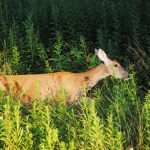
With the hunting seasons approaching, hunters should be armed with the facts about the various diseases plaguing white-tailed deer.
A Pittsburgh daily newspaper reported this week that the Pennsylvania Game Commission is investigating a disease outbreak thatÄ¢¹½ÊÓƵ killed at least 150 deer in recent days in Allegheny, Beaver and Washington counties, and more deaths are expected.
Game Commission officials are quoted in the story as saying they believe the deaths result from epizootic hemorrhagic disease (EHD). Tests on the dead deer are not yet final but all signs point to EHD as the cause. The disease is sometimes called “bluetongue.�
Hunters in our area will recall two or more outbreaks of EHD in Fayette and Greene counties several years ago. EHD is caused by the bite of an infected fly-like insect called a midge. The insects feed by biting through the skin of victims and extracting a small amount of blood. The EHD virus is transmitted during the bite. Deer so bitten begin to lose blood and fluids through body openings. Infected deer become emaciated and die within five to 10 days of the bite. Many are known to seek water as the disease progresses.
Although EHD can cause extensive mortality in deer herds, the impact on the population is temporary. The vector midges die off with the first frost and natural reproduction can restore herds because the sickness cannot be spread from deer to deer. Humans cannot contract EHD, although various breeds of livestock can be infected.
It is important for hunters to know that EHD is not the same — is not related in any way — to the far more serious (from an ecological and population standpoint) malady of deer known as chronic wasting disease (CWD).
Chronic wasting disease has so far never been documented in Fayette, Greene, Washington or any county in southwestern Pennsylvania.
However, and unfortunately, the highest known concentration of CWD-infected deer in Pennsylvania is not far away. Several dozen CWD-infected deer have been detected about 60 miles east of Uniontown along the I-99/Rte. 220 corridor in Bedford and Blair counties. In response, the Game Commission established a Disease Management Area around the infectionÄ¢¹½ÊÓƵ center of concentration. The Disease Management Area does extend into eastern Somerset County, but no CWD-positive deer have so far been found in Somerset.
Chronic wasting disease is an always fatal brain condition that can infect all species of deer, elk, moose and caribou. Unlike EHD, there is no insect vector involved. CWD is spread by deer-to-deer contact or by deer contacting the urine, feces or saliva or an infected deer. Consequently, in areas of high deer density, or within captive herds, the potential for spread is heightened.
Game Commission officials have conducted targeted deer removals — by shooting over bait — in limited areas around where CWD-positive deer have been found. More removals are planned. Reducing deer densities where the disease has shown up is the only known way to even retard its spread.
Still poorly understood, CWD results from abnormal proteins called “prions,� which cause the brain tissue to become spongey and riddled with holes. Infected deer can carry the disease for years before they begin to show symptoms, contacting other deer and shedding prions in their droppings and urine. But CWD is always fatal in the end. There is no way to test a deer for CWD while it is alive. To test for CWD, veterinarians and technicians remove parts of the brain from deer killed on roads or by hunters.
As the disease advances, deer become disoriented and confused, may lose their fear of humans and may tremble uncontrollably.
Special rules are in place within Disease Management Areas established to retard the spread of CWD. Hunters who kill a deer within a Disease Management Area may not transport the animal intact beyond the DMA boundaries. The meat may be transported but all “high-risk� parts must be removed. High-risk parts include the brain, spinal cord and other organs.
It is also illegal to use urine-based deer attractants within a Disease Management Area because of the possibility of disease prions being present in bottled urine, or to artificially feed deer because it concentrates the animals and raises the likelihood of CWD transmission. The precise boundaries of Disease Management Areas and their regulations can be viewed on the Game CommissionÄ¢¹½ÊÓƵ website.
There are no such restrictions at present anywhere in Fayette or Greene counties but Game Commission officials discourage artificial deer feeding everywhere in view of CWDÄ¢¹½ÊÓƵ presence in the state. Officials admit that if the disease continues as it has in some western states, the impact on PennsylvaniaÄ¢¹½ÊÓƵ deer population, and hunting traditions, could be devastating.
Wildlife Management officials have long cautioned hunters about direct contact with high-risk deer parts but cited the lack of any known evidence that CWD can be transmitted to humans. Recent research in Canada, however, could cause a reevaluation of that view. Researchers there fed and injected CWD tainted deer meat into macaque monkeys, a species which had been thought to be immune. Most the monkeys introduced to CWD eventually contracted the disease. The research is continuing.
Hunters or any citizen who observes a sickly or oddly behaving deer are asked to call the Game CommissionÄ¢¹½ÊÓƵ Southwest Region Office at 724-238-9523 to report the sighting and its location.
—â¶Ä”
Ben Moyer is a member of the Pennsylvania Outdoor Writers Association and the Outdoor Writers Association of America.