

Shed antlers an objective for mild-weather forays
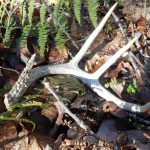
This is an awkward, anticlimactic time of year for outdoor types. We tend to be objective-driven, especially during the hunting seasons, which are closing now. We enjoy the outdoors for its own sake, but we still crave that “edgeâ€� of pursuit. ItÄ¢¹½ÊÓƵ a letdown deepened by the bland and balmy weather this winter, which rules out ice-fishing and cross-country skiing. But there is one goal that remains always available to those who need some draw beyond just a nice day to get them into the woods, and itÄ¢¹½ÊÓƵ enhanced by sunny skies and the snowless landscape–the search for shed antlers.
For some people, shed-hunting is a lifelong obsession and they accumulate hundreds of antlers. For others, itÄ¢¹½ÊÓƵ an occasional excuse for a break from watching football. For both, finding a shed antler is an event to remember and a fascinating glimpse into deer biology.
Only members of the deer family (Cervidae) grow antlers. In North America, the family is represented by white-tailed and mule deer, elk, moose and caribou. Typically, only males grow antlers, except in caribou, where both sexes grow the head-adornments.
And adornments, ornaments even, are pretty much what antlers are. Antlers begin growing from the skull in early spring, stimulated by greater day-length. They are made of bone and grow rapidly through early summer–as much as two inches per day in June, according to the Missouri Dept. of Conservation–and harden in autumn in time for the breeding season, or rut. During the rut, antlers signal a buckÄ¢¹½ÊÓƵ fitness and desirability as a mate to females, and his formidability to other males.
Although bucks often clash in combat for breeding rights, biologists believe that large, well developed antlers actually prevent many fights and injuries because inferior rivals avoid battles with heavy-antlered, dominant males.
Scientists reject the notion that antlers are important as defense against predators such as wolves, coyotes and mountain lions.
ThatÄ¢¹½ÊÓƵ because females lack antlers and, for most of the year a buckÄ¢¹½ÊÓƵ antlers are absent or useless as weapons. After the rut, sometime from late December through winter, the bone cells connecting the antler to the skull break down and the antler falls off, or sheds, by its own weight.
The next seasonÄ¢¹½ÊÓƵ antlers begin growing soon after the shedding but are fragile and easily injured until they harden in the fall.
There are probably more shed antlers lying in the woods right now, ready for finding, than at any other point in the year. Every buck that survived the hunting seasons has, or soon will, dropped a pair. And mice, voles and other rodents haven’t yet had a chance to find new sheds and gnaw them away for the calcium, protein and other nutrients with which they are densely packed.
Some experienced shed-hunters look in specific kinds of places for these off-beat treasures. They advocate following deer trails through the heaviest cover around, believing that dense undergrowth tends to knock loosening antlers from their base at the skull. That makes sense in theory but you can also find sheds lying in open woods or even in fields. When you find a shed in summer or fall, lying in the open, it hints at how seldom humans pass that particular place in the woods. No one who sees a shed neglects to pick it up.
On northern PennsylvaniaÄ¢¹½ÊÓƵ elk range, shed-hunting is a celebrated annual ritual, sometimes heating into territorial disputes as locals and visitors comb the forest for the impressive 5-foot-long antlers shed by the regionÄ¢¹½ÊÓƵ several hundred bull elk.
In my case, I’ve found most of the whitetail sheds I’ve encountered while doing other things besides deliberately looking for castoff antlers, especially gathering ramps and morels in the spring. ItÄ¢¹½ÊÓƵ a good time to happen upon them. The snow is gone, new growth has not yet emerged, and your eyes are trained to the ground on high alert. Many times, I’ve come home with a gracefully arced antler to complement my harvest of wild edibles. Once I found a shed antler lying on the streambed when I knelt to release a trout.
More shed-hunters are finding ways to make use of their bony prizes, fashioning lamps, coat-racks and other decorative accents, but most just stash them away as mementos of out-of-the-way places they like to frequent, seizing on any excuse to be out there.