

Spring not the only season for wildflowers
Wildflowers are most often associated with spring. That may be because delicate spring blooms of trillium, bloodroot and trout lily are so welcome on the heels of winterÄ¢¹½ÊÓƵ bleakness. But right now, at mid-summer, a mostly unnoticed profusion of showy black-eyed Susan, ox-eye daisy, goldenrod, thistle, butterfly weed, day lily, Joe Pye weed, boneset, ironweed, Queen AnneÄ¢¹½ÊÓƵ lace and dozens more adorn our region. ItÄ¢¹½ÊÓƵ an easily accessible spectacle that merits more attention.
While nearly all our spring wildflowers bloom in woodlands, most summer-flowering plants sink their roots in the soil of old fields, pastures, fencerows and roadsides. There, they can afford to wait until July and August to bloom because, in their open habitats, they bask in the unobscured sunlight of long summer days. Woodland flowers, like bloodroot and trout lily for example, bloom in early April because temperatures have risen enough to favor their growth but there is still no foliage on forest trees to block the sun. Woodland flowers have a short “window� to accomplish the demanding task of blooming and producing seed. They get the job done quickly, without attaining much height. But because sunlight is so accessible in fields and pastures, summer-bloomers take their time to grow tall and robust, and produce showy blossoms to compete for the attention of pollinating insects.
It seems contradictory but summer wildflowers may go largely unnoticed because they are so conspicuous. ItÄ¢¹½ÊÓƵ the reverse of the old saying about “not seeing the forest for the trees.â€� In this case, itÄ¢¹½ÊÓƵ a matter of not seeing the flowers for the mass of surrounding flowers. Consider joe-pye weed. It grows along rural roadsides everywhere, exhibiting dense clusters of pink to lavender blooms reaching eight feet in height. Yet, few passing motorists can describe or identify the plant. ItÄ¢¹½ÊÓƵ such a common part of the summer landscape, and we pass by at such speed, that it escapes attention.
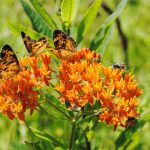
But some summer wildflowers refuse to be ignored. If you pass an old field where butterfly weed is blooming, its eye-catching flash will arrest your gaze. Think about the garish visibility of orange coats deer hunters wear to be safe in December woods. ThatÄ¢¹½ÊÓƵ butterfly weed in a mid-summer field — blazing splashes of vivid orange. Mixed mid-summer stands of butterfly weed, yellow black-eyed Susan, white ox-eye daisy and the bright blue of thistle make a dramatic display.
Butterfly weed is well-named. A close relative to milkweed, its flowers exude a sticky sweet fluid that butterflies and bees cannot resist. If you want to see a diverse selection of butterflies, find a patch of butterfly weed. By mid-morning the insects will swarm over the orange blooms, visiting one cluster, then another.
Because itÄ¢¹½ÊÓƵ so easy to spot, butterfly weed is a good plant to use to make a botanical point about summer wildflowers in general. Most summer wildflowers are more structurally complex than they appear at first glance. Queen AnneÄ¢¹½ÊÓƵ lace, ironweed and joe-pye weed are equally valid examples. In all these plants, what looks from a distance like one bloom, is actually a dense display of dozens, sometimes hundreds, of the plantÄ¢¹½ÊÓƵ true individual flowers.
This structure reaches its most extreme in plants like black-eyed Susan and daisy, which are members of the Composite family, a recognized botanical grouping. The large, bright, yellow “petals� are not part of the true flower at all. The true flowers are hard to see and densely packed at the center of the showy disc — the “eye,� so to speak, of the black-eyed Susan.
Though not composites like daisy, black-eyed Susan, ironweed and thistle, the milkweeds and many others display dense masses of individual flowers that appear from a distance like one large bloom. Apparently, there is some advantage to this strategy shared by diverse plants that bloom in the summer season.
Goldenrods, also members of the Composite family, are amazingly diverse. Though they all look alike at casual glance, there are over 30 different goldenrod species. Only botanical experts can tell some from their relatives.
ItÄ¢¹½ÊÓƵ interesting that many summer wildflowers have “weedâ€� in their name, while the names of spring flowers never convey such a negative tone. Most likely, Joe-Pye weed, ironweed, milkweed, bindweed and others attained their dubious titles because they grow in pastures and fields, where they may compete with cultivated crops or livestock forage. Rooted deep in woodlands, spring flowers never compete with human enterprise.
Any field or pasture where you have permission to hike is a good place to see the diverse profusion of summerÄ¢¹½ÊÓƵ wildflowers. There are also many public land tracts in the region that offer good viewing. The fields along the Outer Loop Trail at Fort Necessity National Battlefield are brimming with butterfly weed right now, and the Mitchell Trail and lower parts of the McCune Trail at Ohiopyle State Park pass through old fields dense with summer flowers. Friendship Hill National Historic Site is another good option.
—â¶Ä”
Ben Moyer is a member of the Pennsylvania Outdoor Writers Association and the Outdoor Writers Association of America.