

PartnershipÄ¢¹½ÊÓƵ plant sale funds fight for Eastern hemlock
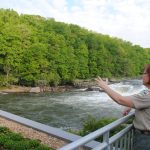
The beckoning Laurel Highlands will host thousands of visitors over the Memorial Day weekend. They’ll drive into the cooling heights for all kinds of reasons, most of which, in one way or another, will connect them with nature and the outdoors. Those who venture to Ohiopyle on Saturday, May 27 can take a bit of the highlands home with them, and help the native landscape they came to enjoy.
The Southern Laurel Highlands Plant & Pest Management Partnership will hold its annual Native Plant Sale that day (May 27) from 9:00 a.m. to 3:00 p.m. at the Falls/Visitor Center area in Ohiopyle. Nearly four dozen different species of flowering plants native to western Pennsylvania will be available for sale and replanting in home gardens. But this yearÄ¢¹½ÊÓƵ sale has a different and important objective. The Plant & Pest Management Partnership will use sale proceeds in its battle to save the Eastern hemlock tree from hemlock woolly adelgid, a devastating invasive insect pest accidentally imported from Asia. Woolly adelgid has spread from the Carolinas and Virginia northward into Pennsylvania, killing millions of beautiful and ecologically vital hemlocks throughout that region. Hemlocks within Ohiopyle State Park and the Laurel Highlands face immediate threat and some have already died.
Hemlock woolly adelgid is a tiny aphid-like insect that probes into hemlock needles and sucks out the fluid. Heavily infested trees lose their green luster and show a sickly, gray color. Trees can die within two to five years after infestation. The insect is named for the “woolly� masses it deposits on the undersides of hemlock needles in which it spends parts of its life cycle protected from winter cold and summer heat. Extremely cold temperatures are known to exact heavy mortality on adelgid populations.
The Southern Laurel Highlands Plant & Pest Management Partnership is a collaboration of several public agencies and private conservation organizations with significant wild land holdings in the Laurel Highlands. The partnership came together to battle invasive species such as Japanese knotweed, garlic mustard, emerald ash borer, and hemlock woolly adelgid, all of which threaten the Laurel Highlands ecosystem. Partners include the DCNR Bureau of State Parks, DCNR Bureau of Forestry, Fayette County Conservation District, National Park Service, Pennsylvania Game Commission, Western Pennsylvania Conservancy and Brandywine Conservancy. Brandywine Conservancy is a recent partner headquartered in eastern Pennsylvania but owns several hundred acres of woodland near Ligonier. Most of the plants available for sale are grown on that property.
“In the past, our native plant sale has had an educational thrust,� said Barb Wallace, environmental education specialist at Ohiopyle State Park. “Our intent then was simply to encourage people to use native plants in their gardens and landscaping, because native vegetation is meant to grow here, and it will grow well with no ecological drawbacks.
“But this year, after such a mild winter, hemlock woolly adelgid is back with a vengeance and we’re seeing it in new parts of the park for the first time. ItÄ¢¹½ÊÓƵ a very serious and far-reaching natural resource problem. We encourage folks to visit our sale and take home some native plants in support of the hemlock, our official state tree.â€�
Treatment of hemlock trees against woolly adelgid with pesticides is expensive and labor-intensive. The pesticide cannot be sprayed over large areas. It must be injected into the soil among the individual treeÄ¢¹½ÊÓƵ roots, for uptake throughout the tree. Wallace said proceeds from the plant sale will be used to buy the “tabletsâ€� that staff and volunteers will inject at the base of trees in identified regions of the park this fall.
“We have 300 acres of hemlock in our 20,000-acre park,â€� Wallace noted. “But itÄ¢¹½ÊÓƵ all vitally important in one way or another. Nearly all our hemlock grows along high-quality mountain streams, where it shades the water and maintains the cool temperatures native brook trout need to survive.â€�
Wallace pointed out another huge liability posed by woolly adelgid.
“Our biggest, old-growth hemlock is along the Youghiogheny River where thousands of visitors come every year to raft and kayak,â€� she explained. “When a big dead hemlock falls into a rapid, itÄ¢¹½ÊÓƵ a safety hazard to boaters and it will require highly skilled and very dangerous work to remove it, not to mention the expense.â€�
Wallace said that Partnership staff and volunteers have already treated all the hemlock on Ferncliff Peninsula, a focal point for Ohiopyle visitors but much remains to be done.
“We have assessed and identified all our hemlock stands in the park,� Wallace said. “Our highest priorities are those along our trout streams and the Yough. Unless we get more funding somehow, we’ll have to be resigned to let some of our hemlock stands die out.�
Wallace recognized the efforts of volunteer Chevron employees who have helped treat hemlock against woolly adelgid, pulled out invasive garlic mustard, eradicated Japanese knotweed and other important tasks that benefit Laurel Highlands environment.
“Chevron sent us a group of volunteers who logged over 2,000 hours of volunteer work last year,� Wallace said. “Last year Chevron even paid for all the hemlock treatment tablets. We greatly appreciate their help with an issue where the public doesn’t always recognize the vital ecological importance.�
Besides cooling mountain streams for trout, hemlock stands also provide essential nesting habitat for about a dozen species of migratory songbirds that return to the Laurel Highlands from Central and South America every spring to breed. Without hemlocks, these birds cannot nest.
“The partnership we’ve formed with the other agencies and organizations, with the help of our volunteers, is the only way we can possibly approach this problem across so large a region,� Wallace continued. “We all help one another battle invasive pests on all the public and conservation lands that thousands of residents and visitors alike enjoy.�
Ben Moyer is a member of the Pennsylvania Outdoor Writers Association and the Outdoor Writers Association of America