

The elusive joys of duck-hunting
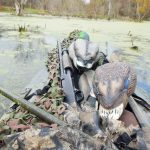
I like duck-hunting–not because I know what I’m doing, but because itÄ¢¹½ÊÓƵ something novel, outside our upland outdoor norm, and I get to use my camo-kayak, which adds a mild sense of adventure.
In this region, hunting ducks is not in our DNA, so to speak. Here, unlike places where wetlands define the landscape, you must seek out overlooked, and out-of-the way backwaters, beaver swamps or sluggish streams to have a chance to even see a duck.
The ducks themselves are another reason I enjoy hunting them. The wood duck, one of two species you are most likely to encounter here in the brief October season (closes tomorrow), is an ornately feathered, mysterious bird that is hard to draw to decoys, impossible to call and whose behavior is tough to predict. To enjoy any success at hunting wood ducks, you must conceal yourself where they want to be, and wait.
Though small as ducks go, wood ducks are also excellent eating. Through random good fortune I have two in my freezer from prior hunts, waiting for enough companions to make a reasonable meal for Kathy and me.
The one-week early season is always in mid-October. In my backlog of outdoor remembrances, I never developed the habit of packing insect repellant for outings at that time of year. I may ask columnist Jack Hughes about this but, in my recalled past, by mid-October hard frosts had suppressed the mosquitoes, midges and entire biodiversity of biting bugs. But no more. These last few October duck seasons have been hot, with long underwear less useful than sunglasses, which, like bug spray, I also never pack.
On the first Saturday of this current season I paddled my kayak to the shallow upstream limit of a secluded boggy slough. Wood duck flank feathers floated on the muck amid cattails and fallen logs, a sure sign that birds had been loafing there, or roosting at night.
“This is the spot,â€� I concluded and tossed out the half-dozen decoys that I can transport in the kayakÄ¢¹½ÊÓƵ tight confines. But there was a problem, at least I perceived it as a problem. There was nowhere convenient enough to off-load my boat and, also, park my truck where it couldn’t be seen by incoming ducks. The best I could do was park it as far as possible from my setup, imperfectly concealed in the brush. My truck looked like a warning sign to waterfowl: “Don’t land here!â€� Still, I liked the spot I’d found farther upstream.
I backed the kayak onto the dank mud among cattails, broke off some of their lance-like leaves and scattered them over the craft for concealment. Damp from the steamy heat, I settled into the boatÄ¢¹½ÊÓƵ cramped seat, hoping the wood ducks that had ventured somewhere to feed on acorns — their favorite food — would return.
Normally, I dismiss mosquitoes as less than an inconvenience. “itÄ¢¹½ÊÓƵ a mental thing,â€� I’ve often advised companions. “Just ignore them.â€�
But these mosquitoes would not be ignored. They rose from the muddy flat in eager waves, as if my warm breath was the first sign of blood-food they’d sensed in weeks. Their whine about my ears was relentless. The cumulative impact of their landing on my neck, ears and face was — well, it was intolerable. Worse, it was unproductive. Waiting, concealed, for ducks, deer or any game, you need to hold still, motionless. Holding still wasn’t going to happen that evening. My gloved hand flailed like a gray squirrelÄ¢¹½ÊÓƵ tail to keep the bugs at bay. Ducks would know there should be no squirrels in a cattail marsh.
Remembering the hood on my jacket, I pulled it over my cap and cinched tight the string that draws the hood around the face. This offered some relief from the insects around my ears but it ended my ability to radiate heat–most uncomfortable. And the mosquitoes only reoriented their attack. They concentrated in a dense hovering cloud in front of my eyes, where they could still sense flesh.
ThatÄ¢¹½ÊÓƵ when I heard a most marvelous sound, the strange, air-shredding sound of wood duck wings shearing the air overhead. A squad of a half-dozen woodies came in from directly behind me, zoomed low over the decoys, and before I could think about raising the gun, streaked out of range and alighted in plain view of my truck.
Through the mosquito cloud, I watched them swim and splash about, then fly up onto a dead snag that overhung the slough. They appeared comfortable, unlikely to join my decoys before the end of legal shooting time.
As time and daylight dwindled, my only chance was to gather my decoys and paddle toward them, possibly getting a shot when they flushed.
The ducks were black silhouettes on the naked snag as I paddled nearer. They remained there, letting me to get much closer than I’d expected. But against the brighter sky beyond, I couldn’t tell which direction the ducks were facing. They were featureless ovals arrayed on a branch.
The ducks flushed all at the same time, with the strange wood duck “squeal,� they emit when alarmed. I’d expected them to fly away from me, offering a shot. But, instead, they streaked directly toward me and overhead, fast — wood duck fast, if you’ve seen their flight and that helps you imagine it. I didn’t even have time to grab for the gun.
I pivoted the boat 90 degrees, just in time to see the ducks glide into the mucky backwater where I’d been waiting with the mosquitoes. On the water, in the dimming light, they looked just like my decoys had appeared there minutes earlier.
I do like hunting ducks. I just need to go back to the beginning and read the reasons why.
Ben Moyer is a member of the Pennsylvania Outdoor Writers Association and the Outdoor Writers Association of America.