

Bear resurgence
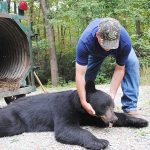
Bears add an element of wildness to the outdoors. They’re associated with remote exotic places where most of us will never visit, and their presence lends a mild sense of adventure to any fishing, camping or hunting sojourn, no matter where the trip occurs.
Black bears, though, the kind we have around here, are more adaptable than anyone gave them credit for. It wasn’t so long ago that our local woodlands held no resident bears, and few believed they ever would–again. Our local span of the Allegheny Mountains was prime bear country in pre-settlement times, but those native bears were all killed off by the mid-1800s. This column has referred to this event before, but a black bear killed by a car on Rte. 711 (Springfield Pike) sometime in the mid-1960s was huge outdoor news then, complete with a photo in the Uniontown Evening Standard featuring the deceased bear and then Fayette County wildlife conservation officer, Alex Ziros.
When hunters began taking a bear or two here every season in the early 1990s, that was news too, and proof that a resident population had returned and taken hold. Now black bears live about as densely in the Laurel Highlands as anywhere in North America.
As proof of the black bearÄ¢¹½ÊÓƵ adaptability and resilience, Pennsylvania hunters this fall set an all-time (meaning in modern times, since data collection began) record for the number of bears taken in a season–4,593. Actually, it was a series of seasons that cumulatively achieved that record total. Spurred by concern for increasing conflicts between bears and people, across an ever-wider swath of the state including some suburban regions, the Game Commission in 2019 approved an unprecedented expansion in bear hunting opportunities.
For years, Pennsylvania had an annual 3- or 4-day bear season, immediately prior to Thanksgiving. But this fall, bear hunters enjoyed a special archery season, an October muzzleloader season, the regular pre-Thanksgiving firearms season, and, in some units, an extended season when bears could be taken during parts of deer season. The statewide population of black bears is estimated to be around 20,000.
Interestingly, the bear take in Fayette in this record year was lower than in some previous, much shorter seasons. Hunters here killed 61 bears in 2019. The county has topped 100 a time or two in the past decade.
Also interesting is that despite the minor slump in FayetteÄ¢¹½ÊÓƵ total bear take, hunters tagged bears over a larger part of the county than ever before. Previously, the Fayette bear kill was concentrated in the mountain townships, and it still is. But this fall hunters took at least one bear in the lowland townships of Franklin, Luzerne, Lower Tyrone, and Menallen. Bears were also tagged in Bullskin, Connellsville, Dunbar, Georges, and Springhill townships, but like the county itself, all those townships are about half mountain and half lowland, and there is no way to tell from available data precisely where their bears came from.
In the mountains, Wharton Township gave up between 16 and 20 bears, according to a color-coded map on the Game CommissionÄ¢¹½ÊÓƵ web page (www.pgc.pa.gov). To review this interesting map, go to the Game Commission home page, pause your cursor on “Hunt & Trapâ€� at the top, then click on “Huntingâ€� in the drop-down box. On the new page that loads, click on “Black Bear.â€� A map of Pennsylvania will appear, but itÄ¢¹½ÊÓƵ not the current bear-kill map. Click on the map and a new map will pop up with up-to-date bear kill data for every township in the state.
Henry Clay and Stewart townships also appear to have yielded 16 to 20 bears each (It can be tough to discern the subtle shades of color on the map). Hunters in Springfield Township took about a dozen bears this fall.
As further testament to the black bearÄ¢¹½ÊÓƵ adaptability, Greene County gave up a bear this year–the third in as many years. This yearÄ¢¹½ÊÓƵ bear came from Greene Township, while previous recent Greene County kills happened in Whiteley and Washington townships.
Friends who run trail cameras in far western Greene County state that they recorded a sow bear and her cubs there several times this summer. The pioneers of Greene CountyÄ¢¹½ÊÓƵ newly rooted bear population apparently swam the Mon River from Fayette or crossed in from West Virginia.
This year, the only western counties to not report a bear kill were Washington, Beaver and Lawrence. Even Allegheny County accounted for two. Wild things, black bears especially, never cease to amaze in their knack to adapt.
Ben Moyer is a member of the Pennsylvania Outdoor Writers Association and the Outdoor Writers Association of America.