

The Raven is real; beyond and before the NFL
Associated Press
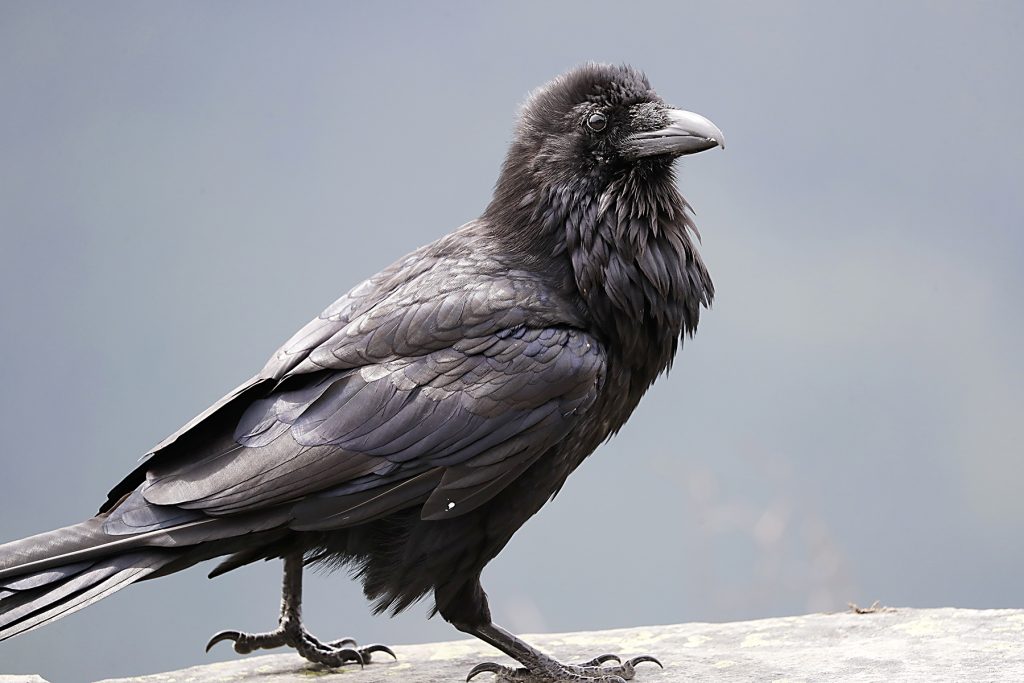
The raven is a real bird, increasingly common across Western Pennsylvania.
Associated Press
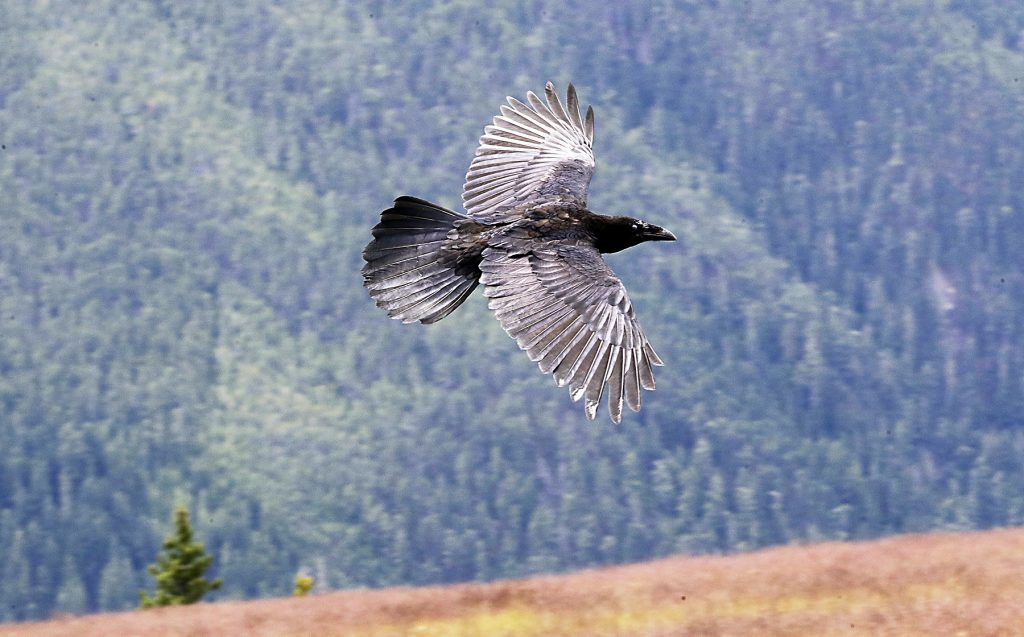
Pictured is a raven in flight. Best known in popular culture as the icon of the NFLÄ¢¹½ÊÓƵ Baltimore squad, the raven is a real bird, increasingly common across Western Pennsylvania.
Last week, driving along Walnut Hill Road south of Uniontown, Kathy and I spotted a raven coursing low over a cornfield. The birdÄ¢¹½ÊÓƵ identity was unmistakable–glossy black with a prominent bill, but much larger than a like-plumaged crow. On strong wingbeats, it cut tight turns and sharp dives as it searched the field for some morsel.
That big black bird called attention to SundayÄ¢¹½ÊÓƵ critical game pitting the Steelers against the Baltimore Ravens. ItÄ¢¹½ÊÓƵ no surprise that an NFL team would choose the raven as its icon. A raven certainly presents a more formidable image than an Arizona Cardinal and, unlike a Seattle Seahawk, the raven is a real and natural bird. I wondered aloud to Kathy if, despite the Steelers’ and Ravens’ well-hyped rivalry, some local fans might be unaware that you can see a real raven around here just about any day you try to.
That wasn’t always true. Ravens were considered a shy bird of remote wilderness until roughly 20 years ago. Before about 2000, if you wanted to see or hear a raven, you had to venture north onto the rugged plateaus of Potter or Cameron counties, or south to the craggy escarpments of West VirginiaÄ¢¹½ÊÓƵ highest peaks. About that time, the first ravens I saw near here soared over the Cheat Canyon at Coopers Rock, just east of Morgantown. Today, itÄ¢¹½ÊÓƵ possible to admire the ravenÄ¢¹½ÊÓƵ powerful flight anywhere along our local ridges.
Ravens build their nest of sticks, bark and deer hair on secluded mountain ledges and cliffs, but they nowadays probe down into the lowlands to feed. They can often be seen cruising over Greene or Washington counties, and, perhaps disappointingly, I’ve even seen them gleaning castoff fast-food on suburban parking lots.
Ravens are more adaptable than once thought, and the landscape has changed in their favor. Ecologists believe that ravens were more abundant than crows in the original American wilderness. After humans altered the landscape with farms and towns, ravens retreated, while their cousins, crows, exploded. But the greatest land use change in eastern America since the middle of the 20th century has been the abandonment of farmland, which reverted to forest. According to U.S. Forest Service statistics, for example, Greene County in 1960 was 19% forested. Today, about 60% of Greene is covered by woodland. In 1965, the number of ravens nesting in Pennsylvania was estimated at less than a thousand, while a recent breeding bird survey pegged their numbers in the state at near 20,000. Ravens like the trend toward reforestation and are reclaiming their original range.
Another fascinating proposal to explain the raven resurgence is linked to coyotes. The theory goes that ravens once associated with wolves, which were abundant throughout this region. Ravens followed the wolf packs, and when wolves killed a deer the ravens cleaned up the scraps. On our modern landscape, coyotes have replaced wolves and since coyotes are capable of killing deer, ravens again have a canine cooperator to help them thrive. They also look for road-kills, unavailable to their ancestors.
Largest of all birds technically classed as “songbirds,� ravens have a wingspread approaching five feet. They are also highly intelligent. Experiments demonstrate their ability to communicate abstract concepts, and they can solve complex problems to obtain food. Male and female ravens pair up early and mate for life. They are among the longest-living of all birds.
Highly vocal, ravens emit a wide range of sounds, some hard to describe. Most common is a harsh croak, but they can also make odd sounds that resemble a melodic xylophone, which can be puzzling to hear on a deer stand in remote woods.
Ravens inhabit arctic and temperate habitats around the northern hemisphere, including Europe, Asia and North America. Many cultures, including Vikings, the ancient Welsh and Native Americans, regarded ravens with mystique and reverence, even linking the birds to the supernatural.
Supernatural mystique explains why a sports team in Baltimore, Maryland chose the raven for its mascot. The poet and author Edgar Allan Poe spent much of his short life in Baltimore and may have written his eerie poem “The Raven� there, forever linking that city to the raven, even though, despite their recent range expansion, it remains unlikely to see a raven in Baltimore. According to the Maryland Department of Natural Resources, the raven is “not very common in Maryland. They are found primarily in the mountainous western counties of Garrett, Allegheny and Washington (from Youghiogheny Reservoir, east to Hagerstown).� Ironically, then, a football fan has a better chance to see a real raven around “the ‘Burgh� than in Baltimore.
I don’t know if that will help the Steelers’ chances on Sunday, but Steeler Nation can take some satisfaction knowing that, except for PoeÄ¢¹½ÊÓƵ poem, we have a better claim on BaltimoreÄ¢¹½ÊÓƵ team icon than they do.
Ben Moyer is a member of the Pennsylvania Outdoor Writers Association and the Outdoor Writers Association of America.