

Bucs by Numbers: Taillon should be on major upswing for 2019
Associated Press
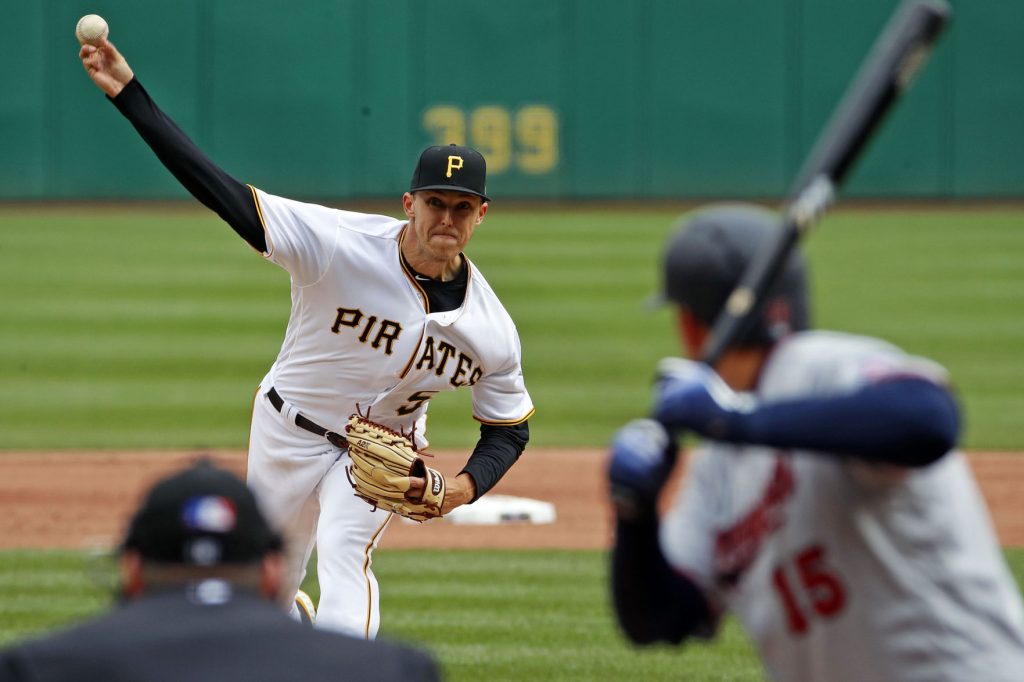
Pittsburgh Pirates starting pitcher Jameson Taillon delivers a pitch in the fifth inning to Minnesota Twins’ Jason Castro (15) during the Pirates’ 2017 home opener.
Three years into the Jameson Taillon experience, Pittsburgh Pirates fans may be feeling a roller-coaster effect with the teamÄ¢¹½ÊÓƵ ace.
He burst on the scene in 2016, doling out heaping helpings of hope that at least ONE of the teamÄ¢¹½ÊÓƵ vaunted pitching prospects would pan out. His career started out on a “normalâ€� trajectory, and if there was anyone that deserved some normalcy, it would be Taillon.
Life had other plans of course, and when cancer struck Taillon in 2017, all he did was serve, again, as a beacon of hope — this time for those similarly afflicted. He stood up to cancer, and fans stood up for him when he came back shortly after treatment. Once again, he reassured them all. This time the sighs of relief followed five innings of shutout ball in his very first start back.
If those same fans didn’t have enough faith in Taillon going forward after all of that, well, they may be bursting at the seams with it after seeing the strides that Taillon took in 2018.
Pitching to a 3.20 ERA/3.46 FIP across 191 innings — which included two complete games, one of which was a shutout — the Houston area product brought out some new toys, and seems to have fully grown into the pitcher many knew he would become.
As 2019 looms, the coaster is about to go up again. Way up.
But to get over the next hump and feel the rush, it may not be TaillonÄ¢¹½ÊÓƵ new-ish slider that will serve as the catalyst. There is no doubt that adding the pitch has helped Taillon evolve to a higher degree than many may have even thought possible. Yet, in a vacuum, the pitch has not been a cure-all. One pitch does not a dynamic pitcher make. Even if it is as good as TaillonÄ¢¹½ÊÓƵ slider is.
You may hear the Pirates brass preach about “fastball command.� Everything depends on fastball command. Breaking pitches, strikeouts, the sogginess of your morning cereal; everything works of off fastball command.
In the olden days of Pirates pitching — and I’m talking 2012 or so here — “fastball command� did not necessarily mean filling the zone with strikes. As with any good sinkerballer, the goal for most Pirates pitchers was to use the sinker/two-seam fastball to induce ground ball and weak contact outs. For a select few — Francisco Liriano comes to mind — it could be used to set up a breaking pitch. But for the 2016 version of Taillon, such a pitch was still a distant dream.
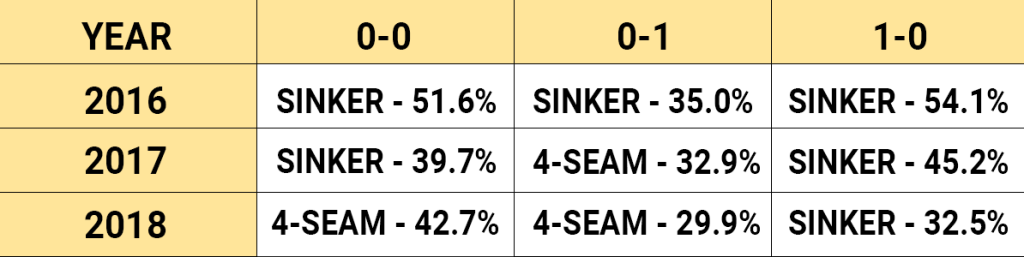
Times have changed, and that is no more readily apparent for Taillon than early in an at-bat. Take a look at his changing plan of attack over the past three seasons:
Nowhere is this change more startling than at first pitch. Taillon went from using a sinker more than half the time here in his first go-round in the majors, to 2018 where the four-seamer did the bulk of the work. ThatÄ¢¹½ÊÓƵ a hell of a swing across just 75 starts. Even if he still uses a sinker to get back into at-bats early at a 1-0 count, the delta is much tighter now, with the four-seam right behind at 26.1 percent.
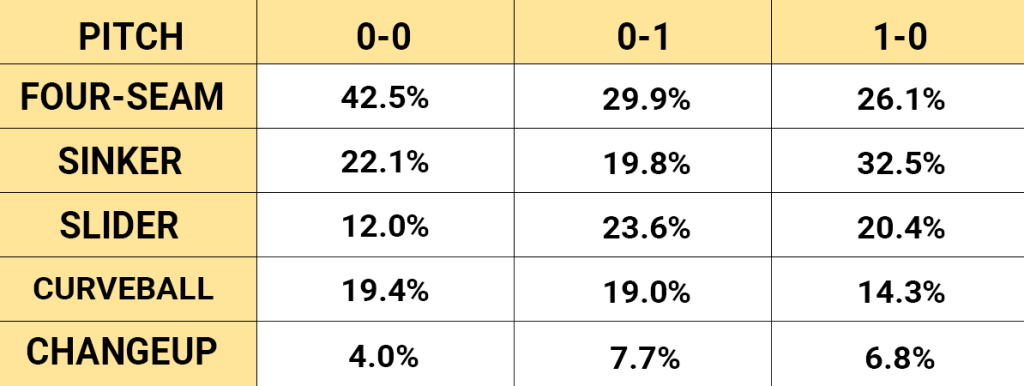
A graphic shows an entire look at what Taillon offered to hitters early on in 2018.
TaillonÄ¢¹½ÊÓƵ 42.5 percent usage of four-seamers at first pitch is much higher than the league rate of 22.2 percent among all starting pitchers in 2018. The differences in approach is a bit less pronounced at 0-1, with MLB starters throwing the straight heat at an 18.4 percent clip. Taillon still bests that mark by 10-plus percentage points, but the other weapons he can throw out guards against hitters picking up on any tendencies.
All of this is presented in a second graph to drive the point home.
TaillonÄ¢¹½ÊÓƵ success will continue to be predicated on how well his four-seam fastball plays. And play it has, with a 12.21 whiff percentage on the pitch overall in 2018, up from 8.29 percent in 2017. Taillon got a strike on 0-0 with a four-seamer 25.2 percent of the time, a figure which vaulted his overall first-strike percentage up to a career-best 63.7 percent in 2018, good for 17th among MLB starting pitchers with at least 150 innings pitched.
The thing is, though…hitters are still hunting fastballs. For as much evolution that has occurred in pitch types, very little has occurred at the plate. At least in hitters looking for certain types of pitches, that is. Consider this: On an MLB-wide level, hitters slugged .449 against four-seamers last year while maintaining a healthy-enough .347 wOBA against the pitch.
On first glance, those might look almost like modest numbers, but they take on a greater meaning when remembering that this is league-wide. Seventy-five percent of this ultimate sample falls within the .470-.485 range in slugging and a .357-.372 range in wOBA.
With this in mind, perhaps Taillon might yet still need to modify his offerings to avoid aggressive hitters.
He certainly has the pitches to tighten up his mix. And, yes, the sinker might still have a role to play just yet. The current trend in MLB sees a rapid rate of pitchers dropping a sinker for harder-breaking stuff, but those with a solid sinker still have a place.
The days of using the pitch as the crux of a pitch-to-contact crutch are long gone, but those with good sink can still throw it out there and be effective. Of the 81 starting pitchers with at least 100 qualified events, Taillon ranked ninth overall in wOBA against the pitch with a .287 rating, considerably better than the MLB rate of .356.
The league-wide average movement on sinkers is 2.34 feet. TaillonÄ¢¹½ÊÓƵ moved at 2.04 feet; While not a huge dropoff, Taillon ranks 103rd out of 110 pitchers in this regard (minimum 250 sinkers thrown). Though it may not move as much as his peers’ do, his sinker is just as effective, with a .096 ISO and a 14.2 fly ball rate on batted sinkers. That last figure is good for 10th best among hurlers with at least 100 sinkers put into play.
As thrilling as it was to see Taillon develop a new out-pitch, as dazzling as his four-seam fastball has shown to be, the sinker still has a place.
n n n
Since he is going to keep using it, letÄ¢¹½ÊÓƵ talk about that four-seamer more in depth.
Average velocity is still there at 95.86 mph in 2018. The pitch has decent spin at 2350 RPM, good for 23rd among qualified major league starters. That modest spin rate takes on a greater significance when paired with TaillonÄ¢¹½ÊÓƵ preference to go up with the heat.
The higher the spin rate, the lesser the pitch drops, giving an illusion of a “rising fastball.� Such pitches are awfully hard to drive with any regularity, limiting damage if done correctly. In the upper third of the strike zone as well as the two halves defined by Statcast as right above the zone, Taillon carries a healthy 21.6 percent whiff-per-swing rate — 27th among that same set of SP qualifiers.
Yet, the argument could be made that Taillon is walking a tightrope by featuring the four-seamer early in the count to get ahead. In 2018, MLB hitters carried a 66.7 swing rate on four-seamers in the zone at any count. Hitters swung against TaillonÄ¢¹½ÊÓƵ heaters in the zone at a slightly higher 67.3 percent rate.
The wOBA on those same four seamers that hitters swung at shows some separation. MLB hitters carried a .355 wOBA when they deemed an in-zone four-seamer as offer-worthy, blessing it with a swing. When hitters made the same decision against Taillon, he held them to a .320 wOBA.
At first glance, big whoop right? A .035 difference in wOBA isn’t a difference maker. Luckily, we can look at xwOBA (expected weighted on base average) for some further differentiation. Under these same parameters, Taillon (.296 xwOBA) gets more out of his in-zone “swingable� four-seamers than MLB SPs on the whole (.348 xwOBA).
If Taillon is walking the tightrope, he is walking it rather well. Need more evidence? He allowed just seven “barrelsâ€� on swung-at, in-zone four-seamers over all of 2018. Barrels are StatcastÄ¢¹½ÊÓƵ fancy big-city metric that judges how well a ball was struck. If you listen to MLBÄ¢¹½ÊÓƵ stats flacks tell it, barrels are close to as singular of a judgement as we can get to batted balls. This author remains skeptical that something with so many variables can be summarized so succinctly, but itÄ¢¹½ÊÓƵ awfully hard to argue with such a low figure across an entire season.
Maybe everything is predicated after the fastball after all?
n n n
So here we are as the 2019 season is about to dawn on our baseball-starved souls, and we’re picking apart TaillonÄ¢¹½ÊÓƵ harder stuff. What about the big bender? What about the change of pace?
Many had fully expected Taillon to embrace his capable curveball as his out-pitch of choice. Having been slapped with a 60 rating on the 20-80 scale by most evaluators, TaillonÄ¢¹½ÊÓƵ bender was supposed to serve as his scariest pitch.
Maybe it still does, and the fright it puts into hitters is simply lurking around the corner for now, content to take a back seat to the slider. In either event, TaillonÄ¢¹½ÊÓƵ curve has considerable spin — 2,649 rpm on average, good to place in the 83rd percentile of all MLB curveballs thrown — while carrying movement that is just on the MLB averages (MLB: 10 inches horizontal/54 inches vertical; Taillon: 11 inches/55 inches).
Most importantly, TaillonÄ¢¹½ÊÓƵ curveball gets hitters to miss at a 37.6 percent whiff rate. This is an improvement upon his 2017 rate of 32.4 percent.
Why have these loopy assassins not been deployed to snuff out more hitters’ hopes and dreams than the 19.74 percent clip they were seen at in 2018? I don’t have an answer for you. I would suspect that we shall see more in 2019, what with the pitch having a .236 wOBA against coupled with the Pirates finally embracing the idea that a pitcher should throw his best pitches more often.
Then again, that slider is pretty good too, with a .289 wOBA and a healthy 23.8 percent whiff rate of its own.
Watching Jameson Taillon put all of these pitches together into an effective mix is going to be a thrilling thing for Prates fans in 2019.
Bucs by Numbers is a twice-monthly column focusing on the Pittsburgh Pirates from an advanced statistic perspective. Please follow Jason on twitter – @jrollisonpgh.