

Bald eagles and Baltimore orioles; Diverse birds enliven spring
What would spring be without birds? Their variety, colors and songs are inseparable from the season. And because our regionÄ¢¹½ÊÓƵ land-use is diverse, with mountain forest, lowland woodlots, rivers, suburbs, city, and farms, we get to experience more than our share of bird species–when we pay attention.
Sometimes, though, you blunder onto a bird that “shouldn’t be there� by blind luck.
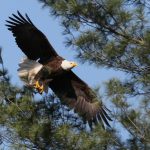
About a week ago, I was fishing on Dunbar Creek, far upstream near the dead-end of the gravel track that probes deep woods from the Dunbar-Ohiopyle Road. ThereÄ¢¹½ÊÓƵ a nice pool along that stretch where I can generally count on catching a fish, and I try to approach it with stealth. Settling into the best casting spot, I was so intent on looking for trout that I ignored the surroundings. A dark motion overhead hooked my attention, and I looked up to see an adult bald eagle launching off a dead snag that overhung the creek. Relieved of its burden, that snag whipped up and down as the eagle bored straight down the creekÄ¢¹½ÊÓƵ corridor toward Dunbar.
That encounter was unusual because bald eagles, owing partly to their large size, are associated with more open habitats–marshes, sprawling lakeshores, and broad rivers–where the huge birds can maneuver, soar, and survey the water below for fish. “Myâ€� Dunbar Creek eagleÄ¢¹½ÊÓƵ 8-foot wingspan was so constrained in the tight tunnel of forest over the flow that it had to power a long way downstream, like a torpedo-bomber in low-altitude attack mode, before the narrow valleyÄ¢¹½ÊÓƵ canopy opened to the sky.
Not so long ago, the notion of seeing a bald eagle in Fayette County would have been unthinkable. In the mid-1970s our national symbol was down to only two nesting pairs in Pennsylvania, both near Pymatuning in the stateÄ¢¹½ÊÓƵ northwest corner. Today, more than 200 pairs nest along the stateÄ¢¹½ÊÓƵ rivers and bigger lakes, with a few of those in Fayette.
A reintroduction program by the Pennsylvania Game Commission, plus cleaner water, the banning of the pesticide DDT, and greater awareness and a generally protective attitude among citizens has enabled the eagle to thrive again.
I’ve been fortunate to see bald eagles locally in both typical and surprising situations, though not so surprising as the upper reaches of Dunbar Creek. Once, an eagle was impossible to miss as I drove down the Connellsville St. exit ramp from northbound Rte. 119. It was hovering over that little pond at Spectra Energy, where you intersect North Gallatin Avenue Extension. Waiting at a stoplight, I was surprised to see another eagle soaring circles over downtown Waynesburg. The driver behind hit the horn well after the light went green.
More typical scenarios include sightings along the Youghiogheny River near Dawson, at Cranberry Glade Lake, High Point Lake, Virgin Run Lake, and at Indian Creek Reservoir near Mill Run.
I didn’t catch a trout that day on Dunbar Creek, and I hope the eagle had better fishing–sort of.
A neighbor of mine sees her birds, not by random encounter but by paying attention. Health challenges restrict her mobility, and she passes much of her day at a window reading, executing domestic paperwork, or looking out at the mountain setting. Yet, she is always cheerful and encouraging. I think of her sometimes as an inspiration if my own disposition disappoints others.
Her family erected a bird feeder for her at that window, and they keep it filled throughout the year. Familiar birds and the occasional rare visitor keep my neighbor enthralled. When I make the turn up our lane, I wave and note the birds sheÄ¢¹½ÊÓƵ attracted, and if I stop for a brief visit, she’ll report the recent activity.
About the time I saw the eagle on Dunbar Creek, four male Baltimore orioles visited her feeder, attracted by orange slices put out to nourish birds, like orioles, that are not typically seed-eaters. The orioles’ vivid orange and black plumage provided my neighbor a memorable show. I haven’t spotted them myself while coming and going, but I did learn something. The birdÄ¢¹½ÊÓƵ name, of course, has nothing to do with the American League baseball team defeated by the Pirates in two World Series in the 1970s. I did assume, though, that the name came from some early abundance of orioles in the city of Baltimore. Not so.
The English Lord Baltimore was the Colony of MarylandÄ¢¹½ÊÓƵ first proprietor back in the 1600s. His familyÄ¢¹½ÊÓƵ coat-of-arms featured the colors orange and black. So, when early Marylanders saw the oriole, which nests over the whole eastern third of North America, they named the handsome bird for their English Lord.
In our region, whether you rove widely or stick close to home, some aspect of nature is always apparent–through accident or awareness.
Ben Moyer is a member of the Pennsylvania Outdoor Writers Association and the Outdoor Writers Association of America.