

A Fowl Accounting
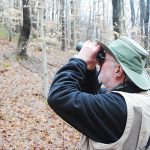
Thirty-four volunteers endured last SaturdayÄ¢¹½ÊÓƵ all-day rain for the Christmas Bird Count, based at the Laurel Highlands Visitor Center in Ohiopyle State Park. Observers fanned out on assigned routes to log 6,288 birds of 52 different species, all within a 7-mile radius of the falls at Ohiopyle.
The tally was an official part of the National Audubon SocietyÄ¢¹½ÊÓƵ 120th Christmas Bird Count but only the second done at Ohiopyle. National Audubon began the annual count in 1900 at 25 locations around the country. Today, bird enthusiasts across the United States, Mexico, Central America and many Pacific islands search for birds in more than 2,600 circles, each 14 miles in diameter, then report their sightings to AudubonÄ¢¹½ÊÓƵ national database. Local organizers can schedule their Christmas count on any date between Dec. 14 and Jan. 5.
“I always wondered why there was no count in Fayette County,� said Matthew Juskowich, an Audubon member from Bethel Park who organized the Ohiopyle event. “For a long time, Allegheny County as well as Butler, Greene, Westmoreland, and Washington counties have hosted two counts each year.
“With FayetteÄ¢¹½ÊÓƵ more extensive forests, plus fields, wetlands, lakes and the Youghiogheny River corridor, itÄ¢¹½ÊÓƵ a natural place to record a lot of different birds. We decided last year to base the Fayette count at Ohiopyle because a 7-mile radius from there takes in all those different habitats.â€�
The Christmas count is more than a novel day outdoors. Audubon has compiled results from counts beginning in 1900. It uses the data to track trends in bird populations and shifts in the ranges of species. Bird-count tallies have helped scientists document changing climate by noting seasonal shifts in where certain species appear, and enabled wildlife agencies to launch conservation initiatives for some birds. National summaries of all counts back to 1901 are available on AudubonÄ¢¹½ÊÓƵ website, www.audubon.org.
“A concentrated effort like this helps you see things that are happening, even on a local level, which is important,� Juskowich said. “We’re seeing a change in species–things that wouldn’t have been here during the winter some years ago–like the eastern towhee, bluebirds, turkey vulture, and the Carolina wren.�
Juskowich also noted that observers working out of Ohiopyle failed to find some birds, once common here, during the 2019 and 2020 Christmas counts. “We failed to find a single ruffed grouse for the second straight year,� he said. “Despite some of our volunteers making a deliberate effort to flush grouse in typical brushy habitat.�
Ruffed grouse are an indirect casualty of changing climate. Pennsylvania Game Commission biologists proved through rigorous experiments that ruffed grouse, PennsylvaniaÄ¢¹½ÊÓƵ state bird, are suffering extensive mortality from West Nile virus, of tropical origin and transmitted by mosquitoes that have thrived here during recent mild winters.
There were some happy highlights in this yearÄ¢¹½ÊÓƵ count. Observers reported seeing eight bald eagles, including three during the same encounter.
“We were searching a portion of the Great Allegheny Passage trail, just downriver from the Bruner Run boaters’ takeout when we saw the three eagles,� said John Bauman of Pittsburgh.
BaumanÄ¢¹½ÊÓƵ small party described seeing one eagle, a sub-adult, fly down the [Youghiogheny] river toward them and perch in a tree. It was joined a moment later by an adult bald eagle. Both birds flew off downriver and another sub-adult followed.
Bald eagles have rebounded from a low point in the early 1970s, when there were only two nesting pairs in Pennsylvania. Now, nearly 300 eagle pairs nest in the state, including several in Fayette County.
Bauman reported that just after their eagle sighting, his party spotted a flock of 10 common mergansers, a species of fish-eating duck, on a pool in the river.
BaumanÄ¢¹½ÊÓƵ route covered Cucumber Run, the Kentuck day-use area and campground, all in Ohiopyle State Park, Middle Ridge Road with a side-excursion to Deer Lake, and the Great Allegheny Passage at Bruner Run. He also reported two screech owls, the only ones recorded on the day of the count.
“Just before dawn, above Cucumber Run, I was playing a recording of the screech owl call loud on my phone,� Bauman said. “I got two screech owls to call back to me from different points in the woods.�
The count accepts records of birds heard but not seen, provided they come from birders accomplished in identifying calls. Bauman returned to the spot later in the day and searched for the owls by sight but could not spot them.
Screech owls are oddly named because they emit a call that sounds nothing like a “screech.� Their call is more accurately described as a “mournful whinny,� according to the Peterson Field Guide to the Birds.
Some other notable sightings included; seven common goldeneye (duck), six belted kingfishers, one ring-necked pheasant, and at least one of all seven woodpecker species known to inhabit this region–pileated, red-bellied, red-headed, yellow-bellied sapsucker, downy, hairy, and flicker.
A sampling of some other birds noted includes mourning dove, wild turkey, CooperÄ¢¹½ÊÓƵ hawk, red-tailed hawk, American kestrel, raven, white-breasted nuthatch, brown creeper, cedar waxwing, and winter wren.
One party visited Cranberry Glade Lake and recorded five gadwall ducks and 15 American black ducks, closely related to the common mallard but in decline continent-wide.
Some observers searched for birds that could only be found in specific types of habitat. The golden-crowned kinglet, for example, is a tiny, attractive but secretive bird with a bright gold crest. It is considered “conifer-obligate.â€� It needs dense stands of conifers like hemlock or spruce to survive. Count volunteers searched hemlock stands along stream courses and counted 71 golden-crowned kinglets, far more than the nine counted in 2019. But ornithologists have concerns for the kingletÄ¢¹½ÊÓƵ future in this region. As eastern hemlock trees decline from infestation by hemlock woolly adelgid, an invasive insect pest favored by warmer climate, conifer-obligate species like the kinglet will need to retreat farther north or perish.
“Birding is such a great hobby,â€� Juskowich said, “but a count like this goes beyond recreation. The Laurel Highlands are such an exceptional area for experiencing nature, and itÄ¢¹½ÊÓƵ vital that we document whatÄ¢¹½ÊÓƵ here now, because things are changing.â€�
Juskowich said the rain likely suppressed both the number of volunteers, and the number and diversity of birds seen, but he noted that some volunteers traveled to Ohiopyle from as far as Beaver County to participate.
“We’re hoping to be consistent and always set our Ohiopyle count for the first Saturday in January,� Juskowich said. “The 2021 count will be Jan. 2.�
Kerry Bell, a wildlife photographer from Connellsville, did not travel far but was glad to be part of the count. “I’ve always had an interest in nature and wildlife,â€� Bell said. “About 250 species of birds are known from Pennsylvania, and itÄ¢¹½ÊÓƵ my personal goal to collect a good photograph of every bird in the state. The Christmas count is like a scavenger hunt for birds, but with a higher purpose.â€�
Ben Moyer is a member of the Pennsylvania Outdoor Writers Association and the Outdoor Writers Association of America.