

Found tackle box a ‘time machine’
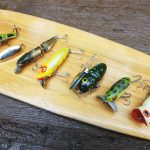
Depending on your worldview, time-travel belongs in the realm of science-fiction or advanced metaphysics. I savored a more down-to-earth version when I re-discovered my dadÄ¢¹½ÊÓƵ old tackle box, forgotten somehow under mounds of my own outdoor gear. Opening the box was a combination of déjà vu and Christmas, surprise and snippets of experience relived.
Inside, the “keys� to the past were old classic fishing lures, some no longer made, some still available but swallowed by conglomerates. These lures arose out of what I think of as the “Golden Age of American Fishing,� when independent entrepreneurs, in small towns and rural crossroads all around the country, crafted handmade tackle that worked, but also imbued fishing with magic and romance. I first saw these lures depicted in luridly painted ads in Outdoor Life and Field and Stream magazines in the 1960s. Always, they depicted an awed angler, standing in a background boat while an acrobatic bass or pike leapt toward the reader with the touted lure swinging from its jaw. Those heroic lures hooked as many anglers as they did fish.
First to catch my eye was a long reptilian-looking ruse, jointed in the middle, that recalled an episode on Cranberry Glade Lake — the venerable Creek Chub Pikie Minnow. My Uncle Max was rowing a john-boat back toward the dock and I was dragging a Creek Chub Pikie behind — I guess we were doing a sort of low-tech trolling. The Pikie floats when at rest but dives with a tantalizing wriggle when retrieved or trolled. A big bass slammed the lure and I fought it to boatside while my uncle whooped to the rest of our clan on shore. He was just about to slip the net under the bass when it vaulted skyward in a head-shaking writhe, flinging that big lure with its three sets of threatening trebles back into the boat. The original Creek Chub Pikies were made of wood in Garrett, Indiana and are highly prized by collectors.
Stashed in another tray were several Flatfish, made by the Helin Tackle Co. of Detroit, Michigan. The Flatfish had an arced body with a wide flange at the front that caused the bait to wiggle violently side-to-side when retrieved. Its action was so pronounced that you felt like you had a fish on the line, even when you didn’t. My standout memory casting a Flatfish is from an excursion to Canaan Valley, West Virginia to fish the Blackwater River in the mid- ’60s, before the first golf course or condo intruded on Canaan. I was a guest on that trip with my school-friend Ric CarollaÄ¢¹½ÊÓƵ family. We camped by a deep hole at a bend in the river, where I cast a yellow Flatfish and caught the only trout of the outing.
Heddon Lures, of Fort Smith, Arkansas is one of the oldest tackle companies still operating. My dad had several of their classics in his box, like the River Runt with its trademark dished-out snout and metal lip, and one of the “coolest� lures I never caught a fish on — the Crazy Crawler. The Crazy Crawler was a floating surface-lure with two metal arms that folded forward but deployed outward when pulled through the water. The result was an exaggerated swimming motion that churned the surface. Lots of people have caught lots of fish on the Crazy Crawler, but it never worked for me. I should try it again.
Oddly, I caught lots of bass on another lure spawned from the same surface-churning concept–perhaps the most classic bass lure of all time–the Jitterbug from the Fred Arbogast Company of Akron, Ohio. Fred Arbogast himself invented the Jitterbug in 1938 — a simple oval body with big “frog eyes� and an elegantly curved plate of metal beneath. The Jitterbug floats, and when retrieved the curved plate throws the body from side-to-side so the lure wobbles across the surface with a rhythmic gurgle and wake. Fished along the shoreline at dusk or dawn, the Jitterbug was sure to entice explosive strikes. Arbogast also made the nearly equally classic Hula Popper–another surface lure, with a wide mouth and alluring rubber skirt.
No fishing memory is more vivid than one featuring a Jitterbug on Virgin Run Lake. We’d all gone to the lake for some fishing and a cookout to celebrate my cousin Gib GroteÄ¢¹½ÊÓƵ mid-June birthday. While the others hovered at the grill, I chucked a Jitterbug into Virgin RunÄ¢¹½ÊÓƵ weedy shallows. A nice bass crushed the lure and I dragged it onto the bank and knelt beside my prize.
I abhorred short pants then, but for some reason thatÄ¢¹½ÊÓƵ what I was wearing, and when I knelt next to the fish it flopped and stabbed one of the big treble hooks deep into the flesh behind my right knee. So festooned, the fish continued to flop and writhe, unleashing panic and pain in its “catch.â€�
I must have wailed, because my dad sprinted down the bank, reaching for his ever-present penknife. He made one swift incision in my calf and the hooks were free. That may have been the first time “catch-and-release� was practiced by both parties in an angler-fish encounter.
Ben Moyer is a member of the Pennsylvania Outdoor Writers Association and the Outdoor Writers Association of America.