

Glade Run gets an upgrade
Ben Moyer
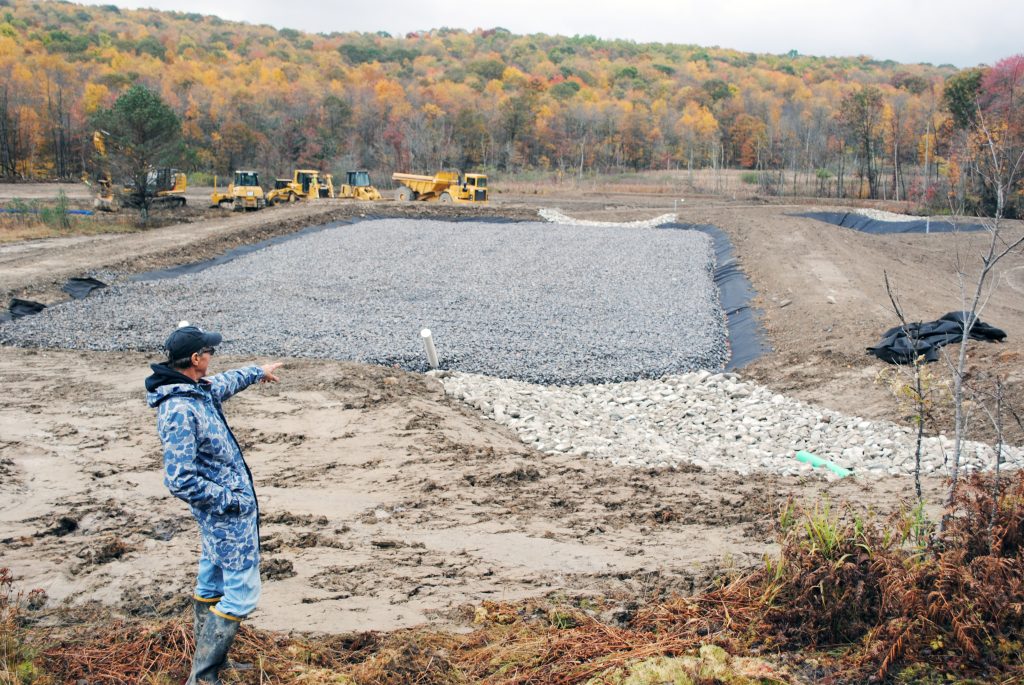
Mark Killar, watershed specialist (now retired) with the Western Pennsylvania Conservancy explains the $800,000 acid-mine-drainage treatment facility nearing completion on the headwaters of Glade Run in Wharton Township.
Ben Moyer
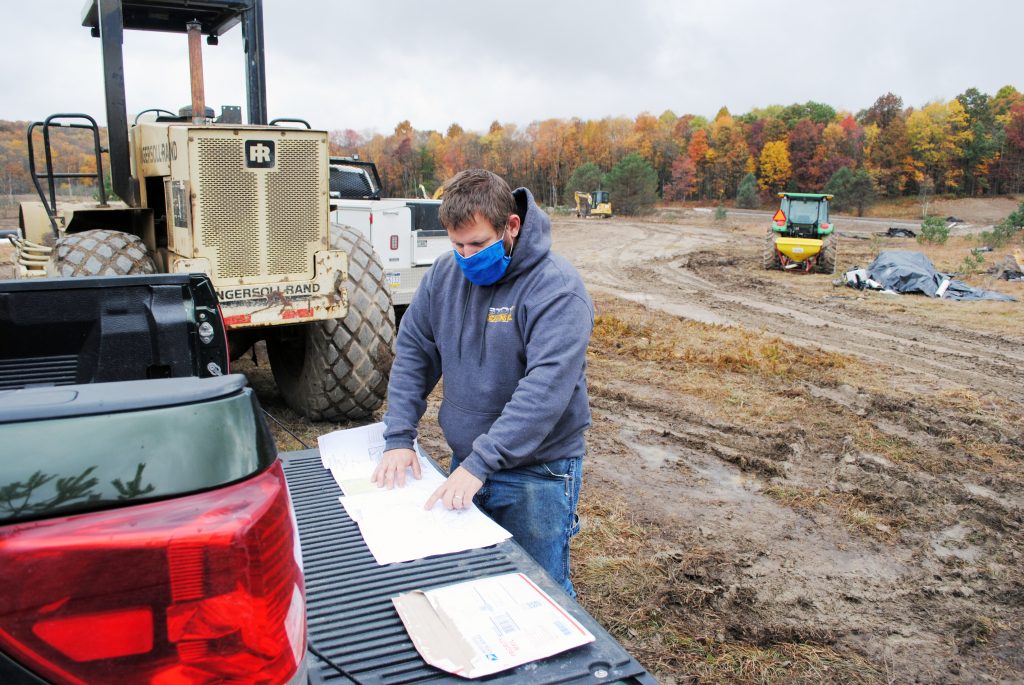
Greg Schaetzle, Western Pennsylvania Conservancy watershed project manager reviews blueprints for a pollution treatment facility built in Wharton Township by Stoy Excavating of Somerset. Improved water quality will benefit Glade Run, Dunbar Creek and the Youghiogheny River below Connellsville. A similar project is being designed to neutralize mine pollution into Jonathan Run nearby.
Coal once brought prosperity to Fayette County.
It also left a legacy of degraded streams, useless as water sources, uninhabitable by fish, a turn-off to tourists, and costly to restore.
Abandoned or poorly reclaimed mine sites unleashed acid, iron, aluminum and other pollutants into surrounding watersheds. Left as they are these sites also drain the countyÄ¢¹½ÊÓƵ potential to draw visitors seeking out attractive places.
A remote knob in the wooded span between Dunbar and Ohiopyle was especially vulnerable to such taint. From there, headwater streams flow west into Dunbar Creek and the lower Youghiogheny River, and east into Jonathan Run in Ohiopyle State Park, which enters the Yough just above the Bruner Run takeout used by whitewater boaters. Two spates of coal surface-mining, first in the 1950s before mining regulation, and again in the early ’80s when post-mining reclamation by the mine operators failed, left the knob scarred and leaching pollution into both streams’ headwaters.
Scientists from California University of PennsylvaniaÄ¢¹½ÊÓƵ Environmental Studies program documented poor water quality and verified in the mid-1990s that no aquatic life inhabited Glade Run, a major tributary to Dunbar Creek originating near the site. The potential of the Glade Run/Dunbar Creek basin as a trout fishery and regional tourism asset was seriously depressed.
But hard work, technical know-how, and money can correct past wrongs. ThatÄ¢¹½ÊÓƵ about to happen in the Dunbar Creek headwaters.
In mid-August, the Western Pennsylvania Conservancy (WPC) notified Stoy Excavating of Somerset that the firm could begin construction of an $800,000 acid-mine-drainage treatment facility atop the old mine footprint near Glade RunÄ¢¹½ÊÓƵ source. Stoy had won the conservancyÄ¢¹½ÊÓƵ bid on the project, funded jointly through the state Dept. of Environmental ProtectionÄ¢¹½ÊÓƵ Growing Greener program, and the Dept. of Community Economic Development.
Covering about eight acres, the system required grading, land re-contouring, and uses almost 3,000 tons of limestone, high in calcium carbonate, to treat the mine discharge. High-grade limestone neutralizes acid and enables harmful metals like iron and aluminum to drop out in settling basins, instead of flowing into streams. About half the limestone had to be buried in an “anoxic limestone drain,� in which polluted discharge flows through a limestone bed in the absence of air.
“In neutralizing mine acid over the long-term, itÄ¢¹½ÊÓƵ important to not have the limestone and water exposed to oxygen during their chemical interaction,â€� said Greg Schaetzle, WPC watershed project manager. “Oxygen causes a non-reactive scale to form on the limestone surface so that it can’t react with the acid. Eventually this clogs the system.â€�
Once the acid is neutralized, harmful iron and manganese suspended in the water can “drop out� or precipitate. A settling basin and man-made wetland intercept this pollution as the last step in the process. Suspended iron caused the infamous orange color in many Fayette County streams that older residents will remember, before reclamation efforts began in the county.
A separate part of the system employs an exposed bed of crushed limestone to remove aluminum, which is highly toxic to fish.
Stoy expects to complete the work by Friday, Nov. 6. Water quality downstream into Glade Run, Dunbar Creek and the Youghiogheny River should begin to improve immediately after Stoy employees open the outlet valves and the system goes on-line.
Schaetzle acknowledged a long history of local groups, notably the Chestnut Ridge Chapter of Trout Unlimited, working to address mine-acid pollution in Glade Run.
“Trout UnlimitedÄ¢¹½ÊÓƵ Chestnut Ridge Chapter, headquartered in Uniontown, built the first, though smaller, facility to treat a different discharge from this mine site in 2003,â€� he said. “We’re continuing in this effort to which a lot of volunteer time has already been committed.â€�
Since 1998, Chestnut Ridge TU has also done “first-aidâ€� on Glade Run by dosing the streamÄ¢¹½ÊÓƵ headwaters twice annually with finely crushed limestone in three locations. The group funds the treatment with grants, receipts from its annual banquet, and a memorial gift from late member Scott HoffmanÄ¢¹½ÊÓƵ family. The new WPC facility could reduce or eliminate the need for the limestone dosing treatment by neutralizing pollution at its source.
Schaetzle views the Dunbar Creek basin as a regionally significant natural resource, with over 50 miles of coldwater streams, most of which flow across public land–State Game Land No. 51. He said the conservancy has applied for Growing Greener funding to build another treatment facility for previously undiscovered discharges to Glade Run, and a similar system near the source of Jonathan Run, once a popular fishing stream that could no longer support trout after the mining operation in the 1980s. The Jonathan Run project is already in the design phase.
“Part of our mission at the Western Pennsylvania Conservancy is to improve water quality across western Pennsylvania,â€� Schaetzle said. “Because of its unique landscape and outdoor recreation potential, the Laurel Highlands are a focal area for our restoration work. Our hope, together with our partners, is to make Glade Run and the Dunbar Creek watershed all that it can be again as an asset for the Dunbar community and the whole Laurel Highlands region. When you have public access to such a large area with clean, cold water, itÄ¢¹½ÊÓƵ a wonderful boost to the communityÄ¢¹½ÊÓƵ pride and appeal.â€�
Ben Moyer is a member of the Outdoor Writers Association of America and the Pennsylvania Outdoor Writers Association.