

Reaching new heights: Uniontown’s 1951 football team was first to go undefeated
Mark Wood Ext.
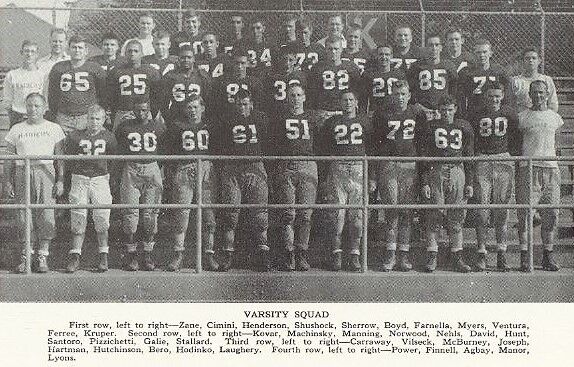
The 1951 Uniontown football team was the first to go undefeated in school history. The Red Raiders were 10-0.
Submitted photo
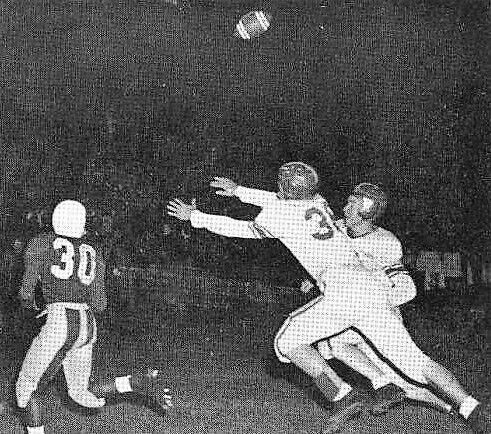
UniontownĢ¹½ÊÓƵ Frankie Henderson (30) tracks down a pass during the Red Raiders’ first undefeated football season in 1951.
Submitted photo
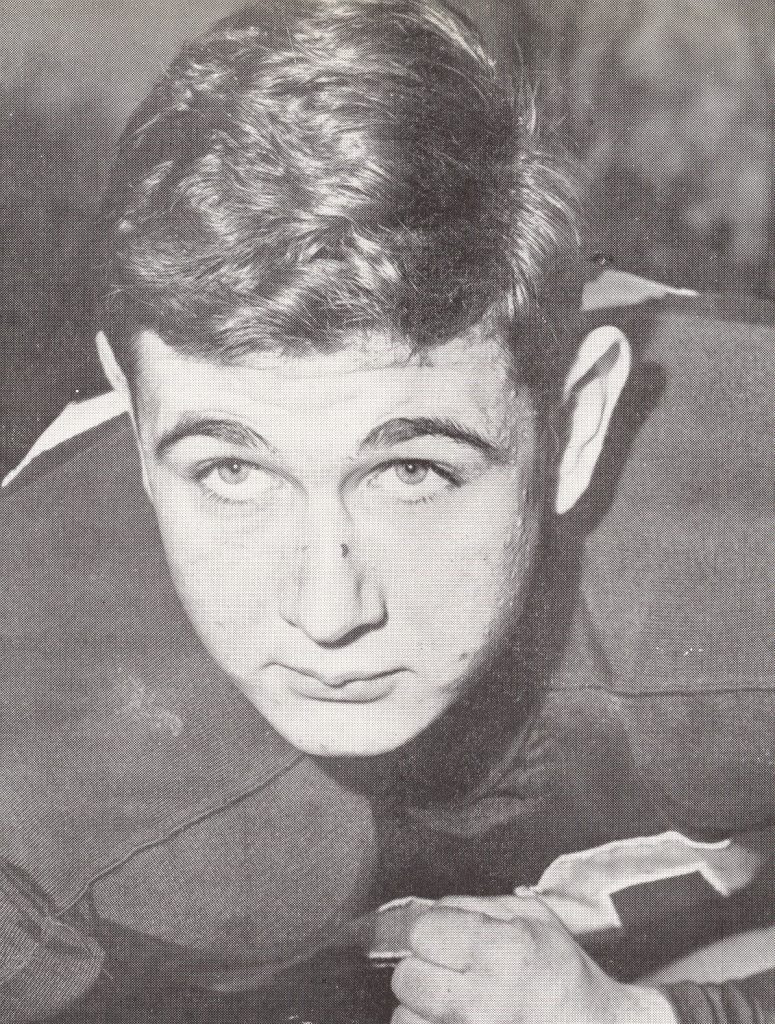
Uniontown tackle Francis “Moose” Machinsky was named All-County, All-WPIAL and first team All-State after the Red Raiders’ undefeated season in 1951.
Submitted photo
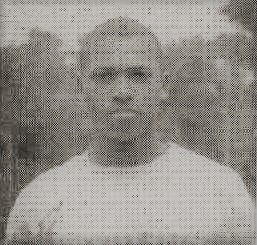
UniontownĢ¹½ÊÓƵ Ron Manning was the starting fullback on the Red Raiders’ undefeated football in 1951.
In his fourth season as head coach of the Uniontown Area High School football team the late Bill Power guided the Red Raiders to the first undefeated season in school history.
The Red Raiders posted a 10-0 record, but were denied and opportunity to compete for a WPIAL title because they didn’t have enough Gardner points. Uniontown finished the season with 127 Gardner points, Farrell had 128 and Munhall 135. Farrell defeated Munhall in front of 5,600 fans in the rain at Ambridge High School 15-0 to capture the WPIAL title. It was a bitter pill for the Red Raiders to swallow.
All-County, All-WPIAL and first team All-State tackle the late Francis “Moose” Machinsky voiced his disappointment in a 2012 Memory Lane article.
“They had the Gardner Points system in those days,” Machinsky recalled. “It is funny, the previous year in 1950 we were way ahead of everybody in points, but if you lost a game you were out of the playoffs and we lost to Latrobe the last game of the season. The next year we beat everybody, but didn’t have enough points.
“We really had a good team that year, in fact better than 1950, but we didn’t have enough points. We all went down to Monessen to see them play and if Monessen had won we would have gotten in, but Monessen lost.”
Indeed Monessen had a chance to put the Raiders in the playoffs with a win against Duquesne, but the Greyhounds were defeated 7-0.
Uniontown steamrolled through that season downing Georges Township 44-6, Dunbar Township 32-13, Monessen 35-6, Redstone 14-0, Monongahela 20-0, South Union 32-6, Mt. Lebanon 39-12, Connellsville 32-0 and Latrobe 46-0. The win over Latrobe was sweet revenge for the 20-6 loss to the Wildcats in the final game of the 1950 campaign 20-6. That loss knocked the Red Raiders out of the WPIAL playoffs.
“We had a beautiful year in 1951,” quarterback Ed Santoro opined in a 2012 Memory Lane. “We had 22 guys that had outstanding talent, we didn’t miss a beat, everybody knew their assignments and thatĢ¹½ÊÓƵ why we did so well. Coach Power was a players coach and Max Zane was the line coach and John Kruper was our ends coach and coached the punter. We had great coaching and it was just a perfect season.”
The Red Raiders were a senior-laden ballclub with 21 seniors and a TNT backfield sparked by 5-foot-9, 168-pound fullback Ronnie Manning. Santoro started at quarterback after Manning switched to fullback, a move Manning took in stride.
“If I remember correctly I was the biggest guy in the backfield at 168 pounds,” Manning recalled in a 2007 Memory Lane. “Frankie Henderson was about 135 pounds and Fred David was about 140 pounds. So coach Power moved me to fullback. I said it was OK because I just wanted to play.”
The Red Raiders backfield in the 1950s was nicknamed “The Pony Backfield.”
“We weren’t very big,” Henderson stated in a 2008 Memory Lane column. “When I was a sophomore I only weighed 120 pounds. When I was a senior I weighed 130 pounds. The biggest guy in the backfield was Manning at 168.
“We did have a big line. I used to run right off of Machinsky and he was tremendous. I never got tackled in the backfield because I ran off of his butt and there was always something there.”
Uniontown dominated the All-County teams in 1950 and 1951, placing six players on the squad in 1950 and seven, including Henderson, on the squad in 1951. Uniontown notched three consecutive Fayette County Class AA titles.
“We were a veteran team,” Henderson offered. “All I used to do was run the ends because I had tremendous speed. We were basically a running football team. Once we got inside the 10-yard line all we did was run straight ahead.”
The center on UniontownĢ¹½ÊÓƵ offensive line was Gerry Boyd who went on to play college football at Eastern Kentucky. He reflected on the great talent on that Uniontown squad.
“Machinsky went to Ohio State,” Boyd recalled. “He was a horse, he was about 245 pounds I guess. We had solid backs in Santoro, Manning, Henderson and Gene Farnella. A good end in Billy Hunt.”
“The whole team was just outstanding,” said Machinsky. “We had Manning, Henderson, Santoro, Hunt — all of them were good. I think we had eight or nine guys that went to college my senior year and either got full scholarships or partial scholarships. ThatĢ¹½ÊÓƵ unbelievable.”
The architect of UniontownĢ¹½ÊÓƵ football success was Power who came to Uniontown from Point Marion in 1948.
“Coach Power came in and he was amazing,” Machinsky explained. “We went to football camp — well nobody went to camp. For some of us kids that didn’t have very much, that never got to go to any kind of a camp, that was a treat. He worked us hard, but we felt we were having fun. We practiced twice a day in pads and then went out at night.
“We went to a boys’ camp near Washington (Pa.) the first year and it was bad. But the next two years we went to West Liberty College and it was nice. When we came back from camp we were in shape and ready to play.”
“He was one of the finest men that I’d ever met,” Manning said of Power. “He was one of the finest teachers, not only as a football coach, but also as a person. He was a good man, an outstanding person.
“It all started our junior year I believe. When Mr. Power came he changed the whole attitude, the mentality of winning. Uniontown used to run the single wing and Mr. Power came in and he went to the T-formation and he brought a different attitude. He wasn’t a loud man and he didn’t swear and didn’t use profanity, but he talked to you as a man and he explained what he wanted and he expected us to go out and do what he wanted.
“He taught us how to win.”
As a sophomore in 1951, Chuck Zawacki was a reserve on the first undefeated football team in Red Raider history. He had a front row seat and saw Uniontown building into a football power.
“Coach Power lived in Point Marion and he used to have me and a couple other guys over to watch film the week of a game of the upcoming opponent,” the late Zawacki recalled. “I look back on that, he was intense. He was very level-headed and he got a lot out his kids. Of course you had great assistants: Max Zane, John Kruper, and I had junior high coaches that helped me out tremendously like Bill Barron. You had great help.”
The 1951 team was one of the greatest in Uniontown history and Manning remembered his time in Uniontown with great pride.
“It was great,” Manning recalled. “I don’t think you can find a better group of guys on a football team or any sport that could compare to the guys I played with during those years. We also had great support from the community.”
George Von BenkoĢ¹½ÊÓƵ “Memory Lane” column appears in the Sunday editions of the Ģ¹½ÊÓƵ. He also hosts a sports talk show on WMBS-AM radio from 10 a.m. to noon on Saturdays.