

Bearing up
Changing land-use patterns welcome returning wildlife to Greene County
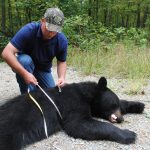 Ben Moyer
This writer has been around long enough to recall when Greene County was not considered “deer country.” Deer lived in the mountains.
The same conception prevailed about Greene for wild turkeys. Biologists and hunters alike believed that only mountain forests could support the big birds.
All that changed, beginning in the 1970s and continuing today. Greene County is widely known as prime ground for both white-tailed deer and large flocks of wild turkeys.
That pattern continues with even bigger game-bears. Not long ago it seemed inconceivable that a population of black bears could inhabit the lowland hills of Greene County. But the observations of wildlife professionals prove that bears find Greene’s hills hospitable, and that their numbers are climbing.
Every month, game wardens around the state are asked to file reports on their observations with the Game Commission’s public information office. These reports are then distributed to professional outdoor writers and other media for distribution to the public.
Greene County game warden Brandon Bonin’s May 26 report states: “Greene County Game Warden Brandon Bonin reports seeing another bear on State Game Lands 302 (near Wind Ridge, Richhill Township). “State Game Lands 302 holds a population of bears and has received almost no bear hunting pressure,” said Bonin. “Hunters willing to scout the rugged terrain may have a good chance to harvest a bear this fall.”
In his June 19 report Bonin stated: “Beekeepers are continuing to have conflicts with Greene County’s growing bear population. It is recommended that beekeepers put up, and maintain, electric fences around their hives. Bonin reported two beehives were damaged by a bear in the Waynesburg area. Putting up electric fences around hives is good practice to keep the bears away and relieve the beekeeper of the frustration of damaged hives.”
More recently, Bonin told this writer in personal communication that he’d picked up a road-killed bear on Interstate 79 near the Greene-Washington County line. “It was a big male, about 350 pounds,” Bonin said.
Harvest data from recent hunting seasons affirms Bonin’s observations. Hunters never tagged a bear in Greene County before 2020, but since then have reported modest harvests of two to three bears per year.
The Game Commission now tallies deer, bear, and turkey harvests at the Wildlife Management Unit level, so it’s difficult to find data on the agency’s website that details harvest by county. But Greene County makes up about half of Wildlife Management Unit 2A, where bear kills are increasing. Since 2020, hunters have legally taken 30 bears in Unit 2A, and over half of those bears were female (17), indicating an entrenched reproducing population.
“I wouldn’t be surprised at a black bear showing up anywhere in Greene County,” Bonin said in personal communication.
The growth of Greene County’s “big game” populations, including deer, bear, and wild turkeys, over recent decades can be attributed more to natural changes in habitat than to deliberate efforts to boost wildlife numbers or range expansion. The Game Commission did relocate some bears from northcentral counties to the mountains of Somerset and Westmoreland counties in the 1980s, which did result in regional population growth. And deliberate efforts by the Game Commission and local chapters of the National Wild Turkey Federation did improve habitat for wild turkeys, the positive results of which are obvious.
But changing land use, driven by social and economic trends, is the primary reason for the increasing diversity and abundance of “big game” in Greene County. According to U.S. Forest Service data, in 1960, 19% of Greene County was covered by forest. Today, woodland covers roughly 60% of the county.
Prior to 1960, Greene County was “sheep country,” dominated by open pasture. Greene County then rivaled Washington County for the top spot in the state as a wool and mutton producer. But gradually, over time, as livestock farmers retired, died, or changed occupations, abandoned pastureland reverted to forest. Wildlife responded to that change, and deer, turkeys, and even bears recolonized the hills. All those species were undoubtedly abundant in what is now Greene County in pre-settlement times before the land was cleared for agriculture, and have now returned.
I can recall riding around Greene County with my grandfather in his hard-used International pickup truck in the 1960s. The dominant landscape then was wide-open vistas of green pastures across the hills, dotted here and there by flocks of sheep. Trees were confined to boundary-line fencerows and scattered woodlots. Today, woodland dominates the view. Greene’s proportion of forestland leveled off with the pipelines and well-pads of the shale-gas boom, but still far exceeds its extent in the grazing era.
Change is inevitable in life and in landscapes. It would be an exciting and enlightening experience to see a bear in Greene County. Recent trends hint it could happen at any time.